Blade length refers to the physical measurement of the cutting edge from the tip to the point where it meets the handle or guard. Your specific requirements for daily tasks and the amount of space you have available in your pocket determine the correct length for your needs.
Which blade length is right for me?
| If this is you | The blade length that suits you | Why |
|---|---|---|
| You primarily need to open boxes, cut tape, or perform light utility tasks. | 2.0 in to 2.5 in | These lengths provide enough reach for common daily tasks while remaining small enough for frequent, low-profile carry. |
| You want a balance between a compact profile and the ability to handle larger pieces of material. | 2.5 in to 3.5 in | This range is the standard for most everyday carry knives, offering a versatile edge for general-purpose use. |
| You work in a field that requires heavier cutting or more leverage, such as outdoor maintenance. | 3.5 in to 4.5 in | A longer blade provides the mechanical advantage needed for heavier tasks, though it increases the physical footprint of the tool. |
| You prioritize maximum concealment and a very slim profile in your pocket. | Under 2.0 in | Smaller blades minimize the “bulk” of the tool, making it easier to carry in tight spaces or minimalist setups. |
| You need a tool that can handle larger tasks like heavy-duty cutting or significant material removal. | Over 4.5 in | Extended lengths provide the reach necessary for larger objects, but these are less common for standard everyday carry. |
Edc Knives covered by our own reviews
From $109 to $259.99: the 3 in this category we have reviewed in full.

Kizer Drop Bear 2 Folding Knife
$109 price checked August 2026
Read our full Drop Bear 2 review
If you prefer a lightweight, durable grip, view our top-rated titanium handle options for your next purchase.
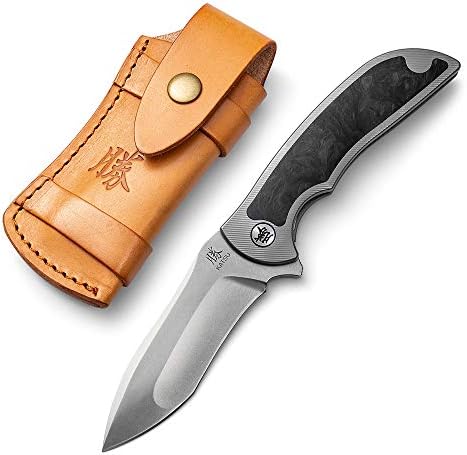

Kizer Pocket Folding Knife Feist Ki3499
$109.99 price checked August 2026
You might also consider comparing the best carbon fiber handle models to see how they stack up against other materials.
How do I measure or establish my required blade length?
To establish your required blade length, you should first identify the largest item you intend to cut regularly. Measure that item and determine how much “reach” is necessary to cut through it comfortably without the blade hitting your hand or the material’s edge.
Finding the measurement on a product
Manufacturers typically list the blade length in inches (in.) within the technical specifications section of the product description. Look for a single number followed by “in.” or “inch.” If the listing only provides the “overall length,” subtract the handle length to find the actual blade measurement.
Establishing a physical reference
If you are unsure of a size, use a standard ruler or a tape measure to mark out different lengths on a piece of cardboard. Hold these markers against your preferred carrying position—such as your pocket or a specific pouch—to see how much space the blade occupies when folded and how much reach it provides when open.
What happens if I choose a blade length that is too short or too long?
Choosing a blade length that is too short often results in a lack of mechanical advantage, which can lead to physical strain. If the blade is too small for the task, you may find yourself having to apply excessive pressure or use awkward grip positions to complete a cut.
Finding the right balance is crucial, so explore our guide on optimal knife weight before making a final decision.
The limitations of a short blade
A very short blade may struggle with thick materials like heavy cardboard or thick rope. Because a shorter edge has less surface area and reach, you may find the blade “pinching” or becoming difficult to maneuver when trying to cut through anything larger than a standard envelope.
The drawbacks of a long blade
A blade length that is too long for your needs often creates issues with “pocket drag” and carry comfort. A long blade creates a larger footprint, which can make the knife feel bulky or heavy in a pocket, and may cause the tool to snag on clothing or other items you carry.
What should I do if I fall between two blade length options?
If your requirements fall between two standard sizes, such as 3.0 in and 3.5 in, you should prioritize your primary use case. If you value ease of carry and pocket comfort above all else, choose the smaller of the two options.
Prioritizing utility and reach
If your primary concern is the ability to handle larger tasks or more demanding materials, choose the longer of the two options. A slightly longer blade provides a safety margin for tasks that might otherwise be difficult with a shorter edge.
Checking local regulations
When deciding between two sizes, you should also confirm the current rules for your specific location before ordering. Some regions have specific limits on the maximum blade length allowed for carry, and choosing a length that exceeds local limits can result in legal complications.