Weight in an edc knife refers to the physical mass of the tool, measured in ounces (oz). Your specific requirement for weight depends on whether you prioritize a tool that disappears in a pocket or one that provides significant heft for heavy-duty tasks.
Which weight is right for my situation?
| If this is you | The Weight that suits you | Why |
|---|---|---|
| You carry a knife in a front pocket for 8+ hours a day. | 1.5 oz to 2.5 oz | Lower weight prevents the tool from sagging or pulling on your clothing during movement. |
| You need to open heavy boxes or cut thick cordage frequently. | 4.0 oz to 6.0 oz | Higher mass provides the inertia needed to drive the blade through dense materials with less effort. |
| You work in a high-mobility job like construction or landscaping. | 2.0 oz to 3.5 oz | This range balances a manageable profile with enough heft to feel secure during repetitive use. |
| You primarily use a tool for light tasks like opening mail or cutting tape. | 1.0 oz to 2.0 oz | Minimal weight ensures the tool remains convenient for high-frequency, low-impact tasks. |
| You prefer a heavy, “substantial” feel for better control and balance. | 5.0 oz and above | Increased weight shifts the center of gravity, allowing for a more stable grip during forceful cuts. |
Edc Knives covered by our own reviews
3 reviewed options, $119 to $165, with the full write-up behind each name.
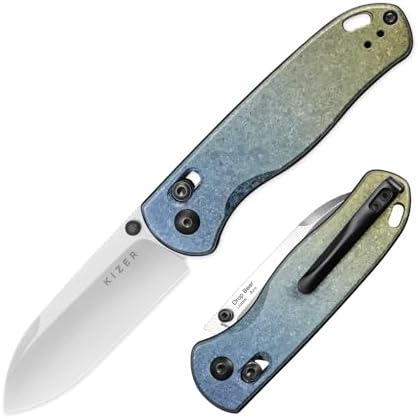
Kizer Drop Bear Folding Pocket Knife
$119 price checked August 2026
Read our full Kizer Drop Bear review
If you prefer a high-tech grip, view our comparison of the best carbon fiber handle pocket knives.


Chameleon Pocket Knife Flame Blue Titanium
For outdoor adventures, see our list of the best folding camping knife options.
$165 price checked August 2026
How do I check the weight of an edc knife before ordering?
To check the weight of an edc knife before ordering, look for the “Weight” or “Mass” specification in the technical data provided by the manufacturer.
Most manufacturers list weight in ounces (oz) or grams (g). To convert grams to ounces, divide the gram count by 28.35. For example, a knife listed at 60g weighs approximately 2.1 oz.
If a manufacturer provides a weight range rather than a single number, the lower number usually refers to the blade and handle alone, while the higher number may include a sheath or a clip.
Determining the ideal size is easy once you study how blade length affects edc knives.
Because shipping and manufacturing tolerances exist, a difference of 0.2 oz or 0.3 oz is common and generally does not indicate a different product.
What happens if the weight is too low or too high?
If the weight is too low, the knife may lack the necessary inertia for heavy-duty tasks, requiring you to apply more physical force to get the blade moving.
A very light knife can feel “flighty” in the hand, which may lead to a less stable cutting surface when navigating through tough materials like thick leather or heavy rope.
If the weight is too high, the knife may become cumbersome for daily carry, causing discomfort or fatigue when kept in a pocket for extended periods.
Excessive weight can also cause the knife to “swing” or shift in your pocket, which may interfere with your stride or cause the tool to poke into your leg.
To ensure your blade holds its edge, review the necessary Rockwell Hardness (HRC) for edc knives.
What if I fall between two weight categories?
If you fall between two weight categories, choose the heavier option if your primary use involves heavy-duty cutting or significant force.
The extra mass provides a safety margin for durability and ease of use during difficult tasks, where the slight increase in pocket weight is a worthwhile trade-off.
Choose the lighter option if your primary use is “everyday carry” where the tool is frequently accessed but rarely used for heavy labor.
In a borderline case where the use is balanced, the lighter option is typically the safer choice for long-term comfort, as it is easier to adapt to a heavy tool than a light tool that feels inadequate during a difficult task.
Before ordering, confirm the specific weight and shipping policies for your location to ensure the tool meets your requirements.
More Edc Knife explainers and comparisons
- Choosing the Best Tactical Folding Pocket Knife for Everyday Carry
- The Compact Folding EDC Knives That Work Best for Everyday Carry
- Which Lightweight Folding Knife Is Best for Everyday Carry?
- Best Titanium Handle EDC Knives
- Carbon Fiber Handle Pocket Knives Compared
- Choosing the Best EDC Knife for Men and Women