When evaluating flashlight batteries, distinguishing between technical performance metrics and marketing fluff is essential for making a budget-conscious purchase. Load-bearing terms focus on chemical energy density, physical dimensions, and electrical compatibility—these are the specs that determine how long your light stays on and whether the battery fits your device. Marketing vocabulary often uses vague descriptors like “ultra-high” or “professional-grade” without providing a corresponding numerical value. To get the most value for your money, prioritize standardized ratings like mAh and discharge rates over subjective adjectives.
Flashlight Battery Capacity and Energy Terms
Flashlight battery capacity determines how much energy the cell can hold for a single use cycle.
- mAh (Milliampere-hour) – This measures the total charge a battery can deliver at a specific current; a higher mAh number means the battery can power your flashlight for a longer duration on a single charge.
- Wh (Watt-hour) – This represents the total energy capacity of the battery, calculated by multiplying the voltage by the Amp-hours; higher Wh values indicate a more energy-dense cell.
- Energy Density – This is the amount of energy stored relative to the battery’s size or weight; for portable flashlights, a higher energy density allows for smaller, lighter devices that still provide long runtimes.
- Cycle Life – This indicates how many times a battery can be recharged before its capacity significantly degrades; a higher cycle count (e.g., 500+ cycles) means the battery will last longer over years of regular use.
Where these choices show up in our reviews
These 3 have their own full review on this site, and run from $109.95 to $244.99.
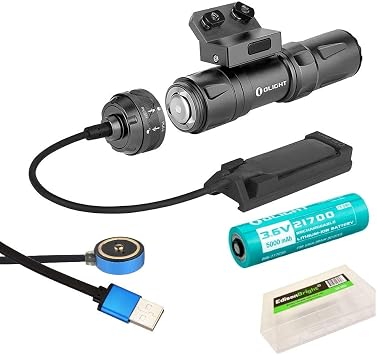
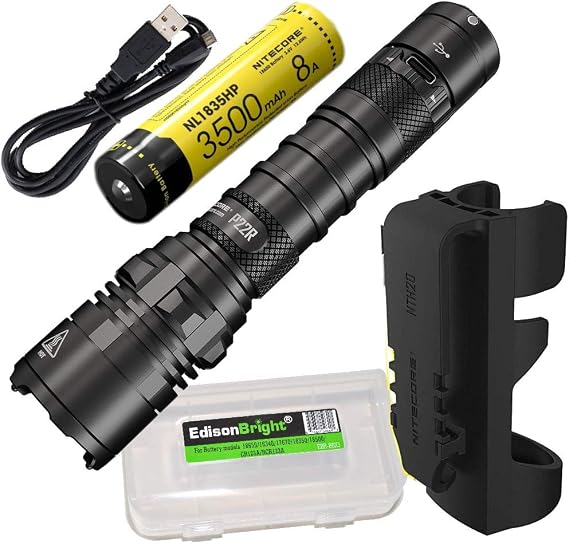
Nitecore P22R Tactical Flashlight Bundle
You can also browse our comparison of budget flashlight batteries to find reliable options that fit a smaller price point.
$109.95 price checked August 2026

CoyoteLight Portable Rechargeable Night Vision Flashlight
$244.99 price checked August 2026
Read our full CoyoteLight Flashlight review
Understanding your options is easier when you compare various flashlight battery types to see which chemistry fits your needs.
Flashlight Battery Power and Output Specs
Flashlight battery power specs describe how quickly and efficiently the cell can provide electricity to the LED.
- Continuous Discharge Rating – This is the maximum current a battery can provide steadily without overheating; a higher rating allows for high-lumen flashlights to run at full power without the battery failing.
- Burst Discharge Rate – This measures the peak current a battery can provide for a very short period; higher burst ratings are necessary for “turbo” modes that briefly spike in brightness.
- Internal Resistance (mΩ) – This measures the opposition to current flow inside the cell; a lower milliohm (mΩ) rating is better as it reduces heat buildup and improves efficiency.
- Voltage (V) – This is the electrical pressure of the battery; you must match the voltage of the battery to the requirements of your flashlight, as mismatched voltages can damage the electronics.
- Cut-off Voltage – This is the point at which the battery’s protection circuit stops the flow of power; knowing this helps determine the “usable” capacity before the battery becomes empty.
Flashlight Battery Physical and Safety Specs
Flashlight battery physical specs ensure the cell fits your hardware and operates safely in different environments.
- Dimensions (mm) – These are the length, diameter, and width of the battery; you must match these exactly to the flashlight’s battery compartment.
- Weight (g) – This is the mass of the battery; lower weight is generally preferred for handheld flashlights to reduce user fatigue.
- Operating Temperature Range – This defines the thermal limits for safe use; a wider range (e.g., -20C to 60C) ensures the battery performs reliably in extreme cold or heat.
- Chemistry (Li-ion, NiMH, LiFePO4) – This identifies the chemical makeup of the cell; different chemistries offer different trade-offs between weight, safety, and discharge speeds.
- Protection Circuit (PCM/BMS) – This is an internal board that prevents over-charging or over-discharging; a built-in circuit is a safety feature that protects both the battery and your flashlight.
Common Flashlight Battery Confusions
Several terms in the flashlight battery market are often confused by shoppers, leading to incompatible purchases or poor performance.
mAh vs. Wh
While mAh measures charge, Wh measures total energy. Because different batteries have different voltages, a 3000mAh battery at 3.7V has less total energy than a 3000mAh battery at 7.4V. Always check the Wh if you need to compare the total “fuel tank” size of batteries with different voltages.
Li-ion vs. LiFePO4
Lithium-ion (Li-ion) batteries typically offer higher energy density and higher discharge rates but have a shorter cycle life. Lithium Iron Phosphate (LiFePO4) batteries are generally heavier and have lower energy density but offer much higher safety ratings and longer cycle lives.
Capacity vs. Runtime
Capacity (mAh) is the size of the fuel tank, while runtime is how long the light stays on. Runtime is a result of both the battery’s capacity and the flashlight’s power draw. A high-capacity battery will provide a shorter runtime if the flashlight’s LED draws a very high amount of current.
Rechargeable vs. Primary
Rechargeable batteries are designed for repeated use and have a cycle life. Primary batteries are “single-use” and are designed to be discarded after one use. Primary batteries often have a lower self-discharge rate, making them better for emergency kits where the battery must sit idle for months.
Browse our other Flashlight Battery pages
- Which Rechargeable Flashlight Batteries Are Best for Night Vision?
- Best Replacement Flashlight Batteries for Heavy Duty Use
- Long Throw Rechargeable Flashlight Batteries Compared
- Choosing the Best Flashlight Batteries for Compact Tactical Lights
- The Rechargeable Flashlight Batteries That Work Best for Outdoor Use
- Which Flashlight Batteries Are Best for High Lumen Output?