For most everyday carry (EDC) knives, a blade thickness between 0.12 in. and 0.16 in. provides the best balance of durability and portability. You should select your specific thickness based on whether you prioritize a slim profile for deep carry or a robust edge for heavier tasks.
Recommended Blade Thickness for Edc Knife Use Cases
| Use Case | Recommended Blade Thickness | Why this number |
|---|---|---|
| Ultra-Light Daily Carry | 0.08 in. to 0.11 in. | Minimizes bulk for pocket comfort while maintaining structural integrity. |
| Standard Everyday Carry | 0.12 in. to 0.15 in. | The standard for most folding knives, providing a reliable edge and weight. |
| Heavy Duty / Utility | 0.16 in. to 0.20 in. | Necessary for tasks involving high-pressure cutting or wood processing. |
| Compact / Minimalist | 0.06 in. to 0.09 in. | Allows for extremely slim profiles but limits use to light slicing. |
Where these choices show up in our reviews
3 reviewed options, $109.99 to $144.90, with the full write-up behind each name.

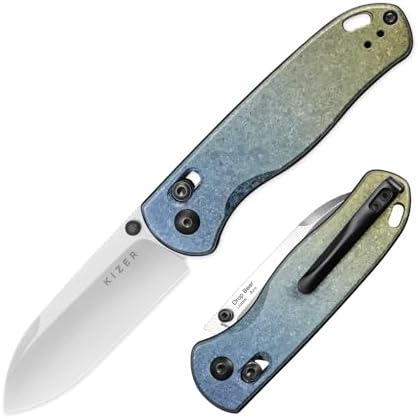
Kizer Drop Bear Folding Pocket Knife
$119 price checked August 2026
Read our full Kizer Drop Bear review
If you need a smaller profile, see our roundup of the best compact folding edc knife options.

What Happens if You Under-Provision or Over-Buy Blade Thickness?
Risks of Under-Provisioning
Under-provisioning occurs when the blade thickness is too thin for the intended task. If you choose a blade thinner than 0.10 in. for heavy use, the material is prone to bending or “rolling.”
Blade roll happens when the edge of the knife tilts away from the desired plane because the steel lacks the mass to resist pressure. A thin blade may also suffer from “flex,” where the spine of the knife bows during a cut, making it difficult to maintain control or precision.
The Costs of Over-Buying
Over-buying happens when you choose a blade that is significantly thicker than necessary for daily tasks. A blade exceeding 0.20 in. for a standard pocket knife adds unnecessary weight and bulk to your carry.
Increased thickness makes the knife harder to conceal and can cause the handle to feel cumbersome. Furthermore, a very thick blade often requires a more aggressive grind, which can actually reduce the available cutting surface area compared to a thinner, more optimized blade.
You can also browse our comparison of the best titanium handle edc knife models for maximum durability.
The Mistake Most Buyers Make with Blade Thickness
Optimising for Geometry Over Mass
Many buyers mistakenly believe that a thicker blade automatically equals a “stronger” knife. While thickness contributes to durability, it is often a secondary factor to the grind geometry and the steel’s heat treatment.
You should optimize for the grind type instead of just the thickness. A 0.14 in. blade with a flat grind offers different performance than a 0.14 in. blade with a hollow grind. The grind determines how the edge meets the material, while thickness simply dictates how much pressure that edge can withstand before the metal deforms.
How Blade Thickness Interacts with Other Deciding Specs
Impact on Weight and Balance
Blade thickness directly dictates the weight distribution of an edc knife. A thicker blade shifts the center of gravity toward the tip, which can make a knife feel “nose-heavy” during use.
If you prefer a balanced feel where the handle sits firmly in your palm, you may need to choose a slightly thinner blade to compensate for the weight of the handle materials. This interaction is a primary factor in how the knife feels during the time someone spends using it.
Portability and Profile Limits
The thickness of the blade determines the maximum “slimness” of the folded knife. Because the blade must fold into the handle, the thickness of the steel limits how narrow the handle can be.
If you require a knife that disappears in a pocket, you must prioritize a lower thickness range. A blade that is 0.18 in. thick will require a wider handle to accommodate the steel, regardless of how small the blade‘s length is. You must balance your desired thickness against your requirements for a low-profile carry.
Relationship to Steel Chemistry
Blade thickness interacts with the chemistry of the steel to determine edge retention. While thickness provides the “meat” behind the edge, the steel’s hardness determines how long that edge stays sharp.
In some cases, a thinner blade made from a high-hardness steel can outperform a thicker blade made from a softer steel. However, a thicker blade provides a larger “reservoir” of steel, allowing for more aggressive sharpening and a longer total lifespan before the blade requires replacement or significant regrinding.