Most general work tasks require a Voltage Rating of 0V as standard safety gloves are not designed for electrical work. For specific electrical applications, you need a rating that meets the ASTM D120 standard or specific industrial requirements, typically starting at 1,000V for high-voltage protection.
Recommended Voltage Rating for Magid Glove and Safety Use Cases
| Use Case | Recommended Voltage Rating | Why this number |
|---|---|---|
| General Construction and Carpentry | 0V (Non-rated) | Standard mechanical protection is sufficient for low-voltage tools where no risk of direct electrical contact exists. |
| Maintenance on Household Appliances | 0V (Non-rated) | Most household repairs involve disconnected components or low-voltage circuits where standard grip and cut protection are the priority. |
| Commercial Electrical Wiring | 1,000V (Class 0) | This rating is the industry standard for many high-voltage applications where workers may encounter live components. |
| Industrial Power Grid Work | 10,000V+ (Class 2 or 3) | High-voltage infrastructure requires specialized insulation that far exceeds standard industrial ratings. |
| Laboratory and Testing Equipment | 1,000V (Class 0) | Provides a safety buffer for testing equipment where voltage spikes can occur unexpectedly. |
Magid Gloves And Safety we have reviewed in detail
From $160.28 to $247.80: the 3 in this category we have reviewed in full.
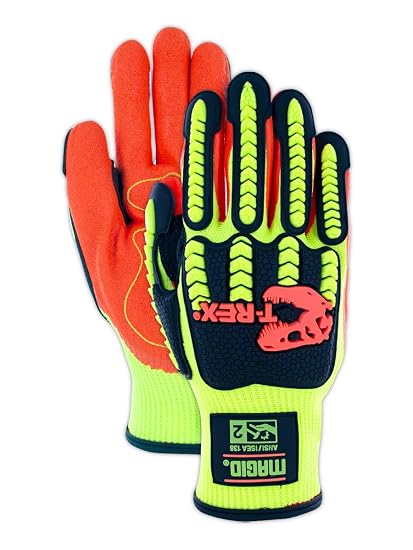


TPR Impact Reducing Mechanic Safety Work Gloves
If you are looking for specific inventory handling gear, view our top-rated Magid warehouse gloves to see which models offer the best protection for shipping and receiving.
$220 price checked August 2026
What Happens if You Under-Provision or Over-Buy Voltage Rating?
Risks of Under-Provisioning
Under-provisioning occurs when you use a glove with a Voltage Rating lower than the electrical potential of the environment. If a glove is not rated for the specific voltage of a circuit, the insulation material can fail, leading to chemical permeation or, more critically, a cut-through failure where the material allows electricity to pass to the skin. This creates a high risk of electrical shock or arc flash. Because electrical safety is binary—a glove is either rated for the voltage or it is not—there is no “safe” middle ground for under-provisioning.
The Real Cost of Over-Buying
Over-buying occurs when you select a high Voltage Rating for a task that does not require it. High Voltage Rating gloves are significantly more expensive than standard work gloves because they require specialized rubber compounds and rigorous certification testing. These gloves are also much thicker and less flexible. If you use a 1,000V rated glove for basic woodworking, you will experience a significant loss of dexterity. The extra material makes it harder to grip small screws or feel the texture of the material you are cutting, which can lead to physical fatigue and a higher risk of mechanical injury due to poor grip.
The Mistake Most Buyers Make with Voltage Rating
Prioritizing Voltage over Mechanical Protection
The most common mistake is assuming that a high Voltage Rating provides superior general-purpose protection. Voltage Rating is a specific dielectric property; it does not improve the glove’s ability to resist cuts, tears, or abrasions. Buyers often spend more on a high-voltage rating they do not need, leaving them with a glove that has inferior mechanical protection compared to a standard heavy-duty work glove. You should optimize for the specific hazard of your environment. If your primary risk is a sharp blade or a splinter, prioritize the EN 388 rating or the cut-resistance level (such as Kevlar or Dyneema fibers) rather than the Voltage Rating.
The Correct Selection Logic
To select correctly, identify the maximum potential voltage of the equipment you will touch. If that number is 0V, ignore the Voltage Rating entirely and focus on the thickness and material of the glove. If the work involves live electrical components, you must match the Voltage Rating to the specific requirements of the site, usually starting at the 1,000V mark. Only choose a higher rating if the specific industrial application demands it.
How Voltage Rating Interacts with Other Deciding Specs
The Dexterity Trade-off
Voltage Rating interacts directly with the “Loss of Dexterity” failure mode. As the Voltage Rating increases, the thickness of the insulating material must also increase. This creates a physical limit on how much precision work you can perform. A glove rated for high-voltage use will feel bulky and may prevent you from performing delicate tasks like wiring a small control panel or handling small components. You must balance the required safety threshold against the physical requirements of the task.
Material and Chemical Interaction
Voltage Rating is often tied to specific rubber and synthetic materials. These materials may have different chemical resistance profiles than standard leather or knit gloves. For example, a glove designed for high-voltage insulation might not be suitable for handling certain hazardous liquids because the insulating material could degrade or allow chemical permeation. Always check the material compatibility for the specific chemicals you use in your workshop alongside the Voltage Rating.
Cut Resistance and Electrical Safety
In some industrial environments, you need both high cut resistance and electrical protection. However, many high-cut-resistance materials (like certain high-performance fibers) are not inherently dielectric. If you need both, you must look for specific safety standards that combine these features, as a standard cut-resistant glove will not provide a Voltage Rating, and a standard high-voltage glove may lack the necessary cut-resistance to protect against sharp metal edges.
Browse our other Magid Glove pages
- Magid Glove and Safety Electrical Gloves Compared
- Choosing the Best Magid Glove and Safety Work Gloves for Mechanics
- The Magid Glove and Safety Gloves That Work Best for Construction
- Which Magid Glove and Safety Gloves are Best for Yard Work?
- Best Magid Glove and Safety Gloves for Warehouse Work
- Heavy Duty Magid Glove and Safety Gloves Compared