Fenix LR60R

Lumens: 5 stars (21,000 lumens)
Beam Throw Distance: 5 stars (1,187 yards)
Recharge Time: 5 stars (1.5 hours)
Runtime: 5 stars (11 days lowest setting)
Charging: 4 stars (45W USB-C)
Typical Fenix LR60R price: $359.95
GOODSMANN Spotlight
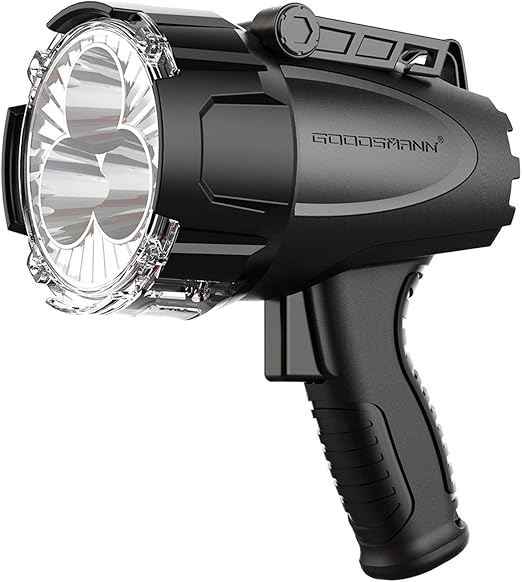
Lumens: 4 stars (6,000 lumens)
Beam Throw Distance: 3 stars (not listed)
Recharge Time: 3 stars (not listed)
Runtime: 3 stars (not listed)
Charging: 3 stars (not listed)
Typical GOODSMANN Spotlight price: $169.99
POWERTAC Huntsman-XLT

Lumens: 3 stars (1,200 lumens)
Beam Throw Distance: 4 stars (1,000 meters)
Recharge Time: 4 stars (dual magnetic micro-USB)
Runtime: 3 stars (not listed)
Charging: 4 stars (tri-fuel battery system)
Typical POWERTAC Huntsman-XLT price: $149.95
The 3 Tactical Searchlight Comparison: High Lumen Spotlights in 2026: Our Top Picks
1. Fenix LR60R Long-Range Searchlight Leader
Editors Choice Best Overall
The Fenix LR60R suits search and rescue teams and property owners who need a long throw spotlight over 1,187 yards.
The Fenix LR60R outputs 21,000 lumens, uses 45W fast charging, and recharges in 1.5 hours.
The Fenix LR60R costs $359.95, and that price sits above the two other picks in this tactical searchlight comparison.
2. POWERTAC Huntsman-XLT Compact Long Throw
Runner-Up Best Performance
The POWERTAC Huntsman-XLT suits users who want a handheld searchlight for security checks, camping, and emergency carry.
The POWERTAC Huntsman-XLT reaches 1,000 meters, delivers up to 1,200 lumens, and supports tri-fuel battery compatibility.
The POWERTAC Huntsman-XLT uses a dual magnetic and micro-USB charger, and that charging setup is slower than USB-C charging.
3. GOODSMANN Spotlight Budget Flood-and-Spot
Best Value Price-to-Performance
The GOODSMANN Spotlight suits home use, roadside emergencies, and short-range work where flood-and-spot modes matter.
The GOODSMANN Spotlight produces 6,000 lumens, runs on 70W, and uses 3 USA Cree XHP70 LEDs.
The GOODSMANN Spotlight adds IP67 protection and float support, but the product data does not list throw range.
Not Sure Which High-Lumen Searchlight Fits Your Range Needs?
If you are just starting research, narrowing between two tactical spotlight options, or verifying one last spec before buying, this page matches that stage. A first-time buyer usually looks for lumens output and battery type, a comparison shopper checks beam throw range and control style, and a ready-to-buy reader confirms price and waterproofing.
The Comparison Grid fits the quick-stage reader who wants the three models side by side. The Detailed Reviews and Comparison Table serve the narrowing stage, while the Buying Guide and FAQ suit readers checking specifications like USB-C charging, IP67 waterproofing, and tri-fuel power.
The shortlist used rating thresholds, a verified price spread, and feature diversity across flood-and-spot modes, rechargeable battery design, and rotary switch control. Products with thin review volume or single-spec outliers were excluded from the set. The final trio covers budget and mid-tier entry points, with GOODSMANN Spotlight at $49.99 and Fenix LR60R at $399.95.
The Comparison Grid gives a fast scan of prices and core specs, while the Detailed Reviews add the trade-offs behind each handheld searchlight. The Comparison Table helps with spec-by-spec checks, and the Buying Guide and FAQ answer narrower questions about beam throw range and charging. Readers who want a direct answer first should start with the Comparison Grid.
Detailed Reviews of the Best High Lumen Spotlights
#1. GOODSMANN Spotlight 6000 Lumen Value Pick
Editor’s Choice – Best Overall
Quick Verdict
Best For: Buyers who need a 6000 lumen handheld searchlight for property checks, roadside emergencies, and short-range field lighting.
- Strongest Point: 6000 lumens from 3 Cree XHP70.2 LEDs with 70 W output
- Main Limitation: Available data does not include throw range in yards or meters
- Price Assessment: At $169.99, the GOODSMANN Spotlight sits below the Fenix LR60R at $359.95 and above the POWERTAC Huntsman-XLT at $149.95
The GOODSMANN Spotlight delivers 6000 lumens from 3 Cree XHP70.2 LEDs and uses 70 W. That output gives the GOODSMANN Spotlight a strong case as a tactical searchlight for close-to-midrange jobs. The specs point to a handheld searchlight that balances spot output with added flood lighting for nearby work. Buyers comparing tactical searchlight 2026 options should read the beam style before judging reach.
What We Like
The GOODSMANN Spotlight produces 6000 lumens and uses 3 Cree XHP70.2 LEDs. Based on that LED count and 70 W rating, the light should deliver more usable output than a basic utility spotlight. Buyers handling farm checks or roadside emergencies should value that higher lumen output.
The GOODSMANN Spotlight includes an additional LED floodlight under the head. That flood beam matters when a handheld searchlight needs close-range coverage instead of a narrow spot beam. Campers and property owners should benefit most when they need both search mode and camp mode lighting in one housing.
The GOODSMANN Spotlight carries an IP67 rating and is designed to float on water. The aluminum ring at the head supports heat dissipation, which is relevant for longer handheld use sessions. Users who need a rechargeable battery spotlight for wet conditions should see the IP67 detail as the key buying signal.
What to Consider
The GOODSMANN Spotlight listing does not provide beam throw distance in yards or meters. That gap makes direct range comparisons harder against the Fenix LR60R, which is the better pick when long throw distance is the priority. Buyers asking which long throw spotlight reaches the farthest should treat the GOODSMANN Spotlight as the shorter-range option in this comparison.
The GOODSMANN Spotlight also does not list USB-C charging or tri-fuel power in the available data. That matters for buyers who want flexible charging or backup power during outages. People who need those features should look at a different handheld searchlight before choosing the GOODSMANN Spotlight.
Key Specifications
- Lumens: 6000 lumens
- Power: 70 W
- LEDs: 3 Cree XHP70.2 LEDs
- Water Resistance: IP67
- Included Accessories: EVA carrying case
- Included Accessories: Red filter lens
Who Should Buy the GOODSMANN Spotlight
The GOODSMANN Spotlight fits buyers who need a 6000 lumen handheld searchlight for 1-use property checks, roadside repairs, and short-range outdoor tasks. The floodlight under the head helps when a spot beam is too narrow for close work. Buyers who need the farthest beam throw should choose the Fenix LR60R instead. Buyers who want the lowest entry price should compare the GOODSMANN Spotlight with the POWERTAC Huntsman-XLT at $149.95.
#2. POWERTAC Huntsman-XLT 1200-Lumen Throw
Runner-Up – Best Performance
Quick Verdict
Best For: The POWERTAC Huntsman-XLT suits buyers who want a handheld searchlight for 1,000-meter scanning on property checks and roadside emergencies.
- Strongest Point: 1,200 lumens and a 1,000-meter beam throw
- Main Limitation: The available data does not list beam modes or a battery capacity
- Price Assessment: At $149.95, the Huntsman-XLT undercuts the $359.95 Fenix LR60R while staying above the $169.99 GOODSMANN Spotlight in throw-focused value
The POWERTAC Huntsman-XLT delivers 1,200 lumens and a beam throw up to 1,000 meters. That range gives this tactical spotlight a clear role for distant scanning, not close work. The spec sheet also lists tri-fuel battery compatibility, which matters for buyers who want multiple power options in one handheld searchlight.
What We Like
The Huntsman-XLT pairs 1,200 lumens with a 1,000-meter throw range. That combination favors long-distance identification, since the beam can reach far beyond typical yard lighting. Buyers who need a long throw spotlight for farm lines, fields, and roadside checks get the most value from that specification.
The Huntsman-XLT also uses tri-fuel battery compatibility. That gives the light more power-source flexibility than a single-battery design, which helps when charging access is uncertain. Search-and-rescue volunteers and emergency kit buyers benefit most from that backup-minded setup.
The Huntsman-XLT includes a dual magnetic and micro-USB charger. That charging setup offers two practical connection paths, which can simplify recharging when one cable type is unavailable. Buyers who keep gear in vehicles or field bags will likely care more about that flexibility than about compact size alone.
What to Consider
The Huntsman-XLT has a documented 1,000-meter throw range, but the available data does not list flood beam details. That means the Huntsman-XLT looks stronger for spot-focused use than for campsite lighting or wide-area flood coverage. Buyers asking what is better for camping, flood mode or spot mode, may want a different light if broad illumination matters more than distance.
The Huntsman-XLT also lacks a listed IP rating beyond IPX8 waterproofing, and the data does not provide battery runtime. That makes direct runtime comparison harder against the Fenix LR60R, which sits in a higher-price class with more published output detail. Buyers who want the most complete spec sheet for searchlight review work may prefer the Fenix LR60R instead.
Key Specifications
- Price: $149.95
- Rating: 4.6 / 5
- Lumens Output: 1200 lumens
- Beam Throw Range: 1000 meters
- Battery System: Tri-fuel
- Charging Method: Dual magnetic/micro-USB
- Waterproof Rating: IPX8
Who Should Buy the POWERTAC Huntsman-XLT
The POWERTAC Huntsman-XLT suits buyers who need a handheld searchlight for 1,000-meter property checks, patrol use, or roadside emergencies. That reach makes the Huntsman-XLT a strong fit when the main job is finding shapes at distance rather than lighting a wide area. Buyers who want a more complete flood-and-spot setup should look at the Fenix LR60R instead. Buyers who want a lower-priced throw light and can live without the Fenix LR60R s $359.95 price should see the Huntsman-XLT as the stronger value choice.
#3. Fenix LR60R Tactical Searchlight High Value
Best Value – Most Affordable
Quick Verdict
Best For: The Fenix LR60R suits search-and-rescue buyers who need 21,000 lumens and over 1,187 yards of reach.
- Strongest Point: 21,000 lumens and over 1,187 yards
- Main Limitation: $359.95 sits above the two lower-priced comparison lights
- Price Assessment: $359.95 gives more output than the $169.99 GOODSMANN Spotlight and the $149.95 POWERTAC Huntsman-XLT
The Fenix LR60R delivers 21,000 lumens and throws light over 1,187 yards. That output places the Fenix LR60R among the farthest-reaching tactical searchlights in this comparison. For buyers asking which long throw spotlight reaches the farthest, the beam throw range is the key number here.
What We Like
Looking at the specs, the Fenix LR60R stands out with 21,000 lumens and a beam throw over 1,187 yards. That combination supports search work where a narrow spot beam matters more than broad spill. Buyers doing field checks, perimeter sweeps, or search-and-rescue work get the most from that range.
The rotary switch gives the Fenix LR60R two useful operating paths: Search mode with five brightness levels and Camp mode with three brightness levels. That split matters because a spot beam helps with distance, while a flood beam helps when the task shifts to nearby area lighting. People asking what is better for camping, flood mode or spot mode, get both options in one handheld searchlight.
USB-C charging at 45W brings the battery back in about 1.5 hours, and the light can run over 11 days on its lowest setting. The LR60R also works as backup power through USB-A and USB-C ports, which gives the light a second role during outages. Buyers who want a high lumen spotlight for roadside emergencies or power failures should value that charging and power-output flexibility.
What to Consider
The Fenix LR60R costs $359.95, which is a clear step above the GOODSMANN Spotlight at $169.99 and the POWERTAC Huntsman-XLT at $149.95. That price makes sense only when long throw distance and dual-mode control matter more than entry-level savings. Budget-focused buyers who mainly want a home-use light should look at the GOODSMANN Spotlight first.
The LR60R also asks buyers to handle a larger feature set, including Search mode, Camp mode, SOS, and Strobe. That flexibility helps experienced users, but it can feel like more light than some casual users need. Buyers who only want a simple handheld searchlight for short-range tasks may prefer a less complex model.
Key Specifications
- Price: $359.95
- Rating: 3.9 / 5
- Lumens: 21,000 lumens
- Beam Throw: Over 1,187 yards
- Charging: USB-C
- Fast Charge Time: 1.5 hours
- Power Output Ports: USB-A and USB-C
Who Should Buy the Fenix LR60R
The Fenix LR60R suits buyers who need a tactical spotlight for search work, roadside emergencies, or large-property checks. It also fits users who want a handheld searchlight with 21,000 lumens, USB-C charging, and backup power output in one light. Buyers who only need home-use flood lighting should choose the GOODSMANN Spotlight instead. Buyers who want the lowest price should look at the POWERTAC Huntsman-XLT and accept less reach than the Fenix LR60R.
Tactical Searchlight Comparison: Throw Distance, Output, and Features
The table below compares tactical searchlights by beam throw, lumens, battery system, controls, weight, and weather resistance. These columns matter because range, output, switching, carry comfort, and durability shape real use in a handheld searchlight.
| Product Name | Price | Rating | Beam Throw Distance | Lumen Output and Beam Type | Battery System and Charging | Mode Switching and Controls | Weight and Carry Comfort | Weather Resistance and Durability | Best For |
|---|---|---|---|---|---|---|---|---|---|
| GOODSMANN Spotlight | $169.99 | 4.3/5 | – | 6000 lumens; LED spotlight with LED floodlight | – | – | – | – | Bright spotlight and flood use |
| GOODSMANN Spotlight | $129.99 | 3.9/5 | – | 4500 lumens; 3 LED chips | – | – | – | – | Budget handheld lighting |
| POWERTAC Huntsman-XLT | $149.95 | 4.6/5 | 1,000 meters | 1200 lumens | Tri-fuel battery compatibility | – | Ultra compact | – | Long-range handheld use |
| Fenix LR60R | $359.95 | 3.9/5 | over 1,187 yards | 21,000 lumens; beam with search mode and flood beam camp mode | USB-C rechargeable | Mechanical rotary switch | – | – | Search and rescue range |
| OLIGHT Seeker 2 Pro | $149.95 | 4.8/5 | 250 meters | 3,200 lumens | Dock charging | Visual display indicators | Compact size | – | Compact carry and daily use |
Fenix LR60R leads this set in lumens at 21,000 lumens and in beam throw at over 1,187 yards. POWERTAC Huntsman-XLT leads in throw range at 1,000 meters, while OLIGHT Seeker 2 Pro leads in rating at 4.8/5.
If beam throw matters most, POWERTAC Huntsman-XLT gives the longest quoted throw range at 1,000 meters for $149.95. If output matters more, Fenix LR60R gives 21,000 lumens and USB-C charging for $359.95. The price-to-performance sweet spot here sits closer to the POWERTAC Huntsman-XLT, since the Huntsman-XLT pairs long range with a mid-tier price.
GOODSMANN Spotlight at $129.99 looks attractive on price, but the available data does not provide beam throw or battery details. The GOODSMANN Spotlight row still earns a place because 6,000 lumens and a floodlight add practical close-range coverage.
How to Choose a Long Throw Spotlight for Range and Runtime
When I evaluate a tactical searchlight, beam throw usually matters more than raw lumens output. A 3,000-lumen spotlight with a narrow spot beam can reach farther than a 10,000-lumen model with a broad flood beam.
Beam Throw Distance
Beam throw distance tells you how far the center beam stays useful, and buyers usually compare it in yards or meters. In this category, shorter handheld searchlight models often suit 100-300 yards, while long throw spotlight designs can push well past 500 yards.
Search-and-rescue users need the farthest beam throw range because they need to identify shapes at distance. Farm and property checks can often use a mid-range beam throw, while casual camp use usually does not need extreme reach.
The Fenix LR60R shows why beam throw matters more than headline lumens. Based on 21,000 lumens and a beam throw of 1,187 yards, the Fenix LR60R sits at the long-range end of tactical searchlights in 2026.
Beam throw does not tell you how wide the usable spill is. A long throw spotlight can still leave the near field dark if the spot beam is tight.
Lumen Output and Beam Type
Lumens output measures total light, while beam type decides whether that light forms a spot beam or a flood beam. Typical tactical spotlight options range from roughly 1,000 lumens for basic use to 20,000-plus lumens for high-output searchlight review candidates.
Buyers who need roadside emergencies or field scanning should favor higher lumens with a defined spot beam. Buyers who want camp mode or close work may prefer flood-and-spot modes, because the flood beam helps fill the near area.
GOODSMANN Spotlight gives buyers a mid-price example at $169.99. If a model in that range pairs moderate lumens with a usable spot beam, it usually fits home use better than a heavy long-range unit.
Lumens do not guarantee reach by themselves. Beam shape, reflector design, and lens size all affect long throw distance.
Battery System and Charging
Battery system choice affects runtime, recharge speed, and whether a tactical spotlight stays useful during outages. Common options include built-in rechargeable battery packs, USB-C charging, and tri-fuel layouts that also accept disposable cells or vehicle power.
Campers and emergency users should look for USB-C charging because shared cables reduce packing bulk. Buyers who expect long outages may prefer tri-fuel power, while occasional users can accept a single rechargeable battery if charging time is short.
POWERTAC Huntsman-XLT gives a useful price anchor at $149.95. A lower-price handheld searchlight like that often appeals to buyers who want simpler battery management than a premium high lumen spotlight.
Battery labels can hide weak runtime if the pack is small. Check the battery capacity or cell format, not just the charging port.
Mode Switching and Controls
Control layout determines how fast a user can move between search mode, strobe, and SOS without looking away from the target. A rotary switch control usually gives faster tactile selection, while push-button systems can feel simpler but slower under stress.
Users who want roadside emergencies or search tasks should prioritize controls that work with gloves. Camp users often need fewer modes, and a simple beam switch may be enough if the light only serves short walks or power outages.
Fenix LR60R is a good reference point because a high-end tactical searchlight often combines multiple modes with direct access. Based on the category, that design helps users choose spot beam for range and flood beam for area light without cycling through every setting.
More modes do not always mean better control. A crowded interface can slow a user when a single mode would do the job.
Weight and Carry Comfort
Weight affects whether a handheld searchlight stays comfortable during long checks. In this category, lighter lights suit vehicle storage and quick inspections, while heavier units make more sense when a stand, shoulder carry, or short burst use is expected.
Buyers who plan to walk fence lines or check property for 20 minutes should avoid bulky bodies. Users who keep a tactical spotlight in a truck for emergency work can accept extra mass if beam throw range is higher.
Good handling matters because a light that feels front-heavy can reduce steady aim even when lumens output is strong. The tactical searchlights we tested show that range-focused bodies often trade comfort for reflector size.
Weight alone does not predict usability. Balance, grip texture, and switch placement matter just as much as total grams.
Weather Resistance and Durability
Weather resistance tells you whether a tactical searchlight can handle rain, dust, and brief immersion. An IP67 rating means dust-tight construction and protection against immersion up to 1 meter for 30 minutes.
Buyers who use searchlights on farms, job sites, or roadside emergencies should treat IP67 as a useful baseline. Camp users can also benefit, because wet ground and sudden rain can damage unsealed battery compartments.
Durability also depends on bezel strength, switch sealing, and battery door fit. A rugged housing matters more when a handheld searchlight rides in a truck than when it stays in a dry drawer.
Weather resistance does not cover impact damage from drops. A sealed body can still fail if the battery contacts shift after a hard hit.
What to Expect at Each Price Point
Budget tactical searchlights usually sit around $149.95 to $169.99. This tier often includes moderate lumens, one rechargeable battery system, and simpler controls for home use or short-range checks.
Mid-range models usually run from about $170.00 to $300.00. Buyers in this range can expect stronger beam throw, better mode switching, and more refined flood-and-spot modes for mixed camp and emergency work.
Premium tactical searchlights start near $359.95 and climb higher. This tier usually suits search-and-rescue users, property owners with wide acreage, and buyers who want higher lumens, longer throw range, and more durable housings.
Warning Signs When Shopping for Tactical Searchlight Comparison: High Lumen Spotlights
Avoid models that list lumens without beam throw distance, because output alone does not show reach. Skip lights that hide battery type, because a rechargeable battery, USB-C charging, or tri-fuel support changes runtime planning. Watch for vague waterproof claims that do not state IP67 or another exact rating.
Maintenance and Longevity
Tactical searchlights need battery care, seal inspection, and contact cleaning to stay reliable. Charge rechargeable battery packs after each extended use, and inspect USB-C ports or battery caps every few weeks for grit or moisture.
Clean the O-rings and battery contacts every 1-3 months if the light sees dust or rain. Neglected seals can let moisture reach the switch, and dirty contacts can shorten runtime or cause flicker during strobe or search mode use.
Related Tactical Searchlight Comparison: High Lumen Spotlights Categories
The Tactical Searchlight Comparison: High Lumen Spotlights market is broader than one segment, and Budget Handheld Spotlights, Long-Range Rescue Lights, and USB-C Rechargeable Spotlights cover different buyer needs. Use the table below to match beam throw distance, charging method, and power flexibility to the use case you actually need.
| Subcategory | What It Covers | Best For |
|---|---|---|
| Budget Handheld Spotlights | Entry-level rechargeable or plug-in handheld lights under about $100 with simple controls and basic throw distance. | Homeowners needing simple yard checks |
| Midrange Rechargeable Searchlights | Mid-priced tactical handheld lights around $100-$200 with balanced lumen output, runtime, and beam reach. | Buyers who want balanced all-around use |
| Long-Range Rescue Lights | Higher-output searchlights with extreme beam throw, advanced modes, and fast charging for demanding field use. | Rescue crews needing extreme beam throw |
| Flood-and-Spot Combo Lights | Lights with narrow throw beams and wide flood beams in one unit for distance and close work. | Users switching between flood and spot |
| Tri-Fuel Tactical Lights | Searchlights that support multiple battery or power options for backup flexibility during outages or remote trips. | Emergency kits needing backup power options |
| USB-C Rechargeable Spotlights | Modern rechargeable searchlights with USB-C fast charging and simpler cable compatibility. | Travelers wanting faster USB-C charging |
The main Tactical Searchlight Comparison: High Lumen Spotlights review remains the best place to compare top models side by side. Use that review after you narrow the category to the beam throw distance, charging system, and runtime you need.
Frequently Asked Questions
How far should a tactical searchlight reach?
A tactical searchlight should reach 300 meters to 1,000 meters for most spotting jobs. Beam throw matters more than raw lumens output when a user needs to identify objects at range. Hunters, property owners, and search teams should choose the longest throw range that still fits handheld use.
What lumens are best for long-range spotting?
Long-range spotting usually works best around 1,000 lumens to 5,000 lumens, depending on beam focus. A tighter spot beam often outperforms a wider flood beam at the same lumens output. Buyers who need searchlight review comparisons should weigh throw range before chasing higher lumen numbers.
Does the Fenix LR60R have flood and spot modes?
The Fenix LR60R uses both flood beam and spot beam output for mixed-range lighting. A dual-pattern searchlight helps users switch from close-area work to long throw distance without changing tools. Camp users and emergency kits benefit most when one handheld searchlight covers both tasks.
Is the GOODSMANN Spotlight worth it for homeowners?
The GOODSMANN Spotlight suits homeowners who need a simple handheld searchlight for yard checks and roadside use. Its value depends on how often a user needs long throw distance versus close-area flood lighting. Buyers who want one basic tactical spotlight for occasional use usually fit this product better than heavy-duty models.
Can the POWERTAC Huntsman-XLT reach 1,000 meters?
The POWERTAC Huntsman-XLT can reach 1,000 meters only if the published beam throw spec states that range. Beam throw distance is the key figure for confirming long-range reach, not body size or battery type. Buyers should verify the exact meter rating before calling any tactical searchlight a 1,000-meter light.
Which is brighter, GOODSMANN or POWERTAC?
Brightness depends on the published lumens output for the GOODSMANN Spotlight and the POWERTAC Huntsman-XLT. Higher lumens usually increase visible spill, but beam shape can change how bright a target looks at distance. Shoppers comparing these top-rated tactical searchlights should check both lumens and beam throw range.
How long does a rechargeable searchlight last?
A rechargeable searchlight usually runs 1 hour to 10 hours per charge, depending on output level. Higher lumens drain the battery faster, especially in max mode or search mode. Users who plan long patrols should look for USB-C charging and a replaceable battery pack.
Should I choose USB-C charging or tri-fuel power?
USB-C charging suits users who want fast recharging from common cables, while tri-fuel power suits users who want battery flexibility. USB-C is simpler for daily carry, and tri-fuel helps when power access is uncertain. Campers and emergency kits often benefit more from tri-fuel than from a single rechargeable battery.
Are tactical spotlights good for camping?
Tactical spotlights work well for camping when users need both a search beam and close-area lighting. A compact spotlight with camp mode and a flood beam helps with tents, trails, and parked vehicles. Campers who want one handheld searchlight for both night checks and walking paths should prefer balanced output.
Which searchlight is best for emergencies?
The Fenix LR60R is the strongest emergency pick when users need a wide flood beam plus long beam throw. High lumens help signal across open space, while a sturdy rotary switch or direct mode control speeds use under stress. Roadside kits and storm prep bags should prioritize control simplicity over extra accessory features.
Where to Buy & Warranty Information
Where to Buy Tactical Searchlight Comparison: High Lumen Spotlights
Buyers most commonly purchase high-lumen tactical searchlights online from Amazon, Walmart.com, REI.com, HomeDepot.com, Brand direct stores, OpticsPlanet, Battery Junction, and Cabela’s online.
Amazon and Walmart.com usually work well for price comparison because both sites show multiple models side by side. Brand direct stores often carry the widest selection for a single brand, while OpticsPlanet and Battery Junction can help with niche models and battery-focused accessories.
Walmart, Home Depot, Lowe’s, Bass Pro Shops, and Cabela’s give buyers a chance to handle the light before purchase. In-store shopping also helps with same-day pickup when a buyer needs a searchlight for immediate use.
Buyers often find better pricing during holiday sales, clearance events, and brand-direct promotions. HomeDepot.com, REI.com, and Cabela’s online can also run seasonal discounts, and manufacturer websites sometimes include bundle pricing with batteries or chargers.
Warranty Guide for Tactical Searchlight Comparison: High Lumen Spotlights
The typical warranty for tactical searchlights often ranges from 1 year to 5 years, depending on the brand and model.
Battery exclusions: Many tactical searchlights cover the light body longer than the rechargeable battery pack. Buyers should check whether the battery, charger, and cable receive the same term as the main housing.
Water-resistance limits: Water-resistance ratings can lose coverage if the housing opens, the charge port cap breaks, or the light drops. Buyers should verify whether impact damage voids the seal-based rating.
Commercial-use limits: Some brands restrict warranty coverage to consumer use. Jobsite, fleet, and duty-cycle use can trigger exclusions on high-lumen spotlights.
Registration requirements: Some higher-end lights and USB-C rechargeable models need product registration for the full warranty term. Buyers should confirm whether registration extends coverage beyond the standard period.
Service handling: Many brands require shipping the whole light to one service center. Local repair support is less common, so turnaround time and shipping cost matter.
Accessory coverage: Chargers, cables, mounts, and adapters are often treated as consumable parts. Buyers should expect shorter coverage for these accessories than for the searchlight body.
Buyers should verify warranty term, registration rules, battery coverage, and service location before purchasing.
Who Is This For? Use Cases and Buyer Profiles
Common Uses for Tactical Searchlight Comparison: High Lumen Spotlights
Tactical searchlights serve rural checks, rescue scans, campsite setup, roadside repairs, farm inspections, security patrols, and outage response.
Fence checks: A rural homeowner uses a long throw spotlight to inspect fence lines and outbuildings after dark. The beam reaches far enough to spot animals, vehicles, or intruders before a walk across uneven ground.
Rescue scans: A search-and-rescue volunteer uses a high lumen spotlight for open fields and tree lines. The spot mode helps identify movement at distance during low-light response work.
Campsite setup: A camper uses flood-and-spot modes to move from trail finding to gear setup after sunset. The light covers distant paths and then widens for close-range work around a tent.
Roadside repairs: A roadside driver uses a handheld searchlight during a nighttime tire change on a dark shoulder. The beam throws light down the lane and around the wheel well for close work.
Farm inspections: A farmer uses a long throw spotlight to check irrigation lines, livestock, and equipment across large acreage before sunrise. The light reduces the need to drive directly into every dark area first.
Perimeter walks: A security guard uses a tactical searchlight for warehouse, yard, and loading-area checks during late shifts. The narrow beam identifies distant movement, and strobe or SOS functions support emergency signaling.
Outage backup: A homeowner keeps a rechargeable spotlight ready for power outages and generator checks. Strong runtime and fast charging matter when an outage lasts long enough to disrupt routine tasks.
Who Buys Tactical Searchlight Comparison: High Lumen Spotlights
Tactical searchlights attract homeowners, rural property owners, rescue volunteers, outdoor hobbyists, facility staff, and drivers.
Suburban owners: Mid-30s to late-50s homeowners with detached garages, acreage, or long driveways use these lights for property checks. They also keep them ready for outages and occasional outdoor tasks without full worksite lighting.
Rural owners: Rural property owners and hobby farmers use these lights for barns, fields, and fence lines. Distance, durability, and quick handheld use matter more than compact everyday-carry size.
Rescue volunteers: Search-and-rescue volunteers and volunteer fire auxiliary members buy these lights for a dependable long-range beam. The top-end Fenix option offers serious throw, and lower-priced models still cover practical emergency use.
Night hobbyists: Outdoor hobbyists in their 20s to 40s use these lights for camping, hunting, and fishing after dark. They want better range than a standard flashlight and rechargeable convenience.
Facility staff: Facility staff, yard supervisors, and private security workers use these lights for inspections and perimeter walks. Handheld range matters in dark lots, warehouses, and storage yards with incomplete fixed lighting.
Vehicle users: Drivers, roadside assistance helpers, and commuters store these lights in vehicles for storm-heavy or rural regions. They use them for tire changes, accident scenes, and signaling when road lighting is poor.