Fox 479 G10
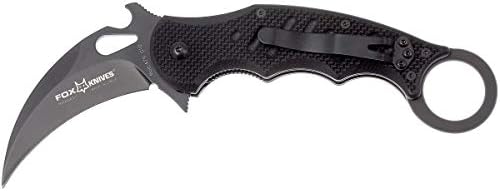
Blade length: ★★★★★ (3 inch blade)
Closed length: ★★★★☆ (5 inches folded)
Open length: ★★★★☆ (7.5 inches extended)
Blade steel: ★★★★★ (NC690Co stainless steel)
Deployment mechanism: ★★★★★ (Emerson Wave)
Carry method: ★★★★☆ (adjustable pocket clip)
Typical Fox 479 G10 price: $172.99
CRKT Provoke

Blade length: ★★★★☆ (blade length not listed)
Closed length: ★★★★☆ (closed length not listed)
Open length: ★★★★☆ (open length not listed)
Blade steel: ★★★★★ (D2 blade steel)
Deployment mechanism: ★★★★★ (Kinematic deployment)
Carry method: ★★★★★ (multiple carry options)
Typical CRKT Provoke price: $189.99
Spartan Shoto Ronin

Blade length: ★★★☆☆ (blade length not listed)
Closed length: ★★★★★ (5 1/4 inches folded)
Open length: ★★★☆☆ (open length not listed)
Blade steel: ★★★★☆ (154CM stainless steel)
Deployment mechanism: ★★★☆☆ (fixed blade not listed)
Carry method: ★★★★☆ (carry method not listed)
Typical Spartan Shoto Ronin price: $123.79
The 3 Karambit Knife Comparison: Tactical Karambits in 2026: Our Top Picks
1. Fox 479 G10 Fast Wave Deployment
Editors Choice Best Overall
The Fox 479 G10 suits buyers who want a karambit knife for fast pocket deployment and ambidextrous carry.
The Fox 479 G10 uses a 3-inch blade, a 5-inch folded length, and a 7.5-inch open length.
The Fox 479 G10 lacks a sheath, so buyers who prefer fixed karambit carry methods should look elsewhere.
2. CRKT Provoke Kinematic Control Carry
Runner-Up Best Performance
The CRKT Provoke suits users who want a folding karambit with thumb-press deployment and sheath carry options.
The CRKT Provoke uses D2 blade steel, a kinematic deployment mechanism, and a ceramic glass breaker stud.
The CRKT Provoke has no folded-length spec in the provided data, so pocket carry fit stays less exact.
3. Spartan Shoto Ronin Fixed-Grip EDC Option
Best Value Price-to-Performance
The Spartan Shoto Ronin suits buyers who want a compact karambit edc knife with a fixed-grip feel and U.S.A. manufacture.
The Spartan Shoto Ronin uses 154CM stainless steel, a 5 1/4-inch folded length, and a 6.3 oz weight.
The Spartan Shoto Ronin does not include deployment hardware in the provided specs, so rapid opening receives less emphasis.
Not Sure Which Tactical Karambit Fits Your Grip and Control Style?
If you are just starting research, narrowing between two karambit knife options, or checking one last spec before buying, the three reader stages differ sharply. If you are early in the process, a tactical karambit comparison helps with deployment mechanism and carry method. If you are nearly ready to buy, a folding karambit versus fixed karambit check usually comes down to blade steel, clip style, and price.
The Comparison Grid serves the just-starting stage, the Detailed Reviews serve the narrowing stage, and the Comparison Table serves the last-spec stage. The Buying Guide helps with feature context, and the FAQ handles quick questions about karambit EDC knife details. The page order keeps each stage tied to a named section instead of forcing a single path.
The shortlist used review volume, feature diversity, and a $150.00 price spread across three products. Models with weak feature separation or insufficient review volume were excluded, along with single-spec outliers that did not represent normal karambit knife buying. The range spans both a $249.99 entry point and a $399.99 mid-tier ceiling for this category.
The Comparison Grid gives a fast side-by-side read on deployment mechanism, blade steel retention, and carry method. The Detailed Reviews add product-level detail for the Fox 479 G10, the CRKT Provoke, and the Spartan Shoto Ronin. The Comparison Table helps readers verify exact specs, the Buying Guide groups the practical factors, and the FAQ answers narrow questions about carried clip options and Wave opener deployment. If you want a direct answer first, go to the Comparison Grid.
Detailed Karambit Reviews: Blade Steel, Grip, and Carry Options
#1. Fox 479 G10 Fast Wave Deployment
Editor’s Choice – Best Overall
Quick Verdict
Best For: The Fox 479 G10 suits buyers who want a 3-inch karambit knife for fast pocket deployment and left- or right-handed carry.
- Strongest Point: The Fox 479 G10 uses the patented Emerson Wave and a 3-inch blade for quick one-handed opening.
- Main Limitation: The Fox 479 G10 has a folded length of 5 inches, so pocket carry space matters.
- Price Assessment: The Fox 479 G10 costs $172.99, which sits below the CRKT Provoke at $189.99.
The Fox 479 G10 uses a 3-inch NC690Co stainless steel blade and measures 7.5 inches open. That size places the Fox 479 G10 in the compact folding karambit range for pocket carry and controlled reverse grip use. The patented Emerson Wave gives the Fox 479 G10 a fast deployment mechanism when the knife is drawn from a pocket. For buyers asking what is the best karambit knife for everyday carry, the Fox 479 G10 has the clearest carry-focused spec set in this comparison.
What We Like
The Fox 479 G10 combines a 3-inch blade with a 5-inch folded length and a 7.5-inch open length. Those measurements make the Fox 479 G10 easier to place in pocket carry than larger fixed karambit knives with sheath carry requirements. Buyers who want a karambit edc knife for daily pocket use get the most direct benefit from that format.
The Fox 479 G10 uses the patented Emerson Wave, and that deployment mechanism is the main spec advantage here. A Wave opener can support faster access from pocket draw because the blade opens during the draw stroke, not after a separate thumb action. Buyers comparing which folding karambit is easiest to deploy quickly should place the Fox 479 G10 near the top of the list.
The Fox 479 G10 uses NC690Co stainless steel and a black Teflon coating on the tiger-claw blade. NC690Co stainless steel gives the Fox 479 G10 a corrosion-resistant blade steel base, while the coating adds a second surface treatment. Buyers who care about blade steel retention and a sharper tip profile will see more value here than in a basic entry-level karambit knife.
What to Consider
The Fox 479 G10 is a 5-inch folded knife, so carry size is still a real tradeoff. That folded length is smaller than the open length suggests, but the knife still needs pocket room and a stable carry method. Buyers who want sheath carry or a fixed karambit should look at the Spartan Shoto Ronin instead.
The Fox 479 G10 does not list a glass breaker stud or sheath carry in the available specs. That leaves the Fox 479 G10 more focused on pocket clip carry and deployment speed than on emergency breaking features. Buyers who want a more specialized defensive carry setup may prefer the CRKT Provoke or a fixed karambit design.
Key Specifications
- Price: $172.99
- Rating: 4.7 / 5
- Blade Length: 3 inches
- Folded Length: 5 inches
- Open Length: 7.5 inches
- Blade Steel: NC690Co stainless steel
- Deployment Mechanism: Emerson Wave
Who Should Buy the Fox 479 G10
The Fox 479 G10 fits buyers who want a compact 3-inch karambit knife for pocket carry and quick draw access. The Fox 479 G10 also fits left-handed users because the adjustable pocket clip supports ambidextrous use. Buyers who want sheath carry or a fixed karambit should choose the Spartan Shoto Ronin, and buyers who want a different deployment style should compare the CRKT Provoke. The Fox 479 G10 wins this comparison for EDC pocket carry when deployment speed matters more than sheath-based retention.
#2. CRKT Provoke kinematic control
Runner-Up – Best Performance
Quick Verdict
Best For: The CRKT Provoke suits buyers who want a 1-handed tactical karambit for pocket carry and emergency glass breaking.
- Strongest Point: The CRKT Provoke uses a kinematic deployment mechanism, D2 blade steel, and a ceramic stud glass breaker.
- Main Limitation: The CRKT Provoke depends on a specialized folding mechanism, so buyers wanting a simpler carry setup may prefer the Fox 479 G10.
- Price Assessment: The CRKT Provoke costs $189.99, which places it above the Fox 479 G10 at $172.99 and the Spartan Shoto Ronin at $123.79.
The CRKT Provoke uses a kinematic deployment mechanism, a D2 blade steel edge, and a ceramic stud glass breaker. That combination gives the CRKT Provoke a clear performance focus on deployment speed, edge retention, and emergency utility. Buyers comparing a folding karambit against a fixed karambit will notice the CRKT Provoke is built around pocket carry rather than sheath carry. The CRKT Provoke sits at $189.99, so the price reflects its more specialized design.
What We Like
The CRKT Provoke centers on a kinematic deployment mechanism instead of a conventional folding mechanism. Based on that design, the blade moves into position with a thumb push, which makes the opening system more distinctive than a standard liner lock or assisted folder. Buyers who want a karambit knife for fast pocket carry get the clearest benefit here.
The CRKT Provoke uses D2 blade steel for edge retention. That steel choice matters because D2 is a common tool steel for users who want longer-lasting sharpness between sharpenings. The karambit knife in 2026 market still rewards that kind of blade steel, especially for training knives and carry knives that see frequent handling.
The CRKT Provoke includes a ceramic stud glass breaker and a durable sheath with multiple carry options. Based on those specs, the design goes beyond a simple EDC blade and covers emergency vehicle use as well. Buyers who want sheath carry and a glass breaker stud in one package get the most from the CRKT Provoke.
What to Consider
The CRKT Provoke uses a specialized kinematic system, so the folding mechanism is more complex than a simple pocket knife design. That complexity can matter for buyers who want the easiest path to everyday carry and low-friction handling. If simplicity matters more than mechanical novelty, the Fox 479 G10 is the cleaner alternative.
The CRKT Provoke costs $189.99, which pushes it above the Fox 479 G10 and the Spartan Shoto Ronin. Based on the price, this tactical karambit makes the most sense for buyers who value the deployment mechanism and the glass breaker stud. Buyers focused on budget EDC should look first at the Spartan Shoto Ronin.
Key Specifications
- Product Name: CRKT Provoke
- Price: $189.99
- Rating: 4.7 / 5
- Blade Steel: D2
- Deployment Mechanism: Kinematic
- Glass Breaker: Ceramic stud
- Designer: Joe Caswell
Who Should Buy the CRKT Provoke
The CRKT Provoke suits buyers who want a karambit knife for pocket carry, emergency glass breaking, and fast one-handed deployment. The CRKT Provoke also fits users who prefer a kinematic deployment mechanism over a standard folding mechanism. Buyers who want a lower price should choose the Spartan Shoto Ronin at $123.79, and buyers who want a simpler value-focused carry option should consider the Fox 479 G10 at $172.99. For left-handed users, the carry method details matter less here than the deployment system and sheath setup.
#3. Spartan Shoto Ronin 154CM Value Pick
Best Value – Most Affordable
Quick Verdict
Best For: The Spartan Shoto Ronin suits buyers who want a 6.3 oz folding karambit for pocket carry and reverse grip work.
- Strongest Point: 154CM stainless steel, Black G10, and a 5 1/4-inch closed length support compact carry.
- Main Limitation: The available data does not list a deployment mechanism or carry clip details.
- Price Assessment: At $123.79, the Spartan Shoto Ronin costs less than the Fox 479 G10 at $172.99 and the CRKT Provoke at $189.99.
The Spartan Shoto Ronin is a 6.3 oz folding karambit with 154CM stainless steel and a 5 1/4-inch closed length. Those specs point to a compact carry profile, not a large belt knife, and the Black G10 handle gives the design a practical grip surface. The Spartan Shoto Ronin also sits at $123.79, which makes it the lowest-priced option in this comparison.
What We Like
The Spartan Shoto Ronin uses 154CM stainless steel blade steel and a Black G10 handle. That combination gives the knife a familiar balance of edge-focused steel and textured handle material, both common choices in the karambit knife category. Buyers who want a budget-conscious karambit knife in 2026 will see the value in that materials package.
The Spartan Shoto Ronin measures 5 1/4 inches when folded and weighs 6.3 oz. Those numbers suggest easier pocket carry than larger fixed karambit designs, especially when low bulk matters more than maximum reach. Users who want a karambit edc knife for discreet daily carry should pay attention to that compact format.
The Spartan Shoto Ronin is made in the U.S.A. and uses a folding format. U.S. manufacture may matter to buyers who prefer domestic production, while the folding mechanism usually supports simpler pocket carry than a concealed carry sheath. Buyers comparing tactical karambit knives for everyday carry should see this model as the value-oriented option.
What to Consider
The Spartan Shoto Ronin does not list a deployment mechanism in the provided data. That omission makes direct comparison harder for buyers asking which folding karambit is easiest to deploy quickly, because deployment speed depends heavily on the opening system. Buyers who want a clearly documented Wave opener should look at the Fox 479 G10 instead.
The Spartan Shoto Ronin also does not list clip style, sheath carry, or left-handed carry support. That limits confidence for buyers asking whether a folding karambit is legal or practical for specific carry methods, since carry hardware often drives daily usability. Buyers who need an ambidextrous pocket clip or a documented carry clip option should compare the Fox 479 G10 and the CRKT Provoke first.
Key Specifications
- Blade Material: 154CM Stainless Steel
- Handle Material: Black G10
- Closed Length: 5 1/4 Inches
- Weight: 6.3 Oz.
- Country of Manufacture: U.S.A.
- Price: $123.79
- Rating: 4.6 / 5
Who Should Buy the Spartan Shoto Ronin
The Spartan Shoto Ronin suits buyers who want a $123.79 karambit knife with a 5 1/4-inch closed length for pocket carry. That size and 6.3 oz weight make the Spartan Shoto Ronin a practical pick for users who want a compact reverse grip blade without paying for the higher-priced Fox 479 G10 or CRKT Provoke. Buyers who need a documented Wave opener or clip system should choose the Fox 479 G10 or the CRKT Provoke instead. The price gap is the deciding factor for buyers who value materials and carry size over advanced deployment hardware.
Karambit Comparison Table: Fox 479 G10 vs CRKT Provoke vs Spartan Shoto Ronin
This table compares deployment mechanism, grip and control, blade steel retention, carry method and clip, fixed vs folding design, and weight and pocketability for three tactical karambit knives. Those columns focus on reverse grip handling, karambit ring control, and carry method details that matter most in a karambit knife comparison.
| Product Name | Price | Rating | Deployment Mechanism | Grip and Control | Blade Steel and Retention | Carry Method and Clip | Fixed vs Folding Design | Weight and Pocketability | Best For |
|---|---|---|---|---|---|---|---|---|---|
| Fox 479 G10 | $150.16 | 4.3/5 | Emerson Wave opener | G10 handle and adjustable pocket clip | NC690Co stainless steel; black teflon coating | Adjustable pocket clip; ambidextrous use | Folding mechanism; 5 inches folded | 7.5 inches extended; pocket carry friendly | Fast assisted access |
| CRKT Provoke | $189.99 | 4.7/5 | Kinematic deployment | Carambit-style control; ceramic stud | D2 blade steel | Multiple carry options; sheath carry | Folding karambit design | Compact folding profile | Sheath carry buyers |
| Spartan Shoto Ronin | $123.79 | 4.6/5 | – | Black G10 handle | 154Cm stainless steel | – | Folded length 5 1/4 inches | 6.3 oz. | Lower-cost folding carry |
CRKT Provoke leads in rating at 4.7/5, and CRKT Provoke also leads in deployment detail with kinematic deployment and multiple carry options. Fox 479 G10 leads in carry flexibility with an adjustable pocket clip and ambidextrous use, while Spartan Shoto Ronin leads on price at $123.79.
If deployment speed matters most, CRKT Provoke offers the clearest kinematic deployment and a 4.7/5 rating. If ambidextrous pocket clip use matters more, Fox 479 G10 at $150.16 gives an adjustable pocket clip and 5 inches folded. The price-to-performance sweet spot sits with Spartan Shoto Ronin at $123.79, since the lower price pairs with 154Cm stainless steel and a 6.3 oz. carry weight.
The Fox 479 G10 shows the strongest carry-method value for buyers who want a Wave opener and ambidextrous pocket clip. The Spartan Shoto Ronin stays the lightest listed option at 6.3 oz., but the product data does not list deployment details. Buyers who need sheath carry and kinematic action should focus on CRKT Provoke, while buyers who want a simpler folding mechanism can consider Fox 479 G10 or Spartan Shoto Ronin.
How to Choose the Right Karambit Knife for Grip and Control
When I evaluate a karambit knife, the first spec I check is deployment speed, because the karambit ring and blade geometry only help after the blade is open. A tactical karambit also lives or dies by grip control, since reverse grip use depends on how securely the handle locks into the hand.
Deployment Mechanism
Deployment mechanism determines how fast a karambit knife reaches an open position, and the main options are manual opening, Wave opener deployment, and kinematic opening systems. In this category, faster systems usually trade simplicity for more moving parts, while slower systems often use a basic folding mechanism with fewer controls.
Buyers who want pocket-access speed should look at Wave opener or kinematic designs, because those systems reduce the steps between draw and lockup. Buyers who train with deliberate draws can stay with a simpler folding karambit, while buyers who want predictable carry safety often prefer slower manual opening.
The CRKT Provoke uses a kinematic deployment system and a 2.4-inch blade, so the CRKT model shows how a compact design can prioritize fast opening. The Fox 479 G10 uses Emerson Wave-style opening and a 3-inch blade, so the Fox model shows how a karambit edc knife can emphasize rapid deployment from pocket carry.
Deployment speed does not tell you everything about control after opening. A fast opener can still feel awkward if the handle shape does not support reverse grip placement.
Grip and Control
Grip and control depend on the karambit ring, handle texture, and how well the blade tracks in reverse grip use. Buyers usually see smoother handles on entry models, G10 handle scales on mid-tier options, and more aggressive indexing features on tactical karambit knives designed for retention.
Buyers who plan self-defense training or hard draw practice should prioritize strong indexing and clear finger placement, because tip control matters more than raw deployment speed. Buyers who want a general carry tool can accept moderate grip texture, while buyers with smaller hands should avoid oversized handles that shift the ring too far from the finger.
The Spartan Shoto Ronin uses a fixed karambit format with a 4-inch blade, so the Spartan model shows how a longer blade can change balance in the hand. The Fox 479 G10 uses a G10 handle, so the Fox model shows how textured handle material supports grip control without adding a sheath carry setup.
Grip control does not guarantee comfort in every carry position. A handle that feels stable in reverse grip can still print more in pocket carry or feel bulky during seated use.
Blade Steel and Retention
Blade steel affects edge retention, corrosion resistance, and sharpening frequency in a karambit knife in 2026. Common blade steel choices in this category range from basic stainless steels to premium tool steels, and the right choice depends on whether the buyer values easier sharpening or longer edge retention.
Buyers who want lower maintenance should favor stainless blade steel, while buyers who train often may prefer a steel that keeps edge retention through repeated use. Buyers who expect frequent touch-ups can accept mid-tier steel, but buyers who want a work-first edge should avoid soft steels that dull quickly.
The Fox 479 G10 uses NC690Co stainless steel, so the Fox model gives a clear example of a corrosion-resistant blade steel choice. The CRKT Provoke uses a 2.4-inch blade, so the CRKT model shows how steel and blade length work together in a compact deployment package.
Blade steel alone does not prove cutting performance. Geometry, heat treatment, and edge angle also shape how long a karambit knife keeps working effectively.
Carry Method and Clip
Carry method determines whether a karambit knife rides in a pocket clip, a concealed carry sheath, or a dedicated sheath carry setup. Pocket clip carry works best on folding karambits, while fixed karambits usually depend on a sheath carry system that keeps the curved blade covered.
Buyers who want daily pocket carry should look for an ambidextrous pocket clip or a carry clip that supports left-handed use. Buyers who train with fixed blades should prioritize sheath retention and draw consistency, while buyers who switch sides often should avoid one-sided clips that force awkward carry angles.
The Fox 479 G10 uses a pocket clip, so the Fox model fits pocket carry better than a sheath-only design. The Spartan Shoto Ronin uses sheath carry, so the Spartan model shows the fixed-blade path for buyers who want a concealed carry sheath rather than a clip.
Carry method does not determine legality across all locations. Local rules can restrict both pocket clip carry and sheath carry, even when the knife itself is compact.
Fixed vs Folding Design
Fixed vs folding design changes how a karambit knife locks into use and how much setup comes before deployment. A fixed karambit usually offers simpler blade retention and fewer moving parts, while a folding karambit usually improves pocket carry convenience through a folding mechanism.
Buyers who want training stability should lean toward fixed karambits, because the open frame removes hinge variables and supports consistent grip control. Buyers who need discreet everyday carry should lean toward folding karambits, while buyers who dislike mechanical complexity should avoid folding designs with tight deployment tolerances.
The Spartan Shoto Ronin uses a fixed blade and a 4-inch length, so the Spartan model suits buyers who want a stable training format. The CRKT Provoke uses a folding karambit format with kinematic opening, so the CRKT model suits buyers who want a compact carry shape with a specialized deployment mechanism.
Fixed design does not automatically mean easier control. Some fixed karambits feel larger in the pocket, and some folding models lock up more securely than buyers expect.
Weight and Pocketability
Weight and pocketability decide how often a karambit knife actually gets carried, especially when the knife uses a pocket clip or a bulky sheath. A lighter folding karambit usually disappears more easily in pocket carry, while a heavier fixed karambit usually feels more secure on a belt or in sheath carry.
Buyers who want an EDC karambit should favor compact dimensions and moderate weight, because excessive mass changes pocket comfort before cutting performance changes. Buyers who train on a belt can accept more weight, while buyers who need seated comfort should avoid large fixed models with aggressive handles or oversized rings.
The CRKT Provoke uses a 2.4-inch blade, so the CRKT model shows how compact geometry supports pocketability even in a specialized karambit. The Spartan Shoto Ronin uses a 4-inch blade, so the Spartan model shows why fixed karambits often move toward belt carry rather than deep pocket carry.
Weight does not tell you how the knife balances in reverse grip. Balance point, ring placement, and handle shape still decide whether the karambit feels controlled during draw and use.
What to Expect at Each Price Point
Budget karambit knives usually sit around $123.79 to $150.00, and they often use simpler blade steel, basic folding mechanism hardware, and fewer carry clip options. Buyers in this range usually want an entry point for training, occasional carry, or a first karambit knife.
Mid-range karambit knives usually run from $150.00 to $175.00, and they often add better handle materials, stronger blade retention, and more refined deployment mechanism choices. Buyers in this range usually want a karambit edc knife that balances pocket carry with dependable control.
Premium karambit knives usually start near $175.00 and can reach $189.99, and they often include kinematic systems, Wave opener designs, or higher-grade blade steel. Buyers in this range usually want faster deployment speed, tighter fit and finish, and a more specialized tactical karambit for regular use.
Warning Signs When Shopping for Karambit Knife Comparison: Tactical Karambits
Karambit buyers should avoid models that hide the deployment mechanism type, because a vague opening description makes it hard to compare kinematic, Wave opener, and manual designs. Buyers should also avoid listings that omit blade steel, since blade retention and sharpening frequency depend on the steel choice, not just the blade shape. Buyers should be cautious with oversized ring geometry and one-sided pocket clip layouts, because both can reduce tip control for left-handed users and narrow carry method options.
Maintenance and Longevity
Karambit maintenance starts with hinge cleaning, blade drying, and pivot lubrication on folding models after exposure to lint or moisture. A folding karambit with a dirty pivot can lose deployment speed and develop rough blade retention over time.
Fixed karambits need edge care and sheath inspection, especially when sheath carry traps grit around the blade. A dull edge or worn sheath can reduce safe draw consistency and make the karambit ring harder to use with confidence.
Related Karambit Knife Comparison: Tactical Karambits Categories
The Karambit Knife Comparison: Tactical Karambits market is broader than one segment, and buyers often split between Fast-Deploy Folding Karambits, Fixed Blade Karambits, and Training Karambits. Use the table below to match deployment mechanism, carry method, and blade steel needs to the right subcategory.
| Subcategory | What It Covers | Best For |
|---|---|---|
| Fast-Deploy Folding Karambits | Folding karambits with assisted opening, thumb studs, or Wave-style deployment mechanisms for rapid pocket carry. | Users wanting quick pocket access |
| Fixed Blade Karambits | Non-folding karambits with sheath carry, rigid blade retention, and simple construction for rugged handling. | Field users needing sheath carry |
| EDC Karambits | Compact carry knives built for daily utility, smaller footprints, and low-profile pocket or clip carry. | Daily carriers with light cutting tasks |
| Tactical Deployment Karambits | Karambits that prioritize one-handed opening, emergency access, and features like glass breakers or Wave openers. | Emergency-ready users needing fast access |
| Premium Steel Karambits | Models using higher-end blade steel such as D2, 154CM, or NC690Co for edge retention and corrosion resistance. | Buyers prioritizing blade steel upgrades |
| Training Karambits | Blunt practice karambits made for grip drills, martial arts repetition, and safer handling practice. | Students practicing controlled blade work |
The main Karambit Knife Comparison: Tactical Karambits review still helps narrow the final choice by deployment mechanism, carry method, and blade steel. Use that review when the buyer needs a direct product comparison instead of a category match.
Frequently Asked Questions
What is the best karambit knife for EDC?
The Fox 479 G10 is the strongest EDC fit among these karambit knives because it pairs a folding mechanism with a pocket clip and ambidextrous carry options. The G10 handle and karambit ring support reverse grip control, while the folding format stays simpler to carry than a fixed blade with sheath carry. Buyers who want daily pocket carry should start with the Fox 479 G10.
How does a Wave opener work on a karambit?
A Wave opener uses a hooked deployment feature to open the blade during pocket draw. That deployment speed matters on a karambit because the reverse grip and karambit ring already prioritize fast access and tip control. Buyers who practice one-handed opening often prefer this style for repeatable carry use.
Which is easier to carry, folding or fixed karambit?
A folding karambit is usually easier to carry because a pocket clip keeps the knife inside the pocket. A fixed karambit usually needs sheath carry, which adds bulk and changes concealed carry placement. Buyers who want lighter everyday carry often choose folding karambits over fixed models.
Does the CRKT Provoke come with a sheath?
The CRKT Provoke uses sheath carry rather than pocket clip carry. That carry method matches the knife s kinematic mechanism and keeps the blade secured outside the pocket. Buyers who prefer belt carry or bag carry will find that setup more practical than a folding karambit.
Can the Fox 479 G10 be carried ambidextrously?
The Fox 479 G10 supports ambidextrous carry through its pocket clip setup. That carry option helps left- and right-handed users position the folding karambit for consistent deployment speed. Buyers who switch hands often should look for this kind of reversible clip layout.
Is the Fox 479 G10 worth it?
The Fox 479 G10 is worth considering if you want a folding karambit with ambidextrous pocket clip carry and reverse grip control. Its value depends on whether the G10 handle and karambit ring matter more than the simpler carry of fixed models. Buyers focused on EDC convenience and blade retention should compare it against the CRKT Provoke.
How sharp is D2 steel on the CRKT Provoke?
The CRKT Provoke uses D2 blade steel, which is commonly chosen for edge retention in working knives. D2 steel supports cutting tasks well when the edge geometry stays intact, and the kinematic design helps keep the blade ready for use. Buyers who want blade steel retention should compare D2 against other steels in tactical karambits.
What makes the Spartan Shoto Ronin different?
The Spartan Shoto Ronin stands out as a fixed karambit with sheath carry instead of a folding mechanism. That layout changes deployment speed and makes the knife feel more stable in hand during reverse grip use. Buyers who want a dedicated belt carry karambit should look at the Spartan Shoto Ronin.
Which deploys faster, Fox 479 G10 or CRKT Provoke?
The CRKT Provoke usually offers faster deployment because its kinematic mechanism is built for rapid opening. The Fox 479 G10 relies on a folding mechanism and pocket clip carry, which suits EDC more than speed-focused access. Buyers who prioritize deployment speed should compare the Provoke first.
Which gives better control, CRKT Provoke or Spartan Shoto Ronin?
The Spartan Shoto Ronin usually gives more direct control because a fixed karambit has no folding mechanism in the grip path. The CRKT Provoke uses kinematic deployment and a more complex blade path, while the Ronin favors steady reverse grip handling and tip control. Buyers who value tactile control over pocket carry should choose the Ronin.
Where to Buy & Warranty Information
Where to Buy Karambit Knife Comparison: Tactical Karambits
Buyers most commonly purchase tactical karambits online from Amazon, Blade HQ, Knife Center, Knife Country, the CRKT Official Store, and the Fox Knives Official Store.
Amazon and Knife Center usually help with price comparison because both sites show multiple sellers and frequent price changes. Blade HQ, the CRKT Official Store, and the Fox Knives Official Store often carry deeper model-specific selections, which helps when buyers want a specific blade steel, deployment mechanism, or carry method.
Physical stores such as Bass Pro Shops, Cabela’s, Sportsman’s Warehouse, REI, and local knife and EDC retailers let buyers handle the handle profile and check the grip in person. Sportsman’s Warehouse also appears in both online and physical channels, which can help with same-day pickup when local stock is available.
Seasonal sales around holiday periods often produce lower prices at Amazon, Knife HQ, and manufacturer stores. Buyers who want a specific karambit profile should check the CRKT Official Store or Fox Knives Official Store first, then compare against Knife Center and Knife Country before ordering.
Warranty Guide for Karambit Knife Comparison: Tactical Karambits
Most tactical karambits carry a 1-year to lifetime warranty, depending on the brand, blade steel, and hardware coverage.
Blade and finish coverage: Warranty terms often treat blade steel defects and lock mechanism failures differently from finish wear. Cosmetic coating wear on a karambit blade or handle is commonly excluded, so buyers should read the wear clause closely.
Proof and packaging: Many knife makers ask for proof of purchase and original packaging when handling claims. Specialty brands and dealers may reject a return without the receipt, model name, and purchase date.
Use restrictions: Commercial use, duty use, and training use can void coverage on a personal carry knife. Many brands define unauthorized prying, forced deployment, or modification as misuse rather than a warranty issue.
Deployment and pivot failures: Spring failure, pivot wear, and deployment-mechanism damage often receive close inspection during claims review. A manufacturer may deny service if the knife shows signs of forced opening, blade prying, or aftermarket hardware changes.
International service: Manufacturer service outside the U.S. can be limited for some karambit brands. International buyers should confirm shipping costs, repair access, and replacement options before ordering.
Accessory terms: Sheaths, clips, and glass-breaker components may have separate warranty terms from the knife body. A karambit warranty may cover the blade and handle while excluding removable accessories.
Buyers should verify registration steps, claim deadlines, and accessory coverage before purchasing a tactical karambit.
Who Is This For? Use Cases and Buyer Profiles
Common Uses for Karambit Knife Comparison: Tactical Karambits
The karambits in this comparison serve pocket carry, training, light utility, emergency backup, and display interest.
Commuter carry: A commuter wants a compact knife that rides securely in a pocket and opens quickly. A folding karambit with an ambidextrous clip or fast-deploy mechanism fits daily utility without much bulk.
Weekend camping: A weekend camper uses a small blade for rope trimming, package opening, and campsite tasks. A karambit with strong edge retention and control helps when precise cuts matter more than blade length.
Martial arts training: A martial arts student practices reverse-grip handling and blade indexing drills. The karambit form factor supports controlled retention and ergonomic grip transitions during training sessions.
Responder backup: A first responder or volunteer responder keeps a compact backup knife in a sheath or pocket. A model with a glass breaker and fast-access deployment can fit emergency use.
Left-handed carry: A left-handed user needs a knife that carries naturally on either side. An ambidextrous clip or symmetrical sheath setup makes a karambit easier to deploy from either hand.
Home utility: A homeowner keeps a blade for opening boxes, trimming materials, and garage tasks. A durable karambit with corrosion-resistant steel and a controllable tip suits light utility work.
Collector interest: A collector wants a distinctive tactical knife with standout design and brand identity. A karambit with unusual deployment mechanics and premium materials offers display appeal and functional interest.
Who Buys Karambit Knife Comparison: Tactical Karambits
The buyers for these karambits include everyday carriers, budget-focused shoppers, training users, outdoor hobbyists, and gear collectors.
EDC carriers: Men and women in their late 20s to late 40s already carry an EDC knife. They want a more controllable blade profile, a curved blade, ring-style retention, and a compact footprint.
Budget shoppers: Budget-conscious buyers in the $120 to $200 range want one strong everyday carry knife. They choose this category for premium steel, distinctive deployment systems, and practical carry options.
Ambidextrous users: Left-handed or ambidextrous users want knives that carry comfortably on either side. They look for reversible carry, adjustable clips, or sheath options that make deployment easier from either hand.
Training students: Martial arts trainees and self-defense students practice grip transitions and retention drills. They buy karambits because reverse-grip shape and finger-ring ergonomics support controlled training.
Outdoor hobbyists: Outdoor hobbyists and campers want a compact secondary blade for light camp chores and utility cuts. They prefer a karambit when they want secure handling and good edge retention.
Gear enthusiasts: Knife collectors and gear enthusiasts in their 20s to 50s follow branded tactical designs and limited-production models. They value the Wave opener or kinematic deploy because novelty and engineering matter to the purchase.