ISOtunes Free 2.0
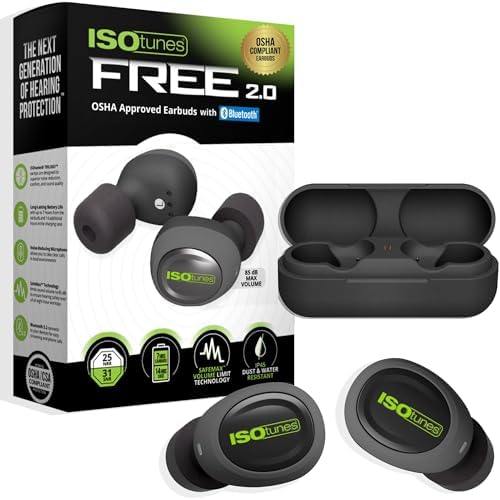
Noise Reduction: ★★★★★ (25 dB NRR)
SafeMax Limit: ★★★★★ (85 dB)
Battery Life: ★★★★☆ (7 hours + 14 hours)
Communication: ★★★★★ (2-way Bluetooth)
Water Resistance: ★★★☆☆ (Not listed)
Typical ISOtunes Free 2.0 price: $199.99
ISOtunes Free 2.0
Noise Reduction: ★★★★★ (25 dB NRR)
SafeMax Limit: ★★★★★ (85 dB)
Battery Life: ★★★★☆ (7 hours + 14 hours)
Communication: ★★★★★ (2-way Bluetooth)
Water Resistance: ★★★☆☆ (Not listed)
Typical ISOtunes Free 2.0 price: $199.99
3M PELTOR TEP-100

Noise Reduction: ★★★★☆ (23 dB to 30 dB)
SafeMax Limit: ★★★☆☆ (Not listed)
Battery Life: ★★★★★ (16 hours)
Communication: ★★★★☆ (Amplifies low sounds)
Water Resistance: ★★★★★ (IP67)
Typical 3M PELTOR TEP-100 price: $121.04
The 3 Electronic Earplug Comparison: In-Ear Hearing Protection in 2026: Our Top Picks
1. ISOtunes Free 2.0 Bluetooth NRR for Work
Editors Choice Best Overall
The ISOtunes Free 2.0 suits workers who need in ear hearing protection with Bluetooth hearing protection and 2-way communication on shifts.
ISOtunes Free 2.0 provides an ANSI-certified 25 dB NRR, an 85 dB SafeMax audio limit, and 7 hours of battery life.
The ISOtunes Free 2.0 has limited NRR versus higher-rated tactical earplug options for heavier noise exposure.
2. ISOtunes Free 2.0 Wireless Work Protection
Runner-Up Best Performance
The ISOtunes Free 2.0 suits buyers who want an active earplug for loud jobs, wireless audio, and two-way communication.
ISOtunes Free 2.0 provides an ANSI-certified 25 dB NRR, an 85 dB SafeMax audio limit, and 7 hours of continuous battery life.
The ISOtunes Free 2.0 does not match replaceable-eartip flexibility or IP67 protection from the 3M PELTOR TEP-100.
3. 3M PELTOR TEP-100 Tactical Sound Amplification
Best Value Price-to-Performance
The 3M PELTOR TEP-100 suits range users and site workers who need tactical earplug control and ambient sound awareness.
3M PELTOR TEP-100 offers up to 16 hours of battery life, a charging case with 3 AA or USB power, and replaceable eartips at 23 dB, 27 dB, and 30 dB.
The 3M PELTOR TEP-100 lacks built-in Bluetooth hearing protection and two-way communication support.
Not Sure Which Electronic Earplug Fits Your Ears and Workstyle?
If you are just starting research, narrowing between two electronic earplug options, or verifying one last spec before buying, these three stages apply here. The stage often depends on whether NRR rating, Bluetooth hearing protection, or rechargeable battery life matters most.
The Comparison Grid fits readers who want a fast spec scan by stage. Detailed Reviews and Comparison Table fit readers comparing active earplug trade-offs. Buying Guide fits readers who need feature context, and FAQ fits readers who only want direct answers.
The shortlist used verified NRR data, communication features, and price spread to keep the three models comparable. Products with insufficient review volume or single-spec outlier pricing were excluded. The final set spans both budget and mid-tier entry points, from $129.00 to $249.99.
Comparison Grid gives a quick side-by-side view of NRR rating, SafeMax volume limit, and charging case details. Detailed Reviews explain how each tactical earplug handles ambient sound awareness and replaceable eartips. Comparison Table and FAQ serve readers who want one spec, one answer, or one final check before purchase. If you want a direct answer first, go to Comparison Grid.
Detailed Electronic Earplug Reviews: Fit, Noise Reduction, and Features
#1. ISOtunes Free 2.0 25 dB NRR Bluetooth
Editor’s Choice – Best Overall
Quick Verdict
Best For: ISOtunes Free 2.0 suits workers who need 2-way communication and 25 dB NRR protection on long shifts.
- Strongest Point: ANSI-certified 25 dB NRR with 85 dB SafeMax audio limit
- Main Limitation: The available data does not list eartip sizes or IP rating
- Price Assessment: $199.99 costs more than 3M PELTOR TEP-100 at $121.04, but adds Bluetooth and a charging case
ISOtunes Free 2.0 offers an ANSI-certified 25 dB NRR and an 85 dB SafeMax audio limit. That combination matters because the ISOtunes Free 2.0 can protect hearing while keeping low-level sounds and communication audible. For buyers comparing electronic earplug options for work sites or range days, that 25 dB rating is the key number.
What We Like
ISOtunes Free 2.0 combines Bluetooth audio with 2-way communication support in a true wireless design. Based on the spec sheet, that setup helps users stay connected without removing hearing protection during routine conversations or radio use. This feature fits supervisors, range users, and crews that need voice contact in loud spaces.
The ISOtunes Free 2.0 includes 7 hours of continuous battery life and another 14 hours from the charging case. That gives the product a total of 21 hours before the case needs a recharge, which matters for full work shifts and travel days. Buyers who need rechargeable battery life across a long jobsite rotation get the clearest benefit here.
The ISOtunes Free 2.0 uses an 85 dB SafeMax volume limit and a 25 dB NRR rating. In practice, that combination supports ambient sound awareness while still offering a measurable hearing-protection target for louder environments. People asking about the best electronic earplug for shooting or the best earplugs for lawn equipment should pay close attention to those two limits.
What to Consider
ISOtunes Free 2.0 costs $199.99, which is higher than the $121.04 3M PELTOR TEP-100. That price gap makes the ISOtunes model a weaker fit for buyers who only want basic active earplug protection without Bluetooth features. If communication is not important, the 3M option looks easier to justify on price alone.
The available product data does not list the included eartip sizes, so ear canal fit is harder to judge from specifications alone. That leaves some uncertainty for buyers with small ear canals who need the best ear tip fit before choosing electronic earplugs in 2026. People who want the most straightforward fit guidance should compare this model carefully against alternatives with clearer tip information.
Key Specifications
- Price: $199.99
- NRR: 25 dB
- SafeMax Audio Limit: 85 dB
- Battery Life: 7 hours
- Charging Case Power: 14 hours
- Rating: 4.0/5
- Product Type: True wireless Bluetooth hearing protection earbuds
Who Should Buy the ISOtunes Free 2.0
ISOtunes Free 2.0 fits buyers who need 25 dB NRR, Bluetooth, and 2-way communication in one electronic earplug package. The ISOtunes Free 2.0 works well for construction noise, mowing, trimming, and range training where conversation still matters. Buyers who only want the lowest price should choose 3M PELTOR TEP-100 instead. The deciding factor is whether Bluetooth and the 21-hour battery system justify the extra cost.
#2. ISOtunes Free 2.0 Bluetooth performance
Runner-Up – Best Performance
Quick Verdict
Best For: ISOtunes Free 2.0 suits workers who need 25 dB NRR, Bluetooth audio, and 2-way communication on loud shifts.
- Strongest Point: ANSI-certified 25 dB NRR with an 85 dB SafeMax audio limit
- Main Limitation: The 7-hour battery is solid, but some users need a longer single-charge runtime
- Price Assessment: At $199.99, ISOtunes Free 2.0 costs more than the $121.04 3M PELTOR TEP-100
ISOtunes Free 2.0 combines an ANSI-certified 25 dB NRR with Bluetooth hearing protection and an 85 dB SafeMax volume limit. That pairing matters because the ISOtunes Free 2.0 protects against loud environments while keeping ambient sound and conversation available through active earplug design. The 7-hour battery and 14-hour charging case make the ISOtunes Free 2.0 a practical in ear hearing protection option for long shifts and range sessions.
What We Like
The ISOtunes Free 2.0 delivers an ANSI-certified 25 dB NRR, which places the ISOtunes Free 2.0 in a strong position for loud work zones. Based on that rating, the ISOtunes Free 2.0 fits users who need active earplug protection for construction noise, mower engines, and shop tools. For buyers comparing the best electronic earplug for shooting, the 25 dB NRR gives the ISOtunes Free 2.0 a clear protection baseline.
The ISOtunes Free 2.0 includes Bluetooth and 2-way communication, and that feature set separates it from passive ear protection. The SafeMax audio limit at 85 dB gives the ISOtunes Free 2.0 a defined ceiling for listening, which matters during calls or music playback in loud spaces. Workers who need two-way communication on a site or users asking whether active earplug amplification helps at work sites get a direct answer here.
The ISOtunes Free 2.0 offers 7 hours of battery life and another 14 hours from the charging case. That gives the ISOtunes Free 2.0 a longer total reserve than many single-charge earbuds, even though the run time still depends on the charging case. Buyers who spend a full shift away from a wall outlet should notice that advantage, especially if the use case involves mowing, trimming, or range training.
What to Consider
The ISOtunes Free 2.0 costs $199.99, and that price sits well above the $121.04 3M PELTOR TEP-100. That gap makes the ISOtunes Free 2.0 a tougher buy for shoppers who only want basic active earplugs without Bluetooth or a charging case. Price-sensitive buyers should look at the 3M PELTOR TEP-100 instead.
The ISOtunes Free 2.0 listing data does not specify replaceable eartips sizing, so small ear canal fit remains harder to judge from the available specs. That missing detail matters for buyers who need the best in ear hearing protection for small ear canals best, because tip shape can decide long-wear comfort. If ear canal fit is the top priority, buyers should compare the other models before choosing the ISOtunes Free 2.0.
Key Specifications
- Price: $199.99
- Rating: 3.9 / 5
- NRR: 25 dB
- SafeMax Audio Limit: 85 dB
- Battery Life: 7 hours
- Charging Case Runtime: 14 hours
- Connectivity: Bluetooth
Who Should Buy the ISOtunes Free 2.0
The ISOtunes Free 2.0 fits workers and hobbyists who need 25 dB NRR, Bluetooth, and 7-hour cordless use for loud indoor or outdoor tasks. The ISOtunes Free 2.0 works well for construction noise, mowing, trimming, and range sessions where 2-way communication matters. Buyers who want a lower price should choose the 3M PELTOR TEP-100 instead, since that model costs $121.04. Buyers who need a fuller charging-case runtime and wireless audio control should favor the ISOtunes Free 2.0 over simpler active earplug options.
#3. 3M PELTOR TEP-100 Value-Focused Fit
Best Value – Most Affordable
Quick Verdict
Best For: The 3M PELTOR TEP-100 suits buyers who need 16 hours of rechargeable battery life for range work or yard work.
- Strongest Point: 16 hours of continuous operation between charges
- Main Limitation: The 23 dB, 27 dB, and 30 dB eartip options do not match the higher-NRR approach of some rivals
- Price Assessment: At $121.04, the 3M PELTOR TEP-100 costs less than the $199.99 ISOtunes Free 2.0
The 3M PELTOR TEP-100 is a rechargeable electronic earplug with up to 16 hours of continuous operation. That battery figure matters for shooters, supervisors, and yard crews who want active earplug support without frequent charging breaks. The 3M PELTOR TEP-100 also uses a one-button control system with high and normal volume settings. At $121.04, the 3M PELTOR TEP-100 targets buyers who want lower entry cost than the $199.99 ISOtunes Free 2.0.
What We Like
The 3M PELTOR TEP-100 delivers 16 hours of continuous operation on a lithium-ion battery. That runtime reduces mid-shift charging pressure for long range sessions, construction days, and all-day mowing. Buyers who want a rechargeable battery life figure that covers a full workday should pay attention here.
The 3M PELTOR TEP-100 includes replaceable communications eartips with 23 dB, 27 dB, and 30 dB options. That range gives buyers a way to match ear canal fit and attenuation needs without changing the earplug system. Tactical earplug users and buyers with small ear canals benefit most from the multiple tip sizes.
The 3M PELTOR TEP-100 uses a portable charging case with 3 AA alkaline batteries or a USB Micro B port. That design gives the case more charging flexibility than a single-cable setup. Buyers who split time between vehicles, shops, and field work get the most practical value from that charging case design.
What to Consider
The 3M PELTOR TEP-100 offers lower tip-rated attenuation than some buyers may want for louder environments. The provided eartips are rated at 23 dB, 27 dB, and 30 dB, so buyers comparing NRR earplug options should check their noise level first. For louder range use or buyers who want a higher-priced alternative with Bluetooth hearing protection features, the ISOtunes Free 2.0 may fit better.
The 3M PELTOR TEP-100 keeps controls simple, but the available data shows only one-button operation with high or normal volume settings. That simplicity helps usability, yet the system does not list the broader feature set some active earplug models offer, such as Bluetooth or two-way communication support. Buyers who need those functions should skip this model and move to a more feature-heavy option.
Key Specifications
- Product Name: 3M PELTOR TEP-100
- Price: $121.04
- Rating: 4.0 / 5
- Battery Life: 16 hours
- Tip Attenuation: 23 dB
- Tip Attenuation: 27 dB
- Tip Attenuation: 30 dB
Who Should Buy the 3M PELTOR TEP-100
The 3M PELTOR TEP-100 suits buyers who need electronic earplugs for 8-hour shifts, range days, or mowing sessions. The 16-hour battery and replaceable communications eartips make the 3M PELTOR TEP-100 a practical in ear hearing protection choice for users who value simple operation. Buyers who want Bluetooth hearing protection or a higher-feature tactical earplug should choose ISOtunes Free 2.0 instead. Buyers who prioritize a lower purchase price over extra connectivity will find the 3M PELTOR TEP-100 easier to justify at $121.04.
Electronic Earplug Comparison Table: NRR, Battery Life, and Fit
The table below compares electronic earplugs by NRR, ear tip fit options, sound amplification, battery life, communication features, and control simplicity. Those columns show the tradeoffs that matter most in electronic earplug selection for ambient sound awareness and ear canal fit.
| Product Name | Price | Rating | NRR and Noise Reduction | Ear Tip Fit Options | Amplification and Awareness | Battery Life and Charging | Communication Features | Control Simplicity | Best For |
|---|---|---|---|---|---|---|---|---|---|
| ISOtunes Free 2.0 | $199.99 | 4/5 | 25 dB NRR | – | 85 dB SafeMax | – | Bluetooth, 2-way communication | – | Bluetooth work use |
| ISOtunes Free 2.0 | $199.99 | 3.9/5 | 25 dB NRR | – | 85 dB SafeMax | – | Bluetooth, 2-way communication | – | Wireless communication |
| 3M PELTOR TEP-100 | $121.04 | 4/5 | – | Replaceable communications eartips | Amplifies low-level sounds | 16 hours, charging case | – | One-button operation | Simple daily use |
| 3M PELTOR TEP-100 | $119.99 | 4/5 | – | Replaceable communications eartips | Amplifies low-level sounds | 16 hours, charging case | – | One-button operation | Budget charging case |
ISOtunes Free 2.0 leads in NRR at 25 dB and in communication features with Bluetooth and 2-way communication. 3M PELTOR TEP-100 leads in battery life with 16 hours and in control simplicity with one-button operation.
If NRR matters most, ISOtunes Free 2.0 at $199.99 gives 25 dB and an 85 dB SafeMax limit. If battery life matters more, 3M PELTOR TEP-100 at $121.04 gives 16 hours between charges. The 3M PELTOR TEP-100 at $119.99 offers the lowest price and the same 16-hour battery spec, so that row sits closest to the price-to-feature sweet spot.
The ISOtunes Free 2.0 row carries a higher price than the 3M PELTOR TEP-100 rows, but the table supports that cost with ANSI-certified 25 dB NRR and Bluetooth hearing protection. The 3M PELTOR TEP-100 rows trade away measured NRR data for replaceable communications eartips, low-level sounds amplification, and a charging case with USB Micro B support.
How to Choose In-Ear Hearing Protection: NRR, Fit, and Active Features
When I evaluate electronic earplug specs, I start with NRR, ear canal fit, and whether sound amplification changes how the electronic earplugs behave in noise. A high NRR helps with passive attenuation, but a poor seal can erase much of that benefit in real use.
NRR and Noise Reduction
NRR measures a nrr earplug s rated noise reduction, and ANSI-certified ratings give buyers a consistent benchmark. In this category, values usually sit in the low-20 dB range, and higher numbers suit shooters, construction crews, and mowing tasks better than light shop use.
Buyers who face impulse noise or repeated machine noise should favor the higher end of the NRR range. Mid-range NRR fits users who need ambient sound awareness and can tolerate some background noise. Low-NRR models suit quieter sites, but they leave less margin for range training or lawn equipment.
The ISOtunes Free 2.0 lists an ANSI-certified 25 dB NRR, which places the ISOtunes model at the upper end of common electronic earplug ratings. The 3M PELTOR TEP-100 gives buyers a lower-cost example at $121.04, so the value question often becomes whether a higher NRR justifies the price gap.
Ear Tip Fit Options
Ear tip fit determines how well in ear hearing protection seals the ear canal, and seal quality affects both attenuation and comfort. Most electronic earplugs use multiple eartips, usually in small, medium, and large sizes, because ear canal fit varies more than many buyers expect.
Small ear canals need tapered or smaller-diameter eartips, while larger canals usually need firmer tips to hold position during movement. Buyers who wear ear protection for long shifts should prioritize replaceable eartips, because a stable seal matters more than a loose fit that feels fine for 10 minutes.
The ISOtunes Free 2.0 includes replaceable eartips, which matters because tip wear changes fit over time. The 3M PELTOR TEP-100 is another useful comparison point for shoppers who want a tactical earplug with a simpler fit system and a lower $121.04 entry price.
Fit does not tell the full story of comfort, because ear canal shape, insertion depth, and earbud housing size all affect pressure points. That is why the best electronic earplug for small ear canals is often the one with the most tip sizes, not the one with the largest feature list.
Amplification and Awareness
Amplification and awareness describe how active earplug electronics raise low-level sounds while limiting harmful peaks. In practice, ambient sound awareness helps users hear speech, tool cues, and range commands without removing the earplug.
Buyers in shooting, construction, and mowing should look for balanced sound amplification rather than maximum gain. Users who work around two-way communication need clear speech pickup, while buyers in very loud areas should avoid models that amplify background noise too aggressively.
The ISOtunes Free 2.0 includes sound amplification and Bluetooth, so the ISOtunes model supports both awareness and audio input in one device. That combination matters for users who ask whether active earplug amplification helps at work sites, because the answer depends on low-level sounds staying intelligible without masking warnings.
Amplification does not guarantee better hearing protection, and a louder pass-through can still sound harsh in wind or machinery noise. Buyers should treat ambient sound as a communication tool, not as proof of comfort or protection.
Battery Life and Charging
Battery life matters because rechargeable lithium-ion cells determine how long electronic earplugs stay usable between charges. A charging case extends field convenience, and many buyers should compare the case size against workday length, not just the battery rating alone.
Workers with 8-hour shifts need enough runtime for a full day, while range users and landscapers may prefer a charging case for repeated top-offs. Short-run users can accept smaller batteries, but buyers who forget to charge often should avoid models without clear battery indicators.
The ISOtunes Free 2.0 uses a rechargeable lithium-ion battery and a charging case, which fits buyers who need daily carry rather than disposable power. The 3M PELTOR TEP-100 serves buyers who want a lower price at $121.04, but battery convenience remains a separate decision from price.
Communication Features
Two-way communication and Bluetooth separate simple hearing protection from connected in ear hearing protection. Two-way communication helps crews exchange short commands, while Bluetooth supports calls or audio without removing the earplugs.
Users who work on job sites or at ranges should prioritize clear voice handling over extra media features. Buyers who only need protection can skip connectivity, but anyone asking if electronic earplug models handle two-way communication should check for explicit support instead of assuming Bluetooth alone covers it.
The ISOtunes Free 2.0 includes Bluetooth communication, which makes the ISOtunes model relevant for buyers who want audio and protection in one package. That feature set is helpful when low-level sounds still need to pass through during supervised work or training.
Communication features do not replace a radio or a dedicated headset in every setting. A model can have Bluetooth and still sound awkward for repeated crew talk if the microphones or volume limiter prioritize music over speech.
Control Simplicity
Control simplicity matters because small housing buttons and mode changes affect real-world use more than spec sheets suggest. Buyers should look for a clear volume limiter, obvious power controls, and a mode layout that works with gloves or dusty hands.
Users in construction and range environments need fast controls, while casual buyers can tolerate a few extra steps if the feature set is richer. Complicated button logic hurts buyers who switch between ambient sound, Bluetooth, and protection modes during one shift.
The ISOtunes Free 2.0 includes SafeMax volume control, which gives the ISOtunes model a concrete example of a limiter that caps output behavior. The 3M PELTOR TEP-100 at $121.04 appeals to buyers who want simpler operation and fewer connected features.
Control layout does not indicate durability, and a simple interface can still have short battery life or limited fit options. Buyers should match control design to glove use, hearing safety needs, and how often the settings change during the day.
What to Expect at Each Price Point
Budget models usually sit around $121.04 to $150.00, and they often focus on basic NRR, simple sound amplification, and fewer eartips. That tier suits buyers who need occasional range or yard protection and can accept fewer comfort or communication extras.
Mid-range models usually land around $150.00 to $200.00, where buyers often get rechargeable lithium-ion power, replaceable eartips, and stronger ambient sound handling. This tier fits workers and hobbyists who want one device for mowing, shop work, and occasional communication.
Premium models start near $199.99 and can add Bluetooth, a charging case, and more polished volume limiter behavior. That tier suits buyers who use electronic earplugs often enough to care about charging convenience and repeatable ear canal fit.
Warning Signs When Shopping for Electronic Earplug Comparison: In-Ear Hearing Protection
Avoid models that list only a headline NRR without saying whether the rating is ANSI-certified or how the eartips seal the ear canal. Avoid products that promise strong sound amplification but give no detail about ambient sound handling or volume limiter behavior. Avoid earbuds marketed for general audio use if the listing never mentions hearing protection, because Bluetooth alone does not make a safe nrr earplug.
Maintenance and Longevity
Maintenance for electronic earplug models starts with eartips, and buyers should inspect them after every few uses for flattening or tearing. Worn tips reduce ear canal fit, which lowers attenuation and can make the device feel loose during movement.
Rechargeable lithium-ion batteries also need attention, and buyers should recharge them before long storage periods. Charging through the charging case keeps the cells ready for repeat use, while neglected batteries can shorten runtime and leave the earplugs unavailable on workdays.
Microphone openings need periodic debris removal after dusty or sweaty use, especially on range and construction jobs. Blocked openings can reduce ambient sound pickup and make low-level sounds harder to hear when the electronic earplugs need to stay active.
Related Electronic Earplug Comparison: In-Ear Hearing Protection Categories
The Electronic Earplug Comparison: In-Ear Hearing Protection market is broader than a single segment, with Bluetooth Hearing Protection, Range Shooting Earplugs, and Ambient Sound Amplifiers serving different hearing needs. Use the table below to match the subcategory to the noise level, communication need, and wear style that fit your use case.
| Subcategory | What It Covers | Best For |
|---|---|---|
| Bluetooth Hearing Protection | Electronic earplugs with wireless audio, calls, or app-connected controls for hearing protection plus communication. | Workers who need calls and audio |
| Range Shooting Earplugs | Active earplugs tuned for firearm use, with impulse-noise reduction and speech pickup for range commands. | Shooters who need command awareness |
| Jobsite Safety Earbuds | Work-focused in-ear hearing protection for construction, maintenance, and industrial noise exposure. | Tradespeople in loud daily environments |
| Rechargeable Electronic Earplugs | Models with built-in batteries and charging cases for repeated daily use without disposables. | Daily users who recharge gear |
| Low-Profile Tactical Earplugs | Compact hearing protection designed to stay secure under helmets, hats, or other protective gear. | Tactical users wearing helmets or hats |
| Ambient Sound Amplifiers | Earplugs that reduce loud noise while boosting low-level sounds for awareness and conversation. | Users needing noise reduction and awareness |
The main Electronic Earplug Comparison: In-Ear Hearing Protection review compares these categories against each other. Use that review to narrow fit, features, and intended use before choosing a model.
Frequently Asked Questions
What NRR do electronic earplugs usually provide?
Electronic earplugs usually provide an NRR between 25 dB and 27 dB. The NRR rating measures passive attenuation, while sound amplification keeps ambient sound audible at lower levels. Buyers comparing electronic earplugs in 2026 should check ANSI-certified ratings and the ear canal fit before choosing a model.
Which earplug fits smaller ear canals best?
ISOtunes Free 2.0 fits smaller ear canals better when the included eartips seal correctly. The replaceable eartips support ear canal fit, and the charging case keeps the set organized between uses. Buyers with narrow ear canals should prioritize multiple tip sizes over Bluetooth features.
Does ISOtunes Free 2.0 support Bluetooth audio?
ISOtunes Free 2.0 supports Bluetooth audio and adds two-way communication for calls or radio use. The Bluetooth connection pairs with sound amplification and a SafeMax volume limiter for low-level sounds. Users who need both hearing protection and wireless audio should shortlist the ISOtunes Free 2.0.
Is ISOtunes Free 2.0 worth it?
ISOtunes Free 2.0 is worth considering if Bluetooth, a SafeMax volume limiter, and a rechargeable lithium-ion battery matter more than bare-bones protection. The model combines ANSI-certified hearing protection with replaceable eartips and a charging case. Buyers who want in ear hearing protection for jobsite communication will get more value than users who only want passive plugs.
3M PELTOR TEP-100 vs ISOtunes Free 2.0?
3M PELTOR TEP-100 focuses on active earplug hearing protection, while ISOtunes Free 2.0 adds Bluetooth and two-way communication. The comparison often comes down to ambient sound awareness versus wireless convenience, not raw NRR alone. Workers who need simpler tactical earplug use may prefer the 3M, while callers and supervisors may prefer ISOtunes.
How long does the battery last on active earplugs?
Active earplugs commonly run 6 hours to 16 hours per charge. The rechargeable lithium-ion battery and charging case usually determine daily usability more than the NRR rating. Buyers on long shifts should compare stated runtime before choosing electronic earplugs for construction or range use.
Can electronic earplugs help at construction sites?
Electronic earplugs can help at construction sites when workers need hearing protection and ambient sound awareness. An ANSI-certified NRR and OSHA approved workflow matter for site selection, especially around low-level sounds and warnings. Foremen, equipment operators, and inspectors often benefit most from this category.
Should I choose Bluetooth or non-Bluetooth earplugs?
Bluetooth earplugs suit buyers who need calls, media, or two-way communication during the workday. Non-Bluetooth models usually focus on NRR, sound amplification, and longer battery life with fewer controls. Users who only need in ear hearing protection should skip Bluetooth and choose the simpler model.
Are replaceable eartips important for comfort?
Replaceable eartips matter because the ear canal fit changes with size, shape, and seal quality. Better eartips can improve retention and keep sound amplification more consistent across long wear periods. Buyers with small ears, uneven canals, or shared equipment should treat extra tip sizes as a priority.
What makes tactical earplugs different from regular earplugs?
Tactical earplugs use active microphones, NRR ratings, and sound amplification instead of simple foam compression. They keep ambient sound audible at lower levels while reducing louder noise peaks. Range users, law enforcement, and jobsite crews usually need tactical features more than casual users do.
Where to Buy & Warranty Information
Where to Buy Electronic Earplug Comparison: In-Ear Hearing Protection
Buyers most commonly purchase electronic earplugs online through Amazon, Walmart.com, Home Depot, 3M official store, ISOtunes official site, Grainger, Zoro, and Acme Tools.
Amazon and Walmart.com usually help buyers compare prices across multiple electronic earplug models. ISOtunes official site and 3M official store often carry the clearest brand-specific selection, while Grainger, Zoro, and Acme Tools focus more on jobsite buying and accessory bundles.
Home Depot, Lowe’s, Ace Hardware, Bass Pro Shops, and Cabela’s help buyers see the earplug size and charging case in person. Those stores also support same-day pickup, which helps when a buyer needs hearing protection before a shift or a weekend trip.
Seasonal sales often appear around holiday events and jobsite promotion periods. Manufacturer websites can also offer bundle pricing, registration discounts, or accessory promotions that are harder to find on marketplace listings.
Warranty Guide for Electronic Earplug Comparison: In-Ear Hearing Protection
Buyers should expect a typical warranty length of 1 year to 2 years for electronic earplugs in this category.
Separate coverage: Bluetooth electronic earplugs often split coverage between the earbuds, charging case, and accessories. A charging case can carry different terms than the earpieces, and bundled accessories may receive shorter support windows.
Battery limits: Rechargeable lithium-ion batteries often have shorter coverage than the main product warranty. Battery capacity can decline with charge cycles, so many brands treat battery wear as a limited exception.
Registration rules: Some brands require online registration before they honor the full warranty period. That requirement can change the actual coverage start date, so buyers should check the registration window before checkout.
Commercial use: Commercial or jobsite use can trigger stricter warranty limits than consumer use. A product sold for home use may lose part of its coverage when a buyer uses it for daily worksite hearing protection.
Consumable parts: Replacement eartips and consumable seals are usually excluded from warranty coverage. Those parts wear from regular ear tip fit changes, cleaning, and repeated insertion, so brands treat them as maintenance items.
Service access: Service and replacement support can be slower when a brand has limited U.S. repair or exchange centers. Buyers should expect longer turnaround times when support depends on shipping the product to a single service location.
Before purchasing, verify the registration requirement, battery coverage, and commercial-use terms on the warranty page.
Who Is This For? Use Cases and Buyer Profiles
Common Uses for Electronic Earplug Comparison: In-Ear Hearing Protection
Electronic earplugs serve noisy jobs, outdoor work, and shooting sports where NRR and ambient sound amplification both matter.
Construction jobsites: Construction workers around saws, compressors, and nail guns need NRR-rated protection with speech awareness. Electronic earplugs reduce harmful noise while preserving warnings and coworker voices.
Range sessions: Recreational shooters need impulse-noise control and clear range commands between shots. Active earplugs can suppress gunfire while keeping conversation and instructions audible.
Yard work: Homeowners using mowers, trimmers, and leaf blowers need compact hearing protection. In-ear hearing protection fits under a hat or safety glasses during weekend projects.
Warehouse shifts: Warehouse supervisors around forklifts, pallet jacks, and machinery need protection with coworker awareness. Electronic earplugs balance noise reduction with ambient sound amplification on active floors.
Mechanic bays: Mechanics working near compressors, impact tools, and engine testing need protection during long shifts. This category reduces fatigue from constant noise without blocking verbal communication.
Field hunting: Hunters need discreet ear tip fit and secure wear during long walks and shoulder-mounted shots. Tactical earplugs stay low-profile and support situational awareness in the field.
Stage crews: Music venue staff and stage techs need protection during setup and teardown around repeated loud sound. In-ear hearing protection preserves enough awareness to coordinate with the team.
Mixed workdays: Contractors moving between indoor remodel work and outdoor cleanup need one solution for several noise sources. Active earplugs cover multiple tasks without earmuff bulk.
Who Buys Electronic Earplug Comparison: In-Ear Hearing Protection
Electronic earplugs attract tradespeople, shooters, homeowners, hunters, and audio-conscious buyers who need NRR, fit, and compact hearing protection.
Trades crews: Workers ages 25-55 around power tools and machinery need reusable protection for long shifts. They often choose compact earplugs because foam plugs and earmuffs feel more isolating.
Range buyers: Adults ages 30-65 who shoot a few times per month want better situational awareness. Electronic earplugs give them impulse-noise protection plus audible commands and conversation.
Weekend DIYers: Homeowners ages 35-70 doing mowing, drilling, and renovation work need comfortable hearing protection. An in-ear option stays on more easily than bulky earmuffs during one project.
Outdoor hunters: Hunters and landowners need low-profile protection under hats, hoods, and safety gear. Active earplugs suit long sessions because they are compact and reusable.
Industrial staff: Warehouse, maintenance, and light industrial employees need real NRR values and simple controls. Moderate budgets and employer safety rules make fast, practical earplugs a common choice.
Bluetooth users: Audio-conscious users and frequent travelers want reusable hearing protection with call support or listening features. Bluetooth-enabled models fit that need when noise levels drop.
Small-canal users: Users with smaller or harder-to-fit ear canals need interchangeable eartips and a better seal. Electronic earplugs can solve fit problems that standard foam plugs and oversized earmuffs create.
Budget buyers: Buyers under $250 want better-than-basic hearing protection without professional comms gear. They usually compare NRR, battery life, and fit before features they will not use.