Most flashlight battery users require a throw distance between 5 m and 50 m for general tasks, though specialized needs can extend this significantly. The specific throw distance you need depends entirely on the maximum distance you intend to illuminate while maintaining enough light to see clearly.
Recommended Throw Distance for Flashlight Batteries by Use Case
| Use Case | Recommended Throw Distance | Why this number |
|---|---|---|
| Household and Workshop | 5 m to 15 m | Short-range illumination allows for a wider beam spread and easier navigation in indoor spaces. |
| Camping and Hiking | 20 m to 50 m | This range provides enough reach to identify trail markers or navigate around obstacles in a forest. |
| Search and Rescue | 100 m to 300 m | Longer distances are necessary to scan large areas and locate subjects from a distance. |
| Tactical and Security | 50 m to 100 m | This range balances the ability to identify a subject at a distance with the need for a usable floodlight. |
| Long-Range Signaling | 500 m+ | Extreme throw distances are used primarily for signaling or spotting distant landmarks rather than navigation. |
Flashlight Batteries covered by our own reviews
3 reviewed options, $109.95 to $244.99, with the full write-up behind each name.
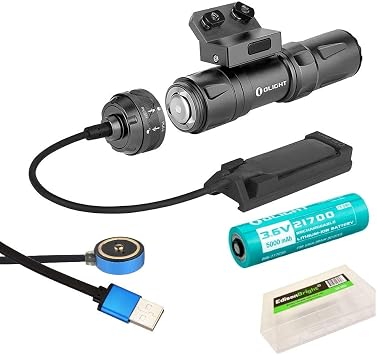
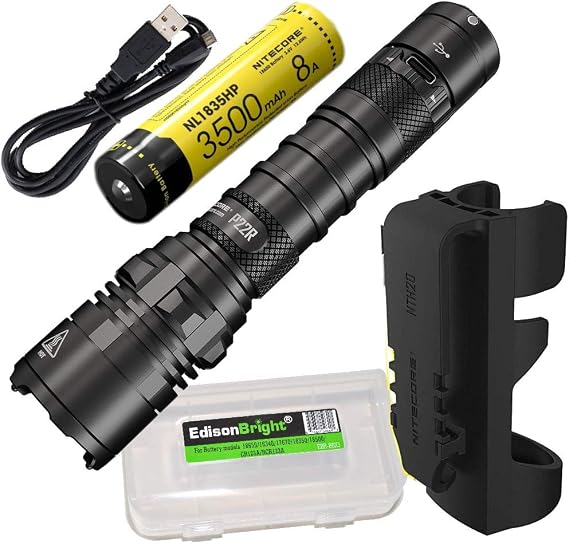
Nitecore P22R Tactical Flashlight Bundle
$109.95 price checked August 2026
Read our full Nitecore P22R review
If your gear faces extreme conditions, see our top heavy duty replacement batteries for reliable power.

What Happens if You Under-Provision or Over-Buy Throw Distance?
Under-provisioning occurs when the throw distance of your flashlight battery setup is shorter than the distance you need to see. If you need to identify a person 40 m away but your setup only provides a clear throw of 10 m, the light will hit the ground or a nearby object before reaching your target. This results in a “wall of light” effect where you can see everything in front of you clearly, but you cannot see anything further away, potentially creating a safety hazard in low-light environments.
The Limits of Short Throw Distances
When the throw distance is insufficient, the light intensity drops off too quickly. You may find yourself having to physically move closer to an object to see details, which limits your mobility and situational awareness. In a workshop, this might mean you cannot see the end of a long workbench; in the woods, it means you might trip over an obstacle that is just outside your current light pool.
Over-buying throw distance involves choosing a battery and light configuration capable of reaching distances you will never actually use. While a high throw distance sounds like a benefit, it often comes with a significant trade-off in “flood” or “spill” light. A light designed to throw 500 m usually produces a very narrow, tight beam. If you only need to see 5 m in front of you, a high-throw setup might leave your peripheral vision in near-total darkness, making it difficult to move safely without constantly sweeping the light around.
Understanding technical specifications is easier if you compare different flashlight battery types for your specific needs.
The Real Cost of Over-Buying
The primary cost of over-buying throw distance is weight and size. High-throw capabilities often require larger battery cells or specialized high-drain configurations that increase the bulk of the flashlight. If you are hiking and only need to see 10 m ahead, carrying a heavy, high-throw setup is a waste of energy and space. Additionally, high-throw configurations may drain the flashlight battery faster, meaning you might have to carry more spare batteries than necessary for your actual needs.
The Common Mistake with Throw Distance and What to Optimize Instead
The most common mistake buyers make is assuming that a higher throw distance number automatically makes a flashlight better. Many people see a high number and assume it provides more light overall, but throw distance is a measure of concentration, not total output. A light that throws 300 m might actually provide very little light at 5 m because the energy is being pushed so far forward.
Focus vs. Total Output
Instead of optimizing for the maximum throw distance, you should optimize for the “useful” distance. This is the distance at which the light remains bright enough to perform a task. For most users, this means finding a balance between throw and flood. If you are looking for a versatile tool, you want a light that provides a usable throw of 30 m while still illuminating the ground 3 m in front of your feet. If you only care about the maximum distance, you may find the light is practically useless for everyday tasks.
Defining Effective Range
Effective range is the distance where the light is still bright enough to distinguish colors and textures. A throw distance of 100 m is only useful if the light is bright enough to see a person’s face at that distance. If the light is too dim, the throw distance is a hollow statistic. Always consider the brightness (lumens) required to make that throw distance useful for your specific environment.
How Throw Distance Interacts with Other Flashlight Battery Specs
Throw distance is not an isolated spec; it is heavily influenced by the battery’s capacity and the discharge rate of the flashlight’s electronics. A high throw distance requires a battery that can provide high current quickly. If the battery has a low discharge rate, it will not be able to power the LEDs at the levels required to achieve the advertised throw distance.
Battery Discharge Rates and Throw
When evaluating flashlight batteries, you must look at the maximum continuous discharge rating. A battery rated for 10A may be sufficient for a 50 m throw, but a 300 m throw might require a battery capable of 20A or more. If the battery cannot provide the necessary current, the light’s throw distance will be significantly shorter than the manufacturer’s claim, or the light may fail to turn on entirely under load.
Capacity vs. Throw Distance
There is a direct relationship between battery capacity (mAh) and throw distance. Higher throw distances often require high-drain cells which typically have lower capacities than standard cells. If you need a long throw, you may have to accept a shorter run time per charge. Conversely, if you prioritize long run times with high-capacity batteries, you will likely find the throw distance is limited because those batteries cannot provide the high-intensity bursts needed for long-range beams.
Heat and Throw Limits
Heat is the ultimate limit on throw distance. To push light far, the LEDs must run hot. The flashlight’s ability to dissipate this heat determines how long the light can maintain its maximum throw. A battery that can provide high power is only useful if the flashlight’s housing can handle the heat generated by that power. If the device reaches its thermal limit quickly, the throw distance will drop as the electronics throttle the power to the LEDs.
The rest of our Flashlight Battery guides
- Best Rechargeable Flashlight Batteries for Duty Use
- Affordable Flashlight Batteries Under $200 Compared
- Which Rechargeable Flashlight Batteries Are Best for Night Vision?
- Best Replacement Flashlight Batteries for Heavy Duty Use
- Long Throw Rechargeable Flashlight Batteries Compared
- Choosing the Best Flashlight Batteries for Compact Tactical Lights