There are four meaningfully different types of Edc Knives, categorized primarily by their deployment mechanism and blade geometry. While marketing often segments these by color or handle material, the technical split that dictates a buying decision is how the blade locks into place and the specific shape of the edge. These mechanical differences determine the speed of deployment, the security of the lock, and the versatility of the cutting surface for different tasks.
What defines a Flipper Knife?
A flipper knife is defined by a blade geometry designed to rotate or “flip” into a locked position, typically utilizing a flipper tab—a small protrusion on the blade itself. This design is for the user who prioritizes rapid, one-handed deployment and a consistent mechanical feel. Because the tab provides a physical point of leverage, these knives excel at moving from a closed to an open state with minimal effort.
The trade-off for this speed is often a slightly larger blade profile to accommodate the tab, which may make the knife less discreet in a pocket. In terms of price, flipper knives generally sit in a mid-range bracket, as the machining required for the flipper tab and the pivot assembly adds complexity compared to simpler designs.
Where these choices show up in our reviews
Prices across these 3 run from $185.50 to $209.25; each one has a full review here.

Spyderco Para Military 2
$185.50 price checked August 2026
Read our full Para Military 2 review
If you need a specific tool for the woods, see our comparison of the best edc knife for hunting.

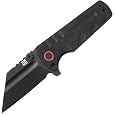
ARTISANCUTLERY Tactical Knife Proponent Folding Knife
$199.49 price checked August 2026
For those seeking lightweight durability, browse the best carbon fiber handle pocket knife options.
What defines a Fixed Blade EDC?
A fixed blade EDC is a knife where the blade is permanently attached to the handle, requiring the user to carry it in a sheath or on a belt. This type is for someone who performs heavy-duty tasks where a folding mechanism would be a point of failure. These knives perform better in high-impact environments because there are no moving parts to fail or become jammed.
The primary compromise is portability; a fixed blade requires more space and is harder to conceal or access quickly than a folding knife. These typically sit in a lower to mid-range price bracket, as the lack of a complex locking mechanism reduces manufacturing costs, though high-end steels can increase the price.
What defines a Straight Edge Folder?
A straight edge folder is a traditional folding knife with a linear blade and a standard locking mechanism, such as a liner lock or frame lock. This type is for the general user who needs a reliable, “no-nonsense” tool for everyday tasks like opening boxes or cutting cord. They excel at providing a predictable, stable cutting surface that is easy to maintain.
These knives give up the specialized speed of a flipper or the heavy-duty durability of a fixed blade. They are the standard for the industry and typically occupy the most accessible price bracket, offering the highest volume of options for different budgets.
What defines an Outfolder Knife?
An outfolder knife is a specific sub-type of folder where the blade is engineered to swing out in a wide arc, often using a specialized pivot and a high-tension spring. This type is for the user who needs an extremely fast, almost instantaneous deployment. They perform better than standard folders in situations where speed is the priority over blade length.
Selecting the right weight is crucial, so learn how to choose your edc knife weight.
The compromise is often a shorter blade length, as the arc of the swing limits how far the blade can travel before hitting the handle. These are generally positioned in a higher price bracket due to the precision engineering required to ensure the blade clears the handle during a high-speed deployment.
Comparison of Edc Knife Types
| Type | Best-Fit Buyer | Main Advantage | Main Compromise |
|---|---|---|---|
| Flipper Knife | User prioritizing speed | Rapid one-handed deployment | Larger blade profile |
| Fixed Blade EDC | Heavy-duty task user | No mechanical failure points | Lower portability |
| Straight Edge Folder | General purpose user | Predictable stability | Slower deployment |
| Outfolder Knife | Speed-focused user | Instantaneous opening | Limited blade length |
How do you know which Edc Knife type is right for you?
You belong in the fixed blade category if your primary use involves heavy materials where you need to apply maximum force without worrying about a locking mechanism. If you do not need to hide the tool and prefer a blade that never moves, this is the correct choice.
You should consider a flipper knife if you frequently need to open a blade with one hand and want a consistent, tactile “click” or “flip” into place. This is ideal for users who want a balance of speed and a folding profile.
You should choose a straight edge folder if you want a reliable tool for general utility and are not concerned with specialized deployment speeds. This is the standard choice for most daily tasks where a simple, sturdy blade is sufficient.
You should opt for an outfolder knife if your specific requirements demand the fastest possible deployment and you are willing to sacrifice some blade length to achieve it. This is a niche choice for those who prioritize the mechanics of the opening action.
Before ordering, confirm the current rules for your specific location, as regulations regarding blade length and locking mechanisms vary significantly by region.