For most everyday carry knives, you should look for a Rockwell Hardness (HRC) between 58 and 62. This range balances the ability to maintain a sharp edge with the durability needed to prevent the blade from chipping during daily tasks.
Recommended Rockwell Hardness (HRC) by Use Case
| Use Case | Recommended Rockwell Hardness (HRC) | Why this number |
|---|---|---|
| General Everyday Carry | 58–60 HRC | Provides a balance of edge retention and toughness for opening boxes and cutting cordage. |
| Heavy Duty / Woodworking | 54–57 HRC | Lower hardness prevents the edge from chipping or rolling when encountering hard fibers or heavy pressure. |
| Precision Slicing / Kitchen | 60–63 HRC | Allows for a finer, sharper edge that stays sharp longer when cutting soft organic materials. |
| Hardwood / Bushcraft | 56–58 HRC | Prioritizes structural integrity and impact resistance over extreme edge sharpness. |
| Lightweight Folding Knives | 58–60 HRC | Maintains a sharp profile while ensuring the blade does not become brittle in a compact form factor. |
Where these choices show up in our reviews
3 reviewed options, $109.99 to $259.99, with the full write-up behind each name.
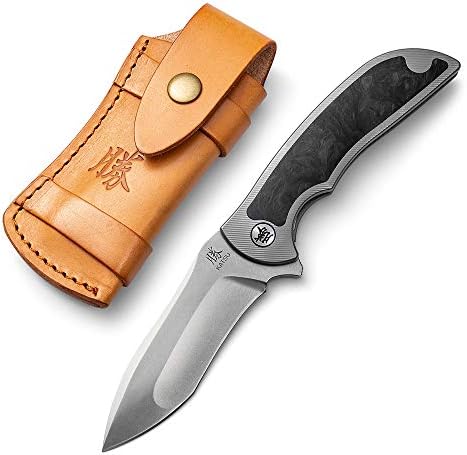

Kizer Pocket Folding Knife Feist Ki3499
If you need a more robust blade for wilderness trips, explore the best folding camping knife options.
$109.99 price checked August 2026
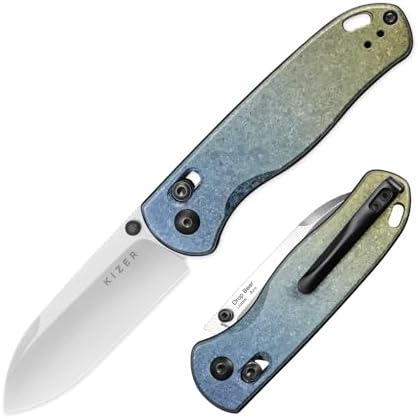
Kizer Drop Bear Folding Pocket Knife
$119 price checked August 2026
Read our full Kizer Drop Bear review
For those needing a specialized tool for the field, see the best edc knife for hunting.
Risks of Under-Provisioning or Over-Buying Rockwell Hardness (HRC)
If the Rockwell Hardness (HRC) of an edc knife falls below the 55 HRC range, the steel becomes too soft for practical use. A soft blade will experience significant edge roll, where the cutting surface tilts or rounds over after only a few uses. You will find yourself needing to sharpen the tool much more frequently because the metal cannot hold a consistent geometry against even moderate resistance.
Consequences of Low Rockwell Hardness (HRC)
Low Rockwell Hardness (HRC) values mean the steel lacks the internal structure to resist deformation. In an edc knife, this results in a “mushy” cutting feel where the blade fails to bite into the material. While these knives are very easy to sharpen, they lose their utility quickly in any environment involving heavy-duty tasks or repetitive cutting.
Conversely, over-buying on Rockwell Hardness (HRC) by selecting steels in the 64 HRC range or higher introduces the risk of brittleness. While these materials can achieve a razor-sharp edge, they behave more like glass than steel under stress. If the blade encounters a hard knot in wood or a metal fastener, a high Rockwell Hardness (HRC) value can cause the edge to chip or the entire blade to snap.
The Cost of Excessive Hardness
High Rockwell Hardness (HRC) is often a marketing point, but it comes with a functional trade-off in durability. For an edc knife, a blade that is too hard is difficult to repair and prone to catastrophic failure during lateral stress. You may find that a “harder” knife actually performs worse in your daily life because it cannot withstand the unpredictable forces of everyday use.
The Common Mistake with Rockwell Hardness (HRC)
The most common mistake buyers make with Rockwell Hardness (HRC) is assuming that a higher number always equates to a “better” knife. Many shoppers look for the highest HRC number available because it sounds like a superior technical specification, but for an edc knife, this is often a counterproductive goal.
Understanding durability is easier once you learn how to choose your ideal blade length.
Prioritizing Toughness over Peak Hardness
You should optimize for a balance of hardness and toughness rather than seeking the maximum Rockwell Hardness (HRC) possible. Toughness is the ability of the steel to absorb energy and resist breaking, while hardness is the ability to resist deformation. An edc knife needs to be tough enough to handle a variety of tasks without breaking, which often requires staying in the 58–60 HRC range.
Instead of chasing a high Rockwell Hardness (HRC) number, look for steels that have been heat-treated to achieve a stable, consistent edge. A knife with a 59 HRC rating that is well-balanced will consistently outperform a 63 HRC knife that chips the first time it hits a hard surface. Focus on the reliability of the material rather than the peak of the scale.
How Rockwell Hardness (HRC) Interacts with Other Specs
Rockwell Hardness (HRC) does not exist in a vacuum; its effectiveness is limited by the blade’s geometry and the steel’s chemistry. A high Rockwell Hardness (HRC) value is wasted if the blade grind is too thick or the steel type is prone to rapid oxidation.
The Impact of Blade Geometry
The physical grind of the blade—such as a convex, flat, or hollow grind—determines how much of the Rockwell Hardness (HRC) you actually feel during use. A thick, heavy grind will feel durable regardless of the HRC, but it will not cut as efficiently. Conversely, a very thin, acute edge relies heavily on a high Rockwell Hardness (HRC) to stay sharp, making it more susceptible to the risks of brittleness mentioned previously.
The Role of Steel Chemistry
The type of steel determines the “ceiling” for what Rockwell Hardness (HRC) is practical for a specific application. Some steels are designed to be high-carbon and high-hardness, while others are stainless alloys designed for corrosion resistance at lower hardness levels. If you require a knife for a wet environment, you may need to accept a lower Rockwell Hardness (HRC) to ensure the steel remains rust-free, as many high-hardness steels are more prone to corrosion.
When choosing an edc knife, ensure the Rockwell Hardness (HRC) aligns with the intended use-case and the material properties of the steel. A value of 58–60 HRC remains the “sweet spot” where the steel is hard enough to hold a sharp edge for weeks of use, yet tough enough to survive the daily rigors of a pocket carry.
Browse our other Edc Knife pages
- Carbon Fiber Handle Pocket Knives Compared
- Choosing the Best EDC Knife for Men and Women
- The Folding Camping Knives That Work Best for Outdoor Use
- EDC Knives for Hunting Compared
- Choosing the Best Tactical Folding Pocket Knife for Everyday Carry
- The Compact Folding EDC Knives That Work Best for Everyday Carry