In the category of waterproof combat boots, there are no legally mandated safety certifications for general retail sale. Most markings found on footwear are voluntary certifications from independent testing bodies or voluntary adherence to military specifications. While some markings are purely decorative—designed to imply quality without providing a verifiable standard—others offer meaningful data regarding water resistance, material durability, and structural integrity. A reliability-first buyer should distinguish between a brand’s internal “quality” claim and a third-party certified standard.
What is the AR 670-1 standard?
The AR 670-1 standard is a United States military specification that dictates the requirements for footwear construction, durability, and performance for personnel in the field. This standard ensures that boots can withstand the rigors of military service, including specific requirements for sole thickness, material types, and construction methods.
What AR 670-1 guarantees and does not guarantee
AR 670-1 guarantees that the boot meets specific physical requirements for weight, height, and material durability suitable for military use. It ensures the boot is constructed to withstand heavy use in varied environments. It does not, however, guarantee a specific level of waterproofness or a specific grade of waterproofing membrane; a boot can meet AR 670-1 specifications while lacking high-performance waterproof capabilities.
Where these choices show up in our reviews
From $100 to $149.95: the 3 in this category we have reviewed in full.

Belleville 500 USMC Waterproof Combat Boot
$129.90 price checked August 2026
Read our full Belleville 500 USMC review
If you are on a budget, see the best waterproof combat boots for cold weather under $250.
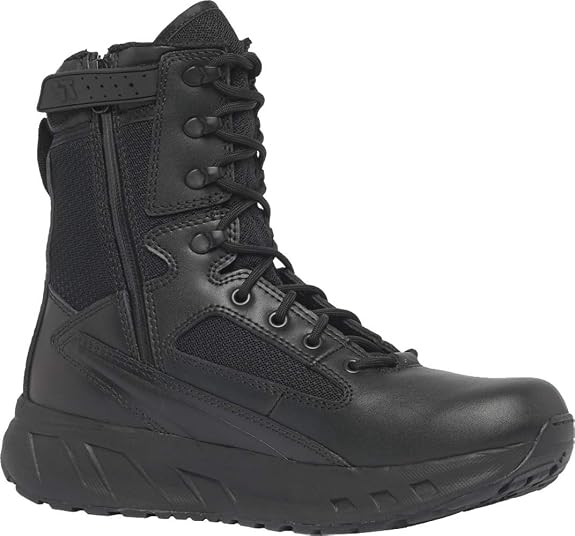

CQR Men’s Waterproof Tactical Boots
$100 price checked August 2026
You might also consider exploring the alternatives to waterproof combat boots if a traditional boot isn’t right.
What does a GORE-TEX certification mean?
GORE-TEX is a proprietary brand of waterproof membrane manufactured by W. L. Gore & Associates. When a waterproof combat boot features this mark, it indicates that the boot incorporates their specific membrane technology into the upper construction.
What GORE-TEX guarantees and does not guarantee
A GORE-TEX mark guarantees that the membrane is designed to be both waterproof and breathable, allowing moisture vapor to escape while preventing liquid water from entering. It provides a measurable level of hydrostatic pressure resistance. It does not guarantee that the boot is “submersible” or that the stitching and seams are perfectly waterproof; if the boot’s construction (such as the eyelets or seams) is not properly sealed with the membrane, water can still enter the boot.
What safety failure modes occur in waterproof combat boots?
Waterproof combat boots are susceptible to specific structural failures that can compromise the wearer’s stability or the boot’s longevity. Identifying the standard that addresses these failures helps determine the reliability of the construction.
Sole delamination and bonding standards
Sole delamination is the structural failure where the outsole separates from the upper. This often occurs due to poor adhesive bonding or heat-related degradation. While there is no single universal “anti-delamination” mark, boots that use heat-molded constructions or high-strength chemical bonding are designed to resist this failure mode. You should look for construction descriptions that specify the bonding method used to secure the sole to the chassis.
Before making a final purchase, look at how waterproof combat boot warranties differ across various brands.
Torsional instability and lateral support
Torsional instability occurs when a boot collapses inward or twists excessively under lateral load, which can lead to ankle rolls. This is a mechanical design issue rather than a material certification. Reliability in this area is determined by the shank material (such as nylon or steel) and the stiffness of the midsole and outsole geometry. A boot with a rigid internal shank is designed to provide the torsional resistance needed for uneven terrain.
Hydrostatic pressure breach and waterproofing
A hydrostatic pressure breach occurs when water seeps through a seam or membrane during prolonged submersion or heavy rain. This is the primary failure mode for waterproof footwear. Standards like GORE-TEX provide a specific threshold for how much water pressure the membrane can withstand before it fails. If a boot lacks a named membrane standard, it likely relies on a “water-resistant” coating, which does not offer a guaranteed pressure threshold and is more prone to breach under heavy conditions.
How do you verify a mark is real?
Because many manufacturers print logos on boxes without the product actually meeting the standard, you must verify the authenticity of a certification through specific documentation and physical markers.
- Check for a manufacturer’s certificate of authenticity or a link to a third-party verification portal on the official website.
- Look for the specific trademark symbol (such as the registered trademark for GORE-TEX) which indicates the brand’s legal right to use the technology.
- Verify the presence of the specific material standard on the physical product’s inner label, which often lists the specific membrane or construction type used.
- Cross-reference the model’s technical specifications with the official website of the certifying body to see if that specific model is listed as compliant.
Which marks are non-negotiable for waterproof combat boots?
The most critical marks for this category are those that provide measurable data on moisture protection and structural integrity. You should prioritize these over decorative branding.
Prioritizing objective performance standards
A named membrane standard, such as GORE-TEX, is a non-negotiable requirement for users who need a guarantee of waterproof performance in heavy rain or wet environments. Because these membranes are tested for specific hydrostatic pressure levels, they provide a reliable baseline for performance. You should treat these as a primary selection criterion.
Weighing construction and durability factors
For durability and structural integrity, military-adjacent specifications like AR 670-1 are highly valuable but may be less critical than the waterproofing standard for many users. If your primary concern is staying dry, the waterproof membrane is the priority. If your primary concern is the longevity of the boot under heavy use, look for construction descriptions that specify high-durability materials like full-grain leather or specialized synthetic weaves, even if they lack a specific “durability” certification mark.