BTECH GMRS-50V2

Output Power: ★★★★★ (50W)
Repeater Access: ★★★★★ (GMRS repeaters)
Scan Receiver: ★★★★★ (VHF/UHF scanning)
Channel Capacity: ★★★★★ (256 channels)
Compatibility: ★★★★★ (FRS and GMRS radios)
Typical BTECH GMRS-50V2 price: $284.89
Midland GXT1000VP4

Output Power: ★★★ (GMRS handheld set)
Repeater Access: ★★★ (GMRS channels)
Scan Receiver: ★★★★ (10 weather channels)
Channel Capacity: ★★★★ (50 GMRS channels)
Compatibility: ★★★★ (142 CTCSS/DCS codes)
Typical Midland GXT1000VP4 price: $114.99
Radioddity DB20-G
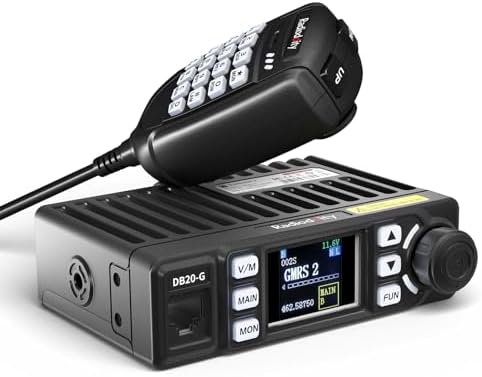
Output Power: ★★★★ (mobile GMRS radio)
Repeater Access: ★★★★ (GMRS repeaters)
Scan Receiver: ★★★★ (UHF/VHF/NOAA)
Channel Capacity: ★★★★ (9 repeater channels)
Compatibility: ★★★★★ (all GMRS radios)
Typical Radioddity DB20-G price: $159.99
The 3 GMRS Radio Comparison: Licensed Band Radios in 2026: Our Top Picks
1. BTECH GMRS-50V2 50W Repeater Radio
Editors Choice Best Overall
The BTECH GMRS-50V2 suits drivers and trail crews who need a 50-watt mobile GMRS radio with repeater access.
The BTECH GMRS-50V2 uses 50 W output, 256 customizable channels, and wideband and narrowband compatibility for licensed GMRS radio use.
Buyers who want a handheld unit will need another gmrs handheld radio, since the GMRS-50V2 is a mobile radio.
2. Radioddity DB20-G Compact GMRS Mobile
Runner-Up Best Performance
The Radioddity DB20-G suits campers and overlanders who want a microMobile radio with repeater-capable operation.
The Radioddity DB20-G supports GMRS repeaters, scans UHF, VHF, and NOAA bands, and adds 9 customizable repeater channels.
Buyers who need a handheld family gmrs radio should skip the DB20-G, since this model is a mobile unit.
3. Midland GXT1000VP4 Privacy-Code Value
Best Value Price-to-Performance
The Midland GXT1000VP4 suits families who want water-resistant walkie-talkies for neighborhood use and road trips.
The Midland GXT1000VP4 includes 50 GMRS channels, 142 CTCSS/DCS privacy codes, and NOAA weather scanning with 10 weather channels.
Buyers who want repeater access will not find a gmrs repeater radio here, because the GXT1000VP4 is a handheld pair.
Not Sure Which GMRS Radio Fits Your Team or Family Comms Best?
If you are just starting research, narrowing between two licensed GMRS radio options, or ready to buy after one last spec check, the page fits each stage. The same gmrs handheld radio search can also include buyers comparing a gmrs repeater radio, a family gmrs radio, or a repeater-capable mobile radio.
Readers who want quick number matching can start with the Comparison Grid. Readers who want feature context can use Detailed Reviews, while readers who want side-by-side specs can open the Comparison Table. Buyers still comparing use cases can move to the Buying Guide, and last-minute questions belong in the FAQ.
The shortlist used verified review volume, price spread, and feature diversity to select Radioddity DB20-G, Midland GXT1000VP4, and BTECH GMRS-50V2. Products with weak review volume or narrow feature sets were excluded, along with single-spec outliers that did not fit the three-model comparison. The final trio spans the budget and mid-tier entry points for this gmrs radio category.
The Comparison Grid gives a fast at-a-glance read on price and core features. Detailed Reviews cover repeater access, noaa weather scanning, and ctcss/dcs privacy codes in more context. The Buying Guide and FAQ handle compatibility, license questions, and feature checks, while the Comparison Table keeps the core numbers in one place. Readers who want a direct answer should start with the Comparison Grid.
In-Depth GMRS Radio Reviews: Radioddity DB20-G, Midland GXT1000VP4, and BTECH GMRS-50V2
#1. Radioddity DB20-G Mobile GMRS Radio 3-way comms value
Editor’s Choice – Best Overall
Quick Verdict
Best For: A family or trail group that wants a 12V mobile GMRS radio with repeater access and NOAA scanning.
- Strongest Point: 9 extra customizable repeater channels with CTCSS/DCS tones
- Main Limitation: The available data does not confirm transmit wattage or IP water-resistance
- Price Assessment: At $159.99, the DB20-G sits below the BTECH GMRS-50V2 and above the Midland GXT1000VP4
The Radioddity DB20-G is a $159.99 GMRS mobile radio with 9 customizable repeater channels. That setup matters because repeater access can extend practical communication beyond direct radio-to-radio coverage. The Radioddity DB20-G also scans UHF, VHF, and NOAA weather bands, which gives the radio more receive coverage than a basic handheld GMRS unit.
What We Like
Looking at the specs, the Radioddity DB20-G stands out because it combines a mobile transceiver format with scan receiver functions. The radio scans UHF, VHF, and NOAA weather, so a driver can monitor local activity and weather alerts from one unit. That combination fits overlanding crews, road-trip convoys, and family GMRS radio setups that stay in one vehicle.
The DB20-G also includes 9 extra empty GMRS repeater channels. Based on the included CTCSS and DCS tone support, the radio can be programmed for repeater access on compatible systems. That matters for buyers who use licensed GMRS radios near towns, camps, or ridge lines where a repeater can improve group coordination.
The handset microphone puts the control buttons on one piece of hardware, and that design reduces dashboard clutter. The display can sync channel name, frequency, and channel number, which helps a driver identify channels without guessing. That layout suits buyers who want a microMobile radio for 1-handed use in a truck or SUV.
What to Consider
The Radioddity DB20-G is a mobile radio, so the buyer needs vehicle power and installation space. That makes the radio a weaker fit than a handheld for hikers or passengers who want a self-contained GMRS radio 2026 option. The Midland GXT1000VP4 is the more portable pick for pure walkie-talkie use.
The available data does not list transmit wattage, water-resistance, or battery operation. That leaves some radio-shootout questions unanswered, especially for buyers comparing range claims across GMRS radios in 2026. Buyers who want a higher-spec mobile unit with clearly stated output may prefer the BTECH GMRS-50V2.
Key Specifications
- Price: $159.99
- Repeater Channels: 9
- Scan Bands: UHF, VHF, NOAA
- Repeater Tone Support: CTCSS/DCS
- Display Data: Channel name, frequency, channel number
- Control Style: Handset microphone
- Product Type: GMRS mobile radio
Who Should Buy the Radioddity DB20-G
The Radioddity DB20-G suits drivers who want a licensed GMRS radio for a truck, UTV, or camper with repeater access. It fits group travel where NOAA weather scanning and channel display details matter more than handheld portability. Buyers who need a handheld pair for short walks or campsite use should choose the Midland GXT1000VP4 instead. Buyers who want a higher-priced mobile radio with more published capability should compare the BTECH GMRS-50V2 against the DB20-G.
#2. Midland GXT1000VP4 36-Mile GMRS Pack
Runner-Up – Best Performance
Quick Verdict
Best For: Midland GXT1000VP4 fits family groups that want an 8-radio kit with NOAA weather alerts and channel scan for road trips or campsite check-ins.
- Strongest Point: 50 GMRS channels plus 142 CTCSS/DCS privacy codes create 3,124 channel options.
- Main Limitation: The JIS4 waterproof rating means splash resistance, not full submersion protection.
- Price Assessment: At $114.99, Midland GXT1000VP4 costs less than the Radioddity DB20-G at $159.99 and far less than the BTECH GMRS-50V2 at $284.89.
Midland GXT1000VP4 is a GMRS handheld radio pack with 50 GMRS channels and a stated 36-mile open-area range. The channel count gives families more GMRS channels to separate conversations, and the range figure applies only to open areas with little or no obstruction. For buyers asking what is the best GMRS radio for family use, this Midland kit fits the group-buying case better than a single-radio purchase.
What We Like
Looking at the specs, the 50 GMRS channels stand out first. Midland GXT1000VP4 pairs that with 142 CTCSS/DCS privacy codes, which creates 3,124 channel options for sorting conversations. That setup suits family groups that need simple channel separation during camping, neighborhood events, or vehicle caravans.
The 9-level EVOX feature is another useful spec. Midland GXT1000VP4 supports hands-free transmission, and the sensitivity levels let users tune voice activation instead of pressing the handset microphone every time. That matters most for drivers, spotters, and hikers who need a GMRS handheld radio with fewer button presses.
NOAA weather scan and alert add practical value for trip planning. Midland GXT1000VP4 automatically scans 10 weather band channels and alerts users of severe weather risk in the area. Families that spend time in remote campsites or on road trips should pay attention to that scan receiver behavior.
What to Consider
The JIS4 rating limits the Midland GXT1000VP4 to splash resistance, not heavy rain immersion. That makes the radio pack less suitable than a more rugged licensed GMRS radio for wet off-road work or canoe trips. Buyers comparing Midland GXT1000VP4 vs Radioddity DB20-G should also remember that the Midland unit is a handheld set, not a repeater-capable mobile radio.
The 36-mile figure is tied to open areas with little or no obstruction. That means dense trees, hills, and buildings will reduce practical range, which is normal for GMRS radios in 2026. Buyers who need a vehicle-mounted repeater access setup should look at the Radioddity DB20-G instead.
Key Specifications
- Brand: Midland
- Model: GXT1000VP4
- GMRS Channels: 50 channels
- Privacy Codes: 142 CTCSS/DCS codes
- Claimed Range: 36 miles
- Weather Channels: 10 channels
- Water Resistance: JIS4
Who Should Buy the Midland GXT1000VP4
Midland GXT1000VP4 suits families that want an 8-radio GMRS handheld radio pack for campgrounds, road trips, and neighborhood communication. The included battery packs, boom mic headsets, belt clips, and dual desktop charger support group use without extra accessory buying. Buyers who need repeater access, a vehicle install, or a microMobile radio should choose the Radioddity DB20-G instead. The main deciding factor is simple: the Midland kit offers more radios in one box, while the Radioddity DB20-G adds mobile radio flexibility.
#3. BTECH GMRS-50V2 50W Value Pick
Best Value – Most Affordable
Quick Verdict
Best For: The BTECH GMRS-50V2 fits drivers who want a 50W licensed GMRS radio with repeater access and vehicle mounting.
- Strongest Point: The BTECH GMRS-50V2 delivers 50W output, 256 customizable channels, and built-in VHF/UHF scanning.
- Main Limitation: The BTECH GMRS-50V2 is a mobile radio, so portable handheld use requires a vehicle power setup.
- Price Assessment: The BTECH GMRS-50V2 costs $284.89, which sits above the Radioddity DB20-G at $159.99.
The BTECH GMRS-50V2 is a 50W GMRS mobile radio with repeater compatibility and a built-in VHF/UHF scan receiver. That combination matters because the radio can handle GMRS channels, NOAA weather, and other receive-only channels from a vehicle install. The BTECH GMRS-50V2 also supports both wideband and narrowband channels, which broadens compatibility across licensed GMRS radios and FRS compatibility use cases.
What We Like
From the specs, the BTECH GMRS-50V2 stands out for its 50W constant GMRS output. That level is typical of a repeater-capable mobile radio, and it gives the radio a different role than a gmrs handheld radio. Buyers who want a microMobile radio for road trips or trail convoys get the most direct benefit from that power level.
The BTECH GMRS-50V2 also includes 256 customizable channels and quick add-or-remove control for GMRS and NOAA entries. Based on that channel flexibility, family groups can organize channel plans without relying on a fixed preset layout. That makes the radio useful for neighborhood communication, camping, and overlanding where a scan function and channel sorting matter.
Another strong point is the built-in VHF/UHF scan receiver. The BTECH GMRS-50V2 can add receive-only channels such as NOAA weather, and that helps answer the question of what is the best gmrs repeater radio for off-road travel. Buyers who want a licensed gmrs radio that doubles as a scanner-style receive unit will find that feature more relevant than extra cosmetic features.
What to Consider
The BTECH GMRS-50V2 is not the lowest-cost option in this comparison. At $284.89, it costs more than the Radioddity DB20-G at $159.99 and much more than the Midland GXT1000VP4 at $114.99. Buyers who only need basic GMRS talk range for short family use should look at the Midland pair instead.
The BTECH GMRS-50V2 also depends on a vehicle installation, which limits portability compared with handheld units. That tradeoff matters for buyers asking should I buy a gmrs mobile radio or handheld pair, because the mobile route favors power and repeater access over pocket carry. Buyers who need a grab-and-go family gmrs radio should skip this model and choose a handheld option instead.
Key Specifications
- Power Output: 50W
- Channel Count: 256 channels
- Channel Mode: Wideband and narrowband
- Receiver Type: VHF/UHF scanning receiver
- Compatibility: FRS and GMRS radios
- Repeater Support: GMRS repeaters
- Price: $284.89
Who Should Buy the BTECH GMRS-50V2
The BTECH GMRS-50V2 suits drivers who need a 50W GMRS radio for vehicles, trail use, or base-station-style installs. The BTECH GMRS-50V2 also fits buyers who want repeater access, NOAA weather receive capability, and a scan receiver in one unit. Buyers who want portable use should choose the Midland GXT1000VP4, and buyers who want a lower-price mobile option should compare the Radioddity DB20-G. For family road trips, the strongest deciding factor is whether 50W and vehicle mounting matter more than handheld convenience.
GMRS Radio Comparison Table: Range, Repeater Support, Channels, and Features
The table below compares GMRS radios using repeater access, GMRS channels, scan function, and NOAA weather support. These columns show the features that most affect licensed GMRS radio use, handheld versus mobile placement, and receive-only monitoring.
| Product Name | Price | Rating | Handheld vs Mobile Form | Repeater Access Support | Channel Capacity and Scanning | Privacy Codes and Squelch | Weather and Emergency Monitoring | Install and Power Requirements | Best For |
|---|---|---|---|---|---|---|---|---|---|
| Radioddity DB20-G | $159.99 | 4.6/5 | Mobile transceiver | GMRS repeater access | GMRS channels with scan function | – | NOAA weather scan receiver | Plug-and-play mobile radio | Truck and base installs |
| Midland GXT1000VP4 | $114.99 | 4.1/5 | Handheld walkie-talkie | GMRS repeater channels | 50 GMRS channels, channel scan | 142 CTCSS | JIS4 splash resistance | Rechargeable handheld radios | Family trail use |
| BTECH GMRS-50V2 | $284.89 | 4.2/5 | Mobile transceiver | GMRS repeater access | Wideband and narrowband compatible; scan receiver | – | NOAA weather receive-only channels | 50W mobile radio | High-power vehicle installs |
| Midland MXT105 | $199.99 | 4.5/5 | MicroMobile radio | – | 15 high/low power channels, channel scan | – | – | 5W mobile radio | Simple vehicle comms |
| Midland MXT115VP3 | $170 | 4.1/5 | MicroMobile radio | – | 15 high/low power channels, channel scan | – | – | 15W mobile radio | Mid-price mobile setup |
| Retevis RT97 | $534.99 | 4.3/5 | Base station repeater | GMRS relay support | – | – | – | Multiple power options | Fixed repeater sites |
| Retevis RB26 | $134.99 | 4.4/5 | Handheld walkie-talkie | – | 30 channels | – | – | 2000mAh battery, USB-C charging | Retail and campus teams |
| Retevis RA86 | $109.89 | 4.2/5 | Mobile transceiver | 8 repeater channels | 22 GMRS channels, CHIRP support | – | – | Compact mobile radio | Budget mobile installs |
| Cobra TrailBlazer 450 | $139.95 | 4.1/5 | Handheld walkie-talkie | 8 GMRS repeater channels | 22 GMRS/FRS channels | – | – | 2.5W handheld radio | Off-road family use |
| Cobra TrailBlazer 250 | $129.95 | 4.1/5 | Handheld walkie-talkie | 8 GMRS repeater channels | 22 GMRS/FRS channels | – | – | 2.5W handheld radio | Entry-level trail use |
Radioddity DB20-G leads the mobile category with GMRS repeater access and a NOAA weather scan receiver. Midland GXT1000VP4 leads the handheld set with 50 GMRS channels and 142 CTCSS codes.
BTECH GMRS-50V2 leads power at 50W, which suits vehicle installs that need a mobile transceiver with receive-only scanning. Retevis RT97 leads the repeater class because the base station design supports fixed GMRS relay use.
If channel capacity matters most, Midland GXT1000VP4 gives 50 GMRS channels at $114.99. If a mobile radio matters more, Retevis RA86 costs $109.89 and adds 22 GMRS channels with 8 repeater channels. The price-to-feature sweet spot sits with the Radioddity DB20-G, because $159.99 buys repeater access, scan function support, and NOAA weather monitoring.
Cobra TrailBlazer 250 and Cobra TrailBlazer 450 look similar at $129.95 and $139.95, but the 450 adds a different model position without changing the core channel set. Performance analysis is limited by available data for privacy-code and squelch details on several licensed GMRS radios.
How to Choose a GMRS Radio for Licensed Family and Team Communication
When I evaluate a gmrs radio, I first look at form factor, channel support, and whether the radio includes repeater access. A good licensed gmrs radio should match the user s travel pattern, because a handheld radio and a mobile transceiver solve different communication problems on the same UHF band.
Handheld vs Mobile Form
A GMRS handheld radio uses a handset microphone, a battery pack, and a compact chassis, while a mobile transceiver usually mounts in a vehicle and uses external power. Handheld sets often suit 1- to 5-mile family use, while mobile units fit convoy work, off-road travel, and neighborhood coordination where vehicle mounting matters.
Buyers who walk, camp, or split up at events usually need a handheld first. Buyers who spend time in trucks or trail rigs should prioritize a mobile radio, because a 12V install and an external antenna matter more than pocket size.
The Radioddity DB20-G is a 20W repeater-capable mobile radio at $159.99. The BTECH GMRS-50V2 is a 50W mobile transceiver at $284.89, so the higher tier suits buyers who need stronger vehicle installation options.
Repeater Access Support
Repeater access lets GMRS radios use a licensed relay station, which can extend practical coverage beyond direct radio-to-radio range. In this category, buyers should look for repeater-capable mobile radio support, clear channel pairing, and stable transmit offsets on GMRS channels.
Drivers who travel between towns usually benefit most from repeater access. Families using radios only around a campsite or a neighborhood often do fine without repeaters, because local simplex communication is simpler and faster.
The BTECH GMRS-50V2 supports repeater-capable operation with 50W output and GMRS channel programming. The Radioddity DB20-G also supports repeater use at 20W, which makes it a lower-cost entry point for buyers learning repeater access.
Repeater capability does not guarantee nearby repeaters, and local licensing rules still apply. A radio can support repeater access and still underperform if the user does not have an antenna with clean line of sight.
Channel Capacity and Scanning
Channel capacity matters because GMRS radios often combine the 22 shared GMRS channels with repeater pairs and memory slots. A useful scan function and scan receiver help users monitor traffic across family channels, trail channels, and emergency activity without changing frequencies manually.
Families who want simple communication can stay near the standard GMRS channels. Users who monitor a group ride, a campground, or a work convoy should prefer more memory and a faster scan receiver, because traffic can move quickly across multiple channels.
Mid-tier GMRS radios commonly include 22 GMRS channels plus memory storage for custom setups. More advanced models add easier scan function control, which helps users follow active channels without locking onto one channel too long.
Channel count does not tell buyers how well a radio filters noise or handles busy airwaves. A large memory list still feels limited if the scan function is slow or the squelch control is coarse.
Privacy Codes and Squelch
CTCSS and DCS are privacy codes, and both work as squelch filters rather than true encryption. These codes reduce unwanted chatter on shared GMRS channels, but other radios can still hear unfiltered traffic when the same channel is monitored.
Families sharing a channel with neighbors usually benefit from CTCSS because it filters casual interference. Teams that share one channel across several vehicles often prefer DCS when they want a slightly wider code set, but neither option replaces clear channel discipline.
The best GMRS radio for family use usually supports both CTCSS and DCS, because mixed groups often need flexible squelch settings. Buyers who only need one local conversation can choose a simpler model, but heavy code menus can slow down new users.
Privacy codes do not improve range, and they do not block all other users. A radio with strong CTCSS and DCS support can still sound busy if the channel itself is crowded.
Weather and Emergency Monitoring
NOAA weather scanning adds receive-only monitoring for weather alerts, and many GMRS radios use a dedicated weather scan receiver for this task. This feature matters most for camping, overlanding, and family emergency kits, because weather checks should not depend on a phone signal.
Users who travel in storm-prone areas should prioritize NOAA weather monitoring over extra accessories. Buyers who mainly communicate in town can treat weather scanning as a useful secondary feature, not the main reason to buy.
GMRS radios in 2026 often combine NOAA weather, alert scanning, and basic receive-only monitoring in one unit. That combination helps a family radio double as a quick emergency monitor without adding another device to the kit.
Install and Power Requirements
Install and power requirements matter because mobile radios need a stable 12V source, antenna placement, and enough space for the chassis. A handset microphone is useful in a truck cab, but the antenna and power path determine whether the radio stays usable on the road.
Battery-powered handhelds suit hikers and family kits. Vehicle-mounted buyers should choose a radio that matches the available mounting space, fuse capacity, and cable routing in the truck or UTV.
The Radioddity DB20-G and BTECH GMRS-50V2 both fit vehicle use, but the 50W BTECH unit asks for more careful power planning. Buyers asking should I buy a gmrs mobile radio or handheld pair should choose the mobile radio when vehicle range and antenna placement matter more than portability.
Installation tells buyers more than output wattage alone. A 50W radio can still disappoint if the antenna mount, coax run, or ground path is poor.
What to Expect at Each Price Point
Budget GMRS radios usually sit around $100.00 to $130.00, with basic channel memory, CTCSS, DCS, and simple NOAA weather scanning. Midland GXT1000VP4 at $114.99 fits buyers who want family comms without a vehicle install.
Mid-range GMRS radios usually run about $130.00 to $220.00, with stronger channel handling, better scan function controls, and some repeater-capable options. The Radioddity DB20-G at $159.99 fits buyers who want a repeater-capable mobile radio without paying premium prices.
Premium GMRS radios usually start near $220.00 and can reach about $300.00 or more, with 50W output, mobile transceiver form, and more installation flexibility. The BTECH GMRS-50V2 at $284.89 fits buyers who need a more serious truck or trail setup.
Warning Signs When Shopping for GMRS Radio Comparison: Licensed Band Radios
Avoid models that hide whether they support repeater access, because repeater-capable operation is a core GMRS feature for many buyers. Also avoid radios that list privacy codes without naming CTCSS and DCS, since those labels matter when comparing squelch behavior across brands. Skip units that advertise channels without stating GMRS channels versus FRS compatibility, because mixed-service claims often confuse new buyers.
Maintenance and Longevity
GMRS radios last longer when buyers inspect antenna connections and power leads every few months. Loose coax, corroded battery contacts, or a damaged handset microphone plug can cause weak transmit audio and intermittent receive problems.
Handheld owners should cycle batteries according to the pack type and replace worn packs when runtime drops noticeably. Mobile radio owners should check fuse condition and mounting screws before long trips, because vibration can loosen a cable run and interrupt power.
Related GMRS Radio Comparison: Licensed Band Radios Categories
The GMRS Radio Comparison: Licensed Band Radios market is broader than one segment, and Budget Handheld Pairs, Water-Resistant Handhelds, and High-Power Mobile Radios cover different use cases. Use the table below to match your range needs, mounting space, and operating style to the right category.
| Subcategory | What It Covers | Best For |
|---|---|---|
| Budget Handheld Pairs | Entry-level GMRS walkie-talkie bundles sold as pairs for basic family and neighborhood communication. | Families needing low-cost short-range radios |
| Water-Resistant Handhelds | GMRS handheld radios with splash resistance for camping, boating, and wet weather use. | Outdoor users facing rain and spray |
| Voice-Activated Handhelds | GMRS portables with VOX hands-free transmission for moving tasks and easier operation. | Users wanting hands-free radio operation |
| High-Power Mobile Radios | Vehicle-mounted GMRS radios with stronger transmit output, external antennas, and repeater support. | Drivers needing larger-area vehicle communication |
| Compact MicroMobiles | Small-form-factor GMRS mobile radios designed for tight dashboards and simple microphone control. | Vehicles with limited dash space |
| Repeater-Capable Radios | GMRS radios chosen for local repeater access and longer-distance communication through repeaters. | Users relying on local repeater access |
The main GMRS Radio Comparison: Licensed Band Radios review helps you compare these categories against specific radios. Use that review to narrow the choice after you identify the right subcategory above.
Frequently Asked Questions
What is a licensed GMRS radio?
A licensed GMRS radio uses the UHF band and operates on GMRS channels under an FCC license. GMRS radios commonly support repeater access, CTCSS, and DCS features for group coordination. Families and work crews often choose licensed GMRS radios when they need more structure than FRS compatibility alone provides.
Can GMRS radios use repeaters?
Most licensed GMRS radios can use repeaters when the radio supports repeater access on the correct GMRS channels. Repeater use extends local coverage through a high-site station, and many models add CTCSS or DCS tones for access control. Buyers who operate across farms, camps, or large properties usually benefit most from repeater-capable radios.
Does the Midland GXT1000VP4 need a license?
The Midland GXT1000VP4 does not need a license for FRS channels, but GMRS use requires an FCC license. Midland GXT1000VP4 is a family-oriented handheld that includes GMRS channels and FRS compatibility in one radio. Parents who want simple short-range communication often start with this model before adding repeaters.
How far will a GMRS handheld radio reach?
A GMRS handheld radio usually reaches 1 to 2 miles in towns and more in open areas. Terrain, antenna height, and squelch settings affect the actual result more than the radio label. Hikers and event staff should expect shorter range than users with a mobile transceiver or repeater access.
Is the Radioddity DB20-G worth it?
The Radioddity DB20-G is worth considering when a buyer wants a 20-watt mobile GMRS radio with repeater access. The DB20-G fits vehicle installations better than handheld use, and the mobile transceiver format usually gives better antenna placement options. Drivers who need a handset microphone in a truck or SUV may find the DB20-G more practical than a handheld.
Radioddity DB20-G vs BTECH GMRS-50V2: which is better?
The BTECH GMRS-50V2 suits buyers who want a 50-watt mobile GMRS radio, while the Radioddity DB20-G fits lower-power installs at 20 watts. BTECH GMRS-50V2 offers more transmitter output, and the DB20-G keeps the setup simpler for smaller vehicles. Drivers who need stronger vehicle-to-vehicle coverage usually favor the BTECH GMRS-50V2.
Midland GXT1000VP4 vs Radioddity DB20-G: which suits families?
The Midland GXT1000VP4 suits families better when portability matters, and the Radioddity DB20-G suits families better when a vehicle mount matters. Midland GXT1000VP4 works as a handheld, while the DB20-G is a mobile transceiver with a handset microphone. Parents who want camp-to-car communication usually prefer the handheld, and road-trip users often prefer the mobile unit.
What channels do GMRS radios use?
GMRS radios use 22 GMRS channels, and several models also share FRS compatibility on the shared low-power channels. Channel plans vary by radio, but the core GMRS set includes simplex use and repeater access on designated pairs. Buyers should confirm channel display and scan function support before comparing models.
Should I buy a mobile or handheld GMRS radio?
A mobile GMRS radio suits vehicles and fixed installs, while a handheld GMRS radio suits walking use and quick carry. Mobile units usually support larger antennas and stronger output, and handhelds trade that for portability and battery operation. Families, trail teams, and overland drivers should choose based on mounting space and communication distance.
Are GMRS radios good for emergencies?
GMRS radios work well for emergencies when cell service fails and a group needs direct voice contact. Many models include NOAA weather receive features, and scan receiver functions help users monitor active channels quickly. Households in storm-prone areas should keep charged handhelds or a vehicle-mounted radio ready for outages.
Where to Buy & Warranty Information
Where to Buy GMRS Radio Comparison: Licensed Band Radios
Buyers most commonly purchase GMRS radios online from Amazon, Walmart.com, Best Buy, Midland USA, BTECH Radios, Radioddity, and BuyTwoWayRadios.com. Online retail gives access to more model options, and brand sites such as Midland USA and BTECH Radios often show current factory configurations.
Amazon, Walmart.com, and Best Buy help buyers compare prices across handheld GMRS radios, mobile GMRS radios, and accessory bundles. Radioddity and BuyTwoWayRadios.com often list niche GMRS models that may not appear at general retailers, which helps when comparing repeater access, scan receiver features, and mounting hardware.
Physical stores like Walmart, Best Buy, Bass Pro Shops, Cabela’s, and Academy Sports + Outdoors help buyers inspect radio size, screen layout, and microphone feel before purchase. Same-day pickup also helps when a handheld GMRS radio, antenna, or charging cradle is needed for a trip or event.
Seasonal sales often appear around holiday promotions, back-to-school periods, and major shopping events. Manufacturer websites can also include direct-buy bundles, registration instructions, and accessory discounts that are not always matched by third-party sellers.
Warranty Guide for GMRS Radio Comparison: Licensed Band Radios
Typical GMRS radio warranties often run 1 year, while some mobile radios and direct-buy models may offer longer coverage. Accessory items can carry separate terms, so the radio body, microphone, antenna, clip, and charger may not share one warranty period.
Coverage length: Handheld consumer GMRS radios usually carry shorter coverage than mobile GMRS radios. Buyers should check whether the warranty starts at purchase date or registration date, because those terms change the effective coverage period.
Water-resistance exclusions: Water-resistance claims often exclude damage from immersion, impact, or an open port cover. A sealed battery compartment and closed accessory ports usually matter for warranty review.
Registration requirements: Many manufacturers require online registration or proof of purchase for support. Direct-buy brands and newer mobile GMRS radios often use these steps before replacement approval.
Service availability: Replacement parts and authorized service vary by brand and model. Niche GMRS radios can have slower turnaround when a microphone, antenna, or main unit needs repair.
Accessory coverage: Microphones, antennas, clips, chargers, and mounting hardware may have different terms from the radio body. A buyer should confirm whether a failed microphone or bracket qualifies for replacement before checkout.
Commercial use limits: Commercial, fleet, or rental use can void a consumer warranty. Buyers using GMRS radios for business communication should verify whether the manufacturer allows that use case.
Programming changes: Firmware changes, channel programming, and user modifications may fall outside warranty coverage. Factory settings usually matter when a claim involves altered menus, custom code, or nonstandard tuning.
Before purchasing, verify the warranty length, registration requirement, accessory terms, and authorized service process for the exact GMRS radio model.
Who Is This For? Use Cases and Buyer Profiles
Common Uses for GMRS Radio Comparison: Licensed Band Radios
GMRS radios serve families, outdoor crews, property owners, and new licensed operators who need licensed-band voice communication.
Power outages: Families keep GMRS handhelds charged for house-to-house contact during outages. Many GMRS models also include NOAA weather monitoring for storm alerts.
Trail convoys: Overlanding drivers use GMRS mobile radios like the Radioddity DB20-G and BTECH GMRS-50V2 for vehicle-to-vehicle contact. Those units support repeater access and stronger in-vehicle installation than a handheld alone.
Camp coordination: Campground hosts and large families use handheld GMRS radios for contact between tents, cabins, and parked vehicles. The Midland GXT1000VP4 adds scan, voice activation, and splash resistance for casual outdoor use.
Large properties: Homeowners with multi-acre properties use GMRS radios to reach a barn, workshop, and main house. Repeater-capable models and mobile units can cover more area than a typical short-range FRS pair.
Event crews: Volunteer crews use GMRS radios for parking, check-in, and runner support. The band offers licensed shared-channel communication and privacy code options for short-term team coordination.
Off-road clubs: Weekend off-road clubs use GMRS radios for common communication across different vehicles. The band supports mobile units, handhelds, and repeaters across compatible brands.
Storm alerts: Rural families use GMRS radios for weather alerts and backup communication when phone service fails. Models with NOAA scanning can monitor emergency updates while keeping family contact open.
Learning basics: New licensed operators use GMRS radios to learn channels, squelch, and repeater basics. The category includes beginner handhelds and advanced mobile radios without amateur-radio-level complexity.
Who Buys GMRS Radio Comparison: Licensed Band Radios
GMRS radios attract suburban homeowners, off-road travelers, rural property owners, event crews, hobbyists, and older adults who want simple licensed communication.
Suburban homes: Mid-30s to mid-50s homeowners buy GMRS radios for family emergency backup. The price range and repeater support on some models fit practical household planning.
Weekend travelers: Campers and Jeep or truck owners choose GMRS radios for vehicle-to-vehicle contact without cellular coverage. Mobile and handheld options can share the same band on trail trips.
Rural owners: Rural property owners and small-acreage hobby farmers buy GMRS radios to reach a barn, workshop, gate, or nearby vehicle. GMRS usually offers more range and flexibility than basic short-range consumer radios.
Event organizers: Event volunteers, youth program leaders, and community organizers use GMRS radios for short-term team coordination. The radios are easier to deploy than full professional systems and can be shared across multiple users.
Radio hobbyists: Newly licensed radio hobbyists and communication tinkerers use GMRS radios to learn repeater use and channel management. GMRS offers a simpler entry point than amateur radio with advanced features on mobile units.
Older adults: Older adults in single-family homes or retirement communities buy handheld GMRS radios for push-to-talk backup during storms. Voice operation stays simple, and charged radios fit household emergency planning.