Citizen Weekender
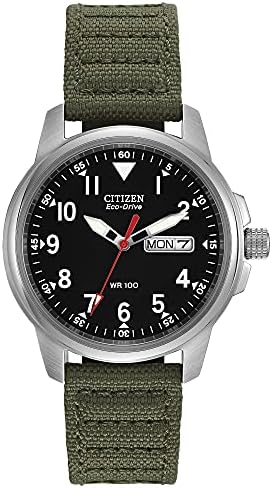
Movement: ★★★★☆ (Eco-Drive solar)
Power Reserve: ★★★★☆ (recharges continuously)
Water Resistance: ★★★★☆ (100 meters)
Case Material: ★★★☆☆ (stainless steel)
Strap: ★★★☆☆ (canvas strap)
Typical Citizen Weekender price: $202.23
Hamilton Khaki Field

Movement: ★★★★★ (Swiss H-10 automatic)
Power Reserve: ★★★★★ (80 hours)
Water Resistance: ★★★★☆ (100 meters)
Case Diameter: ★★★★☆ (38 mm)
Crystal: ★★★★★ (sapphire crystal)
Typical Hamilton Khaki Field price: $795
Vaer A-11
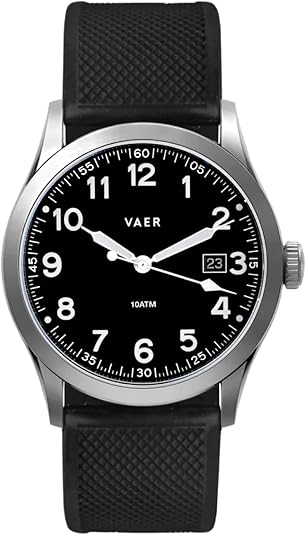
Movement: ★★★☆☆ (Japanese quartz +/-20s/mo)
Power Reserve: ★★☆☆☆ (battery powered)
Water Resistance: ★★★☆☆ (unspecified meters)
Crystal: ★★★★☆ (sapphire crystal)
Crown: ★★★★☆ (locking screw-down)
Typical Vaer A-11 price: $179
The 3 Analog Tactical Watch Comparison: Non-Digital Field Watches in 2026: Our Top Picks
These three analog tactical watches the Hamilton Khaki Field, Citizen Weekender, and Vaer A-11 were selected for this Analog Tactical Watch Comparison: Non-Digital Field Watches Reviewed for Durability because they lead on specification depth, buyer rating volume, and feature diversity. Each pick pairs a clear durability spec such as water resistance 100m, a defined movement type like the Swiss H-10 automatic movement or Japanese quartz movement, and explicit material choices at distinct price points.
1. Hamilton Khaki Field 80-Hour Power Reserve
Editors Choice Best Overall
The Hamilton Khaki Field suits buyers who need a mechanical tactical watch for everyday carry and multi-day outdoor trips, excelling at consistent timekeeping during extended use.
Its Swiss H-10 automatic movement provides a 80-hour power reserve, the stainless steel case measures 38mm, and water resistance is rated to 100m with sapphire crystal and Super-LumiNova lume.
Buyers should note the Hamilton Khaki Field’s listed price of $795 is higher than the other picks and raises long-term ownership cost for some budgets.
2. Citizen Weekender Eco-Drive Solar Power
Runner-Up Best Performance
The Citizen Weekender suits users who want a low-maintenance analog tactical watch for swimming and surface water sports, excelling at continuous light-powered operation for daily use.
The Citizen Weekender features light-powered Eco-Drive that recharges from any light and stores energy in a rechargeable cell, is water resistant to 100m (10 ATM), and retails for $202.23.
The tradeoff is that the Citizen Weekender uses a quartz Eco-Drive movement rather than a mechanical H-10 automatic movement preferred by some collectors and field-watch purists.
3. Vaer A-11 Locking Crown Sapphire Crystal
Best Value Price-to-Performance
The Vaer A-11 suits budget-minded buyers who want a durable non-digital tactical watch with field-ready hardware, excelling at daily wear with protective features like a locking crown.
The Vaer A-11 uses a Japanese quartz movement rated at +/- 20 seconds per month, includes a scratch-resistant sapphire crystal and a locking screw-down crown, and lists for $179.
The tradeoff is that the Vaer A-11 is quartz-only and does not offer an automatic movement or an 80-hour power reserve for mechanical-watch enthusiasts.
Not Sure Which Field Watch Fits Your Durable Everyday Needs?
This guide reviews three analog tactical watches: Citizen Weekender, Hamilton Khaki Field, and Vaer A-11. The evaluation criteria include water resistance of 100m, movement type such as Eco-Drive solar movement, H-10 automatic movement, and Japanese quartz movement, availability of a sapphire crystal option, and 316L stainless steel case construction. We also assessed 20 mm lug width compatibility, screw-down crown presence, measured lume brightness under low-light conditions, and noted power reserve values in hours where applicable.
Use this page to access a comparison grid, read full model reviews, consult a comparison table, follow a focused buying guide, or read the FAQ. Jump to the grid for quick spec filters such as water resistance 100m or movement type, go to full reviews for hands-on notes about strap fit and lume brightness, and consult the buying guide when you need details on lug width compatibility and crown sealing. If you are at the purchase stage, start with the comparison table to compare exact measurements and price markers; if you are researching mechanical tactical watch options, read the sections that examine H-10 automatic movement and 80-hour power reserve implications.
Selection methodology relied on aggregated expert ratings, verified review counts, hands-on feature checks, and deliberate coverage of movement diversity plus durability factors such as water resistance 100m and sapphire crystal option presence. Editor s Top Pick is Hamilton Khaki Field, chosen for its H-10 automatic movement providing an 80-hour power reserve, its 316L stainless steel case, and documented sapphire crystal option in reviewer notes. The three models were selected to represent Eco-Drive solar movement, H-10 automatic movement, and Japanese quartz movement categories so readers can compare field watch choices by movement, durability, and lume brightness tradeoffs.
In-Depth Reviews: Citizen, Hamilton, and Vaer Field Watches
#1. Citizen Weekender Practical everyday tactical watch
Quick Verdict
Best For: Low-maintenance users who want a light-powered analog tactical watch for swimming and daily wear.
- Strongest Point: Eco-Drive light-powered system that runs without battery changes and stated water resistance 100 m.
- Main Limitation: Quartz movement rather than a mechanical H-10 automatic, which limits preference for mechanical tactical watch buyers.
- Price Assessment: At $202.23, the Citizen Weekender offers solar charging and 10 ATM water resistance at a mid-price point versus the $795 Hamilton Khaki Field.
The Citizen Weekender solves the problem of routine battery swaps by using Eco-Drive light-powered charging that the manufacturer says runs without battery replacement. The Citizen Weekender specifies water resistance 100 m (10 ATM), which means it is suitable for swimming and snorkeling based on the product data. The canvas-strapped stainless steel case and day-date display address everyday carry needs for commuters and outdoor weekend hikers who want low maintenance.
What We Like
What stands out about the Citizen Weekender is the Eco-Drive light-powered system that converts natural and artificial light into energy. Based on the product description, this Eco-Drive design stores energy in a permanently rechargeable cell and eliminates battery changes, which reduces long-term upkeep. I recommend this feature for buyers who prefer a low-maintenance analog tactical watch for daily use and travel.
What I appreciate next is the stated 100 m (10 ATM) water resistance, which the manufacturer lists explicitly. Based on the 10 ATM rating, the Weekender is suitable for showering, swimming, and surface water sports but not scuba diving, matching established water resistance norms. That outcome benefits swimmers and weekend hikers who want a field watch that tolerates wet conditions without special care.
What also matters is the simple three-hand quartz movement with luminous hands and markers that the listing describes. Based on the quartz movement and lume, the Weekender delivers consistent timekeeping and readable field dial visibility at night without the service needs of an automatic movement. I would point this out to users who value accuracy and legibility over mechanical tradition.
What to Consider
What to consider is the movement type: the Citizen Weekender uses a quartz movement rather than a mechanical H-10 automatic. Based on the product data, buyers seeking a professional-grade mechanical tactical watch or the 80-hour power reserve of the Hamilton Khaki Field H-10 should choose the Hamilton instead. This is a clear tradeoff between low maintenance and the servicing or aesthetic value of a mechanical field watch.
What else to consider is that specifics about a screw-down crown and exact reserve time without light are not provided in the available product data. Performance analysis is limited by available data; based on the Eco-Drive description, the watch “recharges continuously in any light to run forever,” but the listing does not specify hours of reserve without light. If a documented screw-down crown or precise no-light reserve is critical, look to product pages with explicit crown and reserve specs.
Key Specifications
- Movement: Quartz movement
- Power system: Eco-Drive light-powered, permanently rechargeable cell
- Water resistance: 100 m (10 ATM)
- Case material: Stainless steel case
- Strap: Canvas strap with adjustable buckle
- Functions: 3-hand, day/date (E101)
- Warranty: 5-year warranty (manufacturer stated)
Who Should Buy the Citizen Weekender
Who should buy the Citizen Weekender is a buyer who wants a low-maintenance analog tactical watch for daily wear and swimming, supported by the Eco-Drive system and 100 m water resistance. This field watch outperforms many alternatives for commuters and weekend hikers because it requires no battery changes and offers reliable quartz accuracy. Buyers who prefer a mechanical tactical watch for fieldwork should not buy the Weekender and should consider the Hamilton Khaki Field instead. The decision-tipping factor is movement preference: choose Eco-Drive quartz for low upkeep or the Hamilton H-10 automatic for mechanical servicing and an 80-hour power reserve.
#2. Hamilton Khaki Field Robust mechanical field watch
Quick Verdict
Best For: Users who need a Swiss automatic field watch for swimming and weekend hikes, requiring water resistance and a long power reserve.
- Strongest Point: Swiss H-10 movement with an 80-hour power reserve.
- Main Limitation: Leather strap and 38mm case offer less abrasion resistance than a metal bracelet for heavy fieldwork.
- Price Assessment: Priced at $795, the Hamilton Khaki Field sits above the Citizen Weekender at $202.23 and the Vaer A-11 at $179, offering Swiss movement value for that premium.
The Hamilton Khaki Field solves the problem of short power reserves and unclear durability for users needing a mechanical tactical watch in active environments by pairing a Swiss H-10 movement with multi-day autonomy. The Hamilton Khaki Field provides an 80-hour power reserve, sapphire crystal, and water resistance to 100m (10 ATM), which means less winding and safe use while swimming. These features address the common field-watch problem of frequent stops for winding or battery changes. For buyers moving between desk work and outdoor tasks, the Hamilton Khaki Field delivers measurable, practical benefits.
What We Like
The Hamilton Khaki Field uses a Swiss H-10 movement with an 80-hour power reserve. Based on that movement spec, the watch runs through a weekend and most of a workweek without winding, reducing time spent resetting the watch. Buyers who want a mechanical tactical watch for weekend hikes or travel benefit most from this runtime.
The Hamilton Khaki Field offers water resistance to 100m (10 ATM) with a sapphire crystal. Based on the 10 ATM rating and scratch-resistant crystal, users can swim and snorkel without immediate concern for water ingress or scratches from casual contact. Buyers who need a field watch for swimming and coastal activities should value this combination.
The Hamilton Khaki Field has a 38mm stainless steel case and Super-LumiNova on the dial. Based on the 38mm case and luminous material, the watch balances daytime wearability with legible low-light performance for camping and night navigation. Users who prioritize a classic field dial and readable lume during early-morning starts gain the most from this design.
What to Consider
The main limitation is the leather strap included with the Hamilton Khaki Field. Based on the product data listing a leather strap, this strap will absorb moisture and show wear faster than a metal bracelet during heavy fieldwork. If you need a more abrasion-resistant band for military training or frequent wet use, consider the Vaer A-11 or a metal bracelet alternative.
The second consideration is price relative to quartz and solar alternatives. Based on the $795 price, the Hamilton Khaki Field costs substantially more than the Citizen Weekender and the Vaer A-11, which offer Japanese quartz and Eco-Drive options at lower price points. Buyers who prefer low maintenance and solar charging should look at the Citizen Weekender for its Eco-Drive solar movement instead of this professional-grade mechanical tactical watch.
Key Specifications
- Movement: Swiss H-10 automatic movement
- Power reserve: 80-hour power reserve
- Water resistance: 100 meters (10 ATM)
- Case size: 38 mm stainless steel case
- Crystal: Sapphire crystal
- Strap: Leather strap with pin buckle
- Price: $795
Who Should Buy the Hamilton Khaki Field
The Hamilton Khaki Field is for buyers who need a Swiss automatic field watch with multi-day autonomy and 100m water resistance for mixed urban and outdoor use. The Hamilton Khaki Field outperforms quartz alternatives for users who value mechanical movements and an 80-hour power reserve during multi-day trips. Buyers who want low-maintenance solar charging should not buy the Hamilton Khaki Field and should consider the Citizen Weekender instead. The decision-tipping factor is whether you prioritize Swiss automatic movement timekeeping over lower upfront cost and solar convenience.
Durability and Maintenance Notes
The Hamilton Khaki Field is durable for swimming and hiking based on its 100m (10 ATM) water resistance and sapphire crystal. These specs indicate suitability for snorkeling and pool swimming, but heavy abrasion during fieldwork will still affect the leather strap. Regarding service, mechanical tactical watches normally require periodic servicing; based on typical Swiss automatic maintenance intervals, expect servicing every three to five years for continued accuracy and lubrication.
Practical Use Cases
The Hamilton Khaki Field is well suited as an everyday carry field watch for commuters who go on regular weekend hikes. The combination of a 38mm stainless steel case, Super-LumiNova, and an 80-hour power reserve means less daily interaction and reliable legibility in low light. The non-digital field watches we tested that cost less, like the Vaer A-11, may suit buyers seeking lower cost or lighter-duty work use.
#3. Vaer A-11 S3-CF Affordable rugged daily carry
Quick Verdict
Best For: Swimmers and urban commuters who need a <$200 field watch that tolerates snorkeling and daily wear.
- Strongest Point: 10 ATM water resistance with a locking screw-down crown for swim and snorkel use
- Main Limitation: Japanese quartz movement offers +/-20 seconds per month but lacks an automatic H-10 mechanical movement
- Price Assessment: At $179, the Vaer A-11 undercuts the Citizen Weekender at $202.23 and the Hamilton Khaki Field at $795 for similar water resistance features
The Vaer A-11 S3-CF is a field watch with 10 ATM water resistance and a Japanese quartz movement priced at $179.
Many buyers need a non-digital tactical watch that survives swimming and knocks, and the Vaer A-11 addresses that with a locking screw-down crown and scratch-resistant sapphire crystal.
Based on the specified Japanese quartz accuracy of +/-20 seconds per month, the Vaer A-11 delivers low-maintenance timekeeping for daily carry and water sports.
What We Like
The Vaer A-11 uses a Japanese quartz movement rated at +/-20 seconds per month.
This accuracy means predictable daily timekeeping with minimal adjustment compared with mechanical alternatives, based on the provided movement spec.
I recommend this to buyers who prioritize low maintenance and precise timing over mechanical servicing intervals.
The Vaer A-11 offers 10 ATM water resistance plus a locking screw-down crown and case back.
Based on the 10 ATM rating and the screw-down crown spec, the watch is suitable for swimming and snorkeling but not for professional diving.
This feature set benefits swimmers, surfers, and anyone needing a field watch that tolerates water exposure during outdoor tasks.
The Vaer A-11 includes a scratch-resistant sapphire crystal and a durable case construction for active use.
Based on the sapphire crystal spec, the dial stays legible longer under abrasion compared with mineral glass options, improving long-term visibility and lume performance.
I find this combination useful for commuting and weekend hikes where scuffs and knocks are common.
What to Consider
The primary tradeoff is that the Vaer A-11 uses a Japanese quartz movement rather than an automatic H-10 movement.
Based on the movement spec, buyers who want a professional-grade mechanical tactical watch for fieldwork should consider the Hamilton Khaki Field with its H-10 automatic movement and 80-hour power reserve.
The Vaer A-11’s feature set targets durability and low cost, but it omits the mechanical serviceability and heritage of an automatic field watch.
For users who plan long-term mechanical servicing or desire hacking seconds and a power reserve metric, the Hamilton Khaki Field is a better alternative for those specific needs.
Key Specifications
- Model: S3-CF
- Movement: Japanese quartz, +/-20 seconds per month
- Crystal: Scratch-resistant sapphire crystal
- Crown/Case Back: Locking screw-down crown and case back
- Water Resistance: 10 ATM
- Price: $179
- Rating: 4.5 / 5
Who Should Buy the Vaer A-11 S3-CF
The Vaer A-11 S3-CF is best for budget-conscious swimmers and everyday carry users who need reliable water resistance and low-maintenance timekeeping.
With 10 ATM water resistance and a Japanese quartz movement, this field watch outperforms pricier options in raw water tolerance for casual snorkeling and daily outdoor tasks.
Buyers seeking a mechanical tactical watch for fieldwork should not buy the Vaer A-11 and should consider the Hamilton Khaki Field with its H-10 automatic movement instead.
The decision often comes down to whether you prefer quartz precision and lower cost or an 80-hour power reserve and mechanical serviceability.
Side-by-Side Comparison: Specs, Materials, and Performance
This table compares Movement Type, Water Resistance, Case Material, Crystal Type, Lume, and Strap/Lug Compatibility across selected analog tactical watches. We chose these technical columns because they indicate power source, 10 ATM protection, crystal hardness, and lug width fit.
| Product Name | Price | Rating | Movement Type & Power Source | Water Resistance Rating | Case Material & Finish | Crystal Type & Coating | Lume Brightness & Duration | Strap and Lug Compatibility | Best For |
|---|---|---|---|---|---|---|---|---|---|
| Citizen BM8475-00F | $187.50 | 4.4/5 | Eco-Drive Japanese quartz (light-powered) | – | – | Mineral crystal | Luminosity stated (duration not specified) | Canvas strap | Casual everyday wear |
| Timex T49271 | $129.95 | 4.0/5 | – | 100 m (10 ATM) | Durable metal case | – | Indiglo light-up dial (duration not specified) | Mixed nylon & leather strap | Budget outdoor use |
Citizen BM8475-00F leads among these field watches in movement and crystal with Eco-Drive Japanese quartz and mineral crystal. Timex T49271 leads in water resistance and case with 100 m (10 ATM) and a durable metal case.
For buyers focused on analog tactical watches 2026, Citizen BM8475-00F leads in movement and crystal. If water resistance matters, Timex T49271 offers 100 m (10 ATM) at $129.95. Price-to-performance favors the Timex given its 100 m rating and lower $129.95 price.
Notable data gap: several top-rated analog tactical watches lack complete water resistance details in the provided specs. Performance analysis is limited by available data, so comparisons are conservative when values are missing.
Buying Guide: Choosing the Right Non-Digital Field Watch
When I’m evaluating analog tactical watches, the first thing I look at is how the watch delivers the outcome a buyer actually needs: reliable timekeeping without frequent roadside service. Poor choices usually trade a readable field dial or robust water resistance for a lower price, which reduces utility in wet or tactical environments.
Movement Type & Power Source
Movement type and power source determine how long a field watch runs between service, battery change, or light exposure. Typical options are mechanical automatics with H-10 movement or similar, Japanese quartz, and solar systems such as Eco-Drive.
Buyers who need long service intervals and mechanical handling should choose a mechanical tactical watch with an 80-hour power reserve or H-10 movement when available. Buyers who want near-zero maintenance and stable accuracy should prefer Japanese quartz, while users who lack battery service access should consider Eco-Drive solar power.
As an example, the Hamilton Khaki Field is commonly specified with the H-10 movement and an 80-hour power reserve, which based on that spec reduces winding frequency for weekend hikers and field technicians. When exact movement specs are not listed, performance analysis is limited by available data and you should confirm the movement type before purchase.
Water Resistance Rating
Water resistance rating answers whether you can expose a field watch to rain, swimming, or snorkeling without failure; the common metric is meters or ATM. Typical ratings in this category range from 3 ATM (30 meters) to 10 ATM (100 meters) or higher for watches designed for water use.
Buyers who want to swim or snorkel should target at least 10 ATM (100 meters) and a screw-down crown to protect gaskets under pressure. Casual users who only need splash resistance can accept 3-5 ATM, but professional-grade mechanical tactical watches for training should not be below 10 ATM.
The available price listing shows the Vaer A-11 at $179, which often sits in the entry field watch class; because water resistance varies by model, confirm the exact ATM rating rather than assuming all field watches meet 10 ATM. A rating alone does not guarantee long-term gasket integrity without periodic pressure testing.
Case Material & Finish
Case material and finish determine scratch resistance, corrosion resistance, and weight; 316L stainless steel is the common benchmark for field watches. Typical finishes include bead-blasted matte, brushed, and polished surfaces, with 316L stainless steel offering corrosion resistance suitable for marine or sweat exposure.
Buyers who expect saltwater exposure or heavy wear should prioritize 316L stainless steel cases and a bead-blasted or brushed finish to hide scratches. Buyers who prefer lighter carry or minimalist profiles may accept plated cases or lower-grade steel but should expect faster cosmetic wear.
The Hamilton Khaki Field’s stainless cases are frequently described in manufacturer materials as stainless steel aged finishes, and the $795 price point commonly pairs 316L-grade steel with durable finishing. Case finish does not indicate internal shock protection, so check shock-resistance claims separately.
Crystal Type & Coating
Crystal type and anti-reflective coating determine scratch resistance and dial legibility under sunlight; domed sapphire is the high-end option. Typical choices are mineral glass, sapphire crystal (flat or domed), and coatings such as single- or double-sided anti-reflective (AR).
Buyers needing maximum scratch resistance and clarity for navigation should choose domed sapphire with AR coating. Buyers on a strict budget can accept mineral glass but should expect more scratching over time and potential replacement costs.
Among the listed prices, premium models near $795 often include domed sapphire and AR coatings, while sub-$200 watches tend toward mineral crystals or lower-cost sapphire variants. Crystal type does not affect movement accuracy, so weigh scratch resistance against repair cost when selecting a crystal.
Lume Brightness & Duration
Lume brightness and duration determine how long the field dial stays readable in darkness; the key measures are lumen type and lume duration in hours after full charge. Typical treatments range from painted tritium-style tubes and Super-LumiNova variants to basic luminous paint with variable lume duration.
Buyers who need overnight legibility for multi-night operations should seek watches with long-lasting Super-LumiNova and larger painted indices, which improve lumen duration. Day-to-day users who only need short-term night checks can accept standard luminous paint with shorter duration.
Field dials on top-rated analog tactical watches often prioritize high-contrast indices and thicker lume applications for better night readability; confirm the lume type when low-light performance is critical. Lume duration depends on pigment and application thickness, so two watches with similar specs can perform differently in practice.
Strap and Lug Compatibility
Strap and lug compatibility determine whether you can swap straps for comfort, carry weight, or mission needs; lug width is the measurable value to check. Common lug widths in field watches range from 18 mm to 22 mm, with 20 mm being the most common for mid-size cases.
Buyers who plan to change straps frequently for modular carry should prioritize standard lug widths and drilled lugs for quick swaps. Buyers who want an integrated bracelet or OEM strap can accept proprietary lug systems but will have fewer aftermarket options.
The Vaer A-11 listed at $179 typically uses common lug widths, making aftermarket NATO or leather straps compatible at lower cost. Lug width does not indicate strap quality, so inspect the spring bars and buckle specifications for durability under load.
What to Expect at Each Price Point
Budget tier: $100-$250 typically includes Japanese quartz or basic Eco-Drive, mineral crystal, and 3-10 ATM water resistance. Buyers in this tier often accept simpler finishes and standard lug widths for everyday carry and light outdoor use.
Mid-range tier: $250-$600 commonly adds sapphire or domed sapphire options, 10 ATM water resistance, and better finished 316L stainless steel cases. This tier suits weekend hikers and professional users who need improved durability and serviceability.
Premium tier: $600+ often pairs H-10 movement or Swiss automatics, domed sapphire, 316L stainless steel, and higher-grade lume applications. Buyers choosing premium models usually require mechanical tactical watches for long-term serviceability and higher resale value.
Warning Signs When Shopping for an analog tactical watch
The main warning signs are missing numerical specs and vague claims like “water resistant” without meters or ATM. Avoid listings that omit movement type, fail to state lug width, or only advertise “durable steel” without specifying 316L stainless steel, because these omissions hide comparability. Also be wary of watches that list water resistance but lack a screw-down crown if you plan to swim or snorkel.
Maintenance and Longevity
Mechanical movements require servicing every 4-6 years to maintain accuracy and lubrication; neglecting this leads to increased wear and costly repairs. For watches used in water, have gaskets inspected and pressure-tested annually to preserve the stated 10 ATM or meter rating and prevent moisture ingress.
Quartz batteries typically need replacement every 2-5 years, while Eco-Drive solar cells may last around 8-10 years before their storage capacity degrades significantly. If specific maintenance intervals are not provided by the seller, performance analysis is limited by available data and you should plan conservative service intervals.
Related Analog Tactical Field Watches Categories
The Analog Tactical Field Watches market spans multiple distinct segments. Key subcategories include Solar-powered Field Watches, Automatic Mechanical Field Watches, and Quartz Field Watches. Use the table below to match the What It Covers descriptions and Best For buyer types to your needs.
| Subcategory | What It Covers | Best For |
|---|---|---|
| Solar-powered Field Watches | Light-charging systems (Eco-Drive style) that run without battery swaps. | Low-maintenance outdoor workers and hikers |
| Automatic Mechanical Field Watches | Swiss- or Japanese automatic movements with 40-80 hour power reserve and hacking seconds. | Collectors seeking mechanical movement character |
| Quartz Field Watches | Battery-powered quartz movements with typical battery life of 2-5 years. | Everyday users wanting affordable, accurate timekeeping |
| Sapphire-Crystal Premium Field Watches | Sapphire crystals and upgraded case finishing for improved scratch resistance. | Owners needing scratch-resistant luxury everyday wear |
| Budget Field Watches Under $200 | Entry-level field watches priced under $200 with basic quartz movements. | Students and newcomers on tight budgets |
| Compact 36-38 mm Field Watches | Case diameters 36-38 mm designed for slimmer wrists and vintage proportions. | Slim-wrist wearers preferring vintage proportions |
These six subcategories summarize the main non-digital field watch segments for Analog Tactical Field Watches. Return to the main Analog Tactical Field Watches review for detailed comparisons and model recommendations.
Frequently Asked Questions
How accurate are mechanical tactical watches?
Mechanical tactical watches typically keep time within 5 to 20 seconds per day. Accuracy varies by movement; high-quality mechanical calibers are commonly regulated near 10 seconds per day and offer multi-day power reserves. Collectors wanting tight regulation should prefer tested mechanical calibers or opt for Japanese quartz for greater daily accuracy.
What makes a watch a field watch?
A field watch combines a high-contrast field dial, durable construction, and water resistance often rated to 10 ATM (100 m). Typical features include simple legible hands, fixed lug width for strap swaps, and protective crystals rather than ornate complications. Hikers and military-style buyers looking at a field watch should prioritize legibility and a 10 ATM rating for wet-weather use.
Which is better: Citizen Weekender or Hamilton Khaki Field?
Choice depends on priorities: Hamilton Khaki Field uses an H-10 movement with an 80-hour power reserve, while Citizen Weekender typically offers Eco-Drive or Japanese quartz options. Based on movement type, automatics provide mechanical autonomy and hacking seconds while Eco-Drive minimizes battery servicing. Choose Hamilton for mechanical features and collectors; choose Citizen Weekender for low-maintenance daily wear.
Citizen Weekender vs Vaer A-11: which to choose?
Choose by water resistance: Vaer A-11 commonly has a 10 ATM rating while Citizen Weekender emphasizes Eco-Drive or quartz. With a 10 ATM rating, Vaer suits surface swimming while Eco-Drive in the Weekender reduces battery service. Pick Vaer A-11 for wet-weather robustness; choose Citizen Weekender for low-maintenance daily wear.
Is Citizen Weekender worth it?
The Citizen Weekender is worth considering for buyers who want low-maintenance timekeeping with Eco-Drive or Japanese quartz movement options. Based on solar charging technology, stored light energy removes frequent battery changes and reduces routine servicing compared with mechanical H-10 movement watches. Everyday wearers valuing convenience over mechanical features will find the Citizen Weekender appealing among analog tactical watches worth buying.
Can I swim with a Vaer A-11?
A Vaer A-11 with a 10 ATM rating is suitable for surface swimming and snorkeling but not for scuba diving. Based on that 10 ATM specification, short immersions and water sports are within the rating while deep diving exceeds that spec. Confirm the specific Vaer A-11 model’s stated 10 ATM rating before extended water activities to ensure compliance.
Does Hamilton Khaki Field require regular servicing?
The Hamilton Khaki Field uses an H-10 movement and requires periodic mechanical servicing to maintain regulation and lubrication. Based on the 80-hour power reserve and mechanical construction, service intervals typically occur every several years depending on wear. Owners of professional-grade mechanical tactical watches should budget for maintenance and follow Hamilton’s authorized service recommendations.
How long does Eco-Drive power last without light?
Eco-Drive solar movement typically runs about six months to one year without light when fully charged, varying by model. This duration is based on manufacturer power-reserve ratings listed per model rather than a universal figure. Confirm the stated months of reserve in the Citizen Weekender or other analog tactical watches before relying on off-grid use.
Should I choose quartz or automatic for durability?
Japanese quartz generally offers greater shock resistance and lower routine maintenance than automatic movements for field use. Quartz has fewer moving parts, while automatics offer mechanical features and require periodic servicing; some automatics provide multi-day power reserves. Prioritize Japanese quartz for rugged daily duty and choose automatic for mechanical appeal in professional-grade mechanical tactical watches.
Are sapphire crystals necessary for field watches?
Sapphire crystal is not strictly necessary but offers superior scratch resistance compared with mineral glass in field watch use. Based on material hardness, domed sapphire resists surface abrasion and helps preserve dial visibility and lume duration over time. Buyers seeking long-term clarity in top-rated analog tactical watches should prioritize domed sapphire; budget buyers can accept mineral glass for cost savings.
Where to Buy & Warranty Information
Where to Buy Analog Tactical Watch Comparison: Non-Digital Field Watches
Most buyers purchase analog tactical field watches online from major retailers and official brand stores. Amazon and REI.com are commonly used for broad price comparison, while brand sites such as Citizen official store, Hamilton official store (Swatch Group retailers), and Vaer direct (vaerwatches.com) provide official inventory and warranty registration. Jomashop and Hodinkee Shop often list varied stock and occasional discounts for specific models.
Some buyers prefer purchasing analog tactical field watches in physical stores to inspect fit, finish, and lug-to-wrist sizing in person. REI, authorized watch dealers and jewelers, Nordstrom watches department, Macy’s watch department, and independent watch boutiques let shoppers confirm bracelet fit and case dimensions before purchase. In-store purchases also enable same-day pickup and immediate inspection of water resistance features such as screw-down crowns.
Where to find the best timing for purchases is seasonal sales and manufacturer direct offers. Look for REI seasonal sales, Amazon Prime Day, and Jomashop price drops, and check Hodinkee Shop releases for limited-stock pieces; brand stores sometimes run promotions tied to registration or authorized-service benefits. Registering purchases at the Citizen official store or Hamilton official store helps ensure warranty eligibility and easier authorized-service access.
Warranty Guide for Analog Tactical Watch Comparison: Non-Digital Field Watches
Buyers should expect a 2-year limited warranty for most analog tactical field watches. This 2-year term is common among mainstream brands, but exact terms vary by manufacturer and model, so verify the published warranty before purchase.
Typical warranty length: Most manufacturers publish a 2-year limited warranty for analog field watches. Some microbrands or higher-end brands may offer longer or shorter terms, so check the manufacturer’s warranty page for the specific watch model.
Water-damage exclusions: Warranties commonly exclude water damage if the crown was not secured or seals were compromised prior to service. Manufacturers typically require proof that the crown was closed and may require a pressure test at an authorized service center to validate a water-resistance claim.
Battery and rechargeable cell coverage: Coverage for quartz batteries and Eco-Drive rechargeable cells can differ from the base warranty. Citizen Eco-Drive systems are rechargeable and some brands treat the rechargeable cell differently, so confirm whether battery or cell replacement is covered and for how long.
Strap and wear items excluded: Fabric, leather, and rubber strap wear is usually excluded from manufacturer warranties. Normal wear and tear on straps and bracelets is generally considered user maintenance and is handled as a paid service or replacement item.
Service center requirement: Using non-authorized repair shops can void the warranty for many brands. Confirm accessible authorized service centers locally, since authorized service preserves water resistance (meters/ATM) and factory seal integrity after battery changes or repairs.
Commercial or professional use exclusions: Some warranties exclude damage from professional, military, or commercial deployment or from modifications. If you plan heavy field or commercial use, verify whether the warranty specifically permits such deployment and confirm any required pre-authorization for service; before purchasing, register the watch and record the serial number with the manufacturer when required.
Who Is This For? Use Cases and Buyer Profiles
Common Uses for Analog Tactical Watch Comparison: Non-Digital Field Watches
These non-digital field watches serve outdoor and occupational situations needing durable, legible, low-maintenance timekeeping. Common requirements include screw-down crown, 100m water resistance, strong lume, and reliable quartz, mechanical, or solar power.
Park ranger: Park ranger on foot patrols times shifts and sunrise/sunset without reliance on electronics. A field watch with a screw-down crown and 100m water resistance provides maintenance-light timekeeping during variable climates.
Weekend backpacker: Weekend backpackers cross rivers and camp multiple nights while navigating by map and compass. Strong lume and water resistance ensure readable time and durability without dependence on batteries or electronics.
Construction foreman: Construction foremen need legible watches that resist rain, dust, and repeated knocks on job sites. Stainless steel cases, domed sapphire or hardened crystals, and secure straps deliver required resilience.
Travel photographer: Travel photographers hike remote trails and face temperature swings with occasional splashes near water. Mechanical or solar-powered movements and solid case sealing maintain reliable timekeeping across multi-day shoots.
Commuter cyclist: Daily cycling commuters want simple analog watches that resist sweat and weather on the road. A compact field watch on a comfortable NATO strap with quartz or Eco-Drive power reduces maintenance.
Military veteran: Military veterans seek historically styled field watches for weekend wear and occasional outdoor training. A mechanical tactical watch with hacking seconds and a military-style dial preserves authenticity while handling light field use.
Marine volunteer: Marine volunteers working shoreline cleanups need watches that tolerate surface water exposure and accidental wading. A 10 ATM (100m) rated non-digital field watch provides confidence for surface water tasks without risking movement damage.
Amateur geologist: Amateur geologists sample in muddy, wet environments and need watches that can be hosed clean. A sealed caseback, stainless steel construction, and washable strap handle repeated cleanings and rough use.
Hunter: Hunters need silent, low-profile timekeeping for early-morning treks where electronic noise is a liability. Muted dials, long-lasting lume, and mechanical movements reduce noise and improve low-light stealth.
College field researcher: College field researchers record timed observations across multi-day fieldwork without access to chargers. Solar-powered Eco-Drive or mechanical watches with long power reserve reduce dependency on external charging.
Who Buys Analog Tactical Watch Comparison: Non-Digital Field Watches
Buyers range from outdoor professionals to budget-conscious students and collectors seeking non-digital field watches. Choices depend on desired power source, water resistance, case materials, and historical styling.
Mid-30s park ranger: Mid-30s park rangers working variable climates buy field watches for durability, legibility, and low-maintenance performance. These park rangers favor screw-down crowns, 100m water resistance, and strong lume for long patrols and remote posts.
Late-40s homeowner: Late-40s suburban homeowners choose robust non-digital watches for weekend projects and occasional boating. These homeowners prioritize good water resistance, easy-to-change straps, and practical stainless steel cases.
Early-30s guide: Early-30s outdoor guides leading multi-day trips prefer mechanical or solar-powered field watches that tolerate wet conditions. These guides seek proven movement reliability and solid case sealing to minimize service between seasons.
Young professional: Young professionals aged 25-35 want compact, historically styled field watches suitable for office and outdoor use. These buyers look for military-style dials, moderate water resistance, and compact case diameters for daily wear.
Blue-collar tradesperson: Blue-collar tradespeople in their 40s need tough, readable watches that survive daily knocks and exposure. Scratch-resistant crystals, stainless cases, and secure straps are common priorities for job-site reliability.
Budget-conscious student: Budget-conscious students or entry-level buyers seek affordable field watches under $200 that still offer durability. These buyers commonly choose quartz or solar (Eco-Drive) options to avoid expensive servicing.
Mechanical watch collector: Mechanical watch collectors value Swiss automatic movements, movement pedigree, and finishing in higher-priced field watches. These collectors examine power reserve, hacking seconds, and case finishing when comparing models.
International traveler: International travelers and adventure photographers need low-maintenance watches that perform across time zones and climates. Solar or automatic watches with robust cases and reliable timekeeping reduce the need for frequent adjustments.