You need a beam distance between 10m and 100m depending on whether you are working in a confined shop or navigating a large outdoor area. For most industrial and outdoor tasks, a beam distance of at least 30m provides the necessary reach to illuminate a workspace without requiring a constant change in position.
Recommended Beam Distance for Projector Headlamps by Use Case
| Use Case | Recommended Beam Distance | Why this number |
|---|---|---|
| Workshop Maintenance | 10m – 20m | Short range allows for a wider flood of light on a nearby workbench or engine block. |
| General Navigation | 30m – 50m | Provides sufficient reach to see obstacles and paths in standard outdoor environments. |
| Search and Rescue | 50m – 100m+ | Long-range reach is required to identify targets or hazards at a distance. |
| Construction Site Work | 20m – 40m | Balances the need to see high-up structures with the need to illuminate the immediate ground. |
| Remote Scouting | 100m+ | Maximized reach is necessary for identifying landmarks or large-scale terrain features. |
Reviewed examples from this category
From $100.95 to $274.95: the 3 in this category we have reviewed in full.
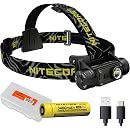
Nitecore HC60 v2
$102.51 price checked August 2026
Read our full Nitecore HC60 v2 review
You can also compare the best headlamp with bluetooth app control to see how different models handle remote features.

Petzl Swift RL Lamp Orange
$100.95 price checked August 2026
Professionals requiring heavy-duty lighting should view our list of high lumen headlamps for work.
Risks of Under-Provisioning or Over-Buying Beam Distance
Under-provisioning occurs when the beam distance is too short for the intended environment, forcing the user to move closer to the object of focus. If you choose a headlamp with a 10m beam distance for a large warehouse, you will find yourself constantly repositioning your head to see the far side of a room. This leads to physical fatigue and can create safety hazards where the user must enter areas that are not properly illuminated.
Safety Hazards of Short Beam Distance
When the beam distance is insufficient, shadows become more prominent and the edges of the work area remain dark. In industrial settings, this lack of reach can hide tripping hazards or moving machinery. A headlamp that cannot project light far enough to clear a workspace creates a “tunnel vision” effect where only the immediate 2 meters are clear, leaving the surrounding environment invisible.
Over-buying beam distance involves selecting a headlamp with extreme long-range capabilities that are unnecessary for the specific task. While a 100m beam distance is impressive, it often comes at the cost of a narrow beam width. If you are primarily working on a car engine, a beam that is designed to throw light 100m away will likely produce a very thin “hotspot” that illuminates a small circle on the hood while leaving the rest of the engine bay in shadow.
The Trade-off Between Distance and Beam Width
High beam distance figures often indicate a narrow, concentrated beam. If you over-buy this spec for a workshop, you may find the light is too focused to be useful. A beam designed for long distance will scatter less as it travels, meaning it stays tight. For tasks requiring a broad area of visibility, a lower beam distance with a wider flood pattern is more effective than a high-distance beam that only hits a single point.
To ensure your gear survives the elements, learn about the proper IP rating for headlamps.
The Mistake of Prioritizing Beam Distance Over Beam Quality
The most common mistake buyers make is assuming a higher beam distance number automatically equates to a brighter or better-lit workspace. Beam distance is a measure of reach, not the intensity of light at the point of impact. A headlamp can have a 50m beam distance, but if the lumen output is low, the light at 5m might still be too dim to see fine details.
Understanding Lumens vs. Distance
You should optimize for the amount of light hitting your target, which is a function of both the lumen output and the beam’s concentration. A headlamp with a 30m beam distance and 1000 lumens will provide a much more usable workspace than a headlamp with a 50m beam distance and only 300 lumens. If your work is within 10m, a high beam distance is a wasted spec; you should instead look for a high-lumen count with a wide flood setting.
How Beam Distance Interacts with Other Projector Headlamp Specs
Beam distance is heavily influenced by the optics and the battery’s ability to maintain power under load. If a headlamp is pushed to its maximum beam distance, the internal components may experience thermal throttling, which reduces the brightness of the light. This means a headlamp might claim a high beam distance on a spec sheet, but the actual usable brightness at that distance may be insufficient for practical use.
Impact of Thermal Throttling on Reach
Projector headlamps with high-output LEDs generate significant heat. If the cooling system cannot dissipate this heat quickly, the device will automatically dim the LEDs to prevent damage. This thermal throttling can occur during sustained use, meaning the beam distance you rely on for a long task might degrade after several minutes of operation. When evaluating reach, consider the heat management and the weight of the unit, as heavier units often have better heat sinks to maintain consistent output.
Battery Sag and Beam Consistency
The power draw required to project light over long distances can cause battery sag, where the voltage drops under a heavy load. This can result in flickering or a noticeable dimming of the beam as the battery depletes. For applications requiring consistent beam distance, the battery chemistry and its capacity are just as important as the optic’s ability to throw light. A headlamp with a high beam distance is only useful if the battery can sustain that power draw for the duration of your task.