For most standard uses, you should look for a projector headlamp with a battery capacity between 2,000 mAh and 5,000 mAh. The specific amount you need depends entirely on the brightness level you plan to run and the duration of your activity.
Projector Headlamp Battery Capacity Requirements by Use Case
| Use Case | Recommended Battery Capacity | Why this number |
|---|---|---|
| Short duration tasks (30-60 minutes) | 1,000 mAh to 2,000 mAh | Small capacities are sufficient for quick tasks like checking a path or short household repairs. |
| Standard hiking or camping (2-4 hours) | 3,000 mAh to 5,000 mAh | These capacities provide a reliable buffer for several hours of steady use at moderate brightness. |
| Extended backcountry use (5+ hours) | 6,000 mAh to 10,000 mAh | High-capacity cells are required to maintain consistent output over long distances or overnight trips. |
| High-output professional use | 8,000 mAh+ | High-lumen projector headlamps drain power rapidly; large capacities prevent dimming during critical work. |
Products in this category with a full review here
These 3 have their own full review on this site, and run from $102.51 to $169.58.


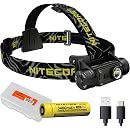
Nitecore HC60 v2
$102.51 price checked August 2026
Read our full Nitecore HC60 v2 review
If you want to customize your settings via your phone, compare the best headlamp with bluetooth app control to see which model fits your needs.
What happens if you under-provision or over-buy Battery Capacity?
Under-provisioning occurs when the battery capacity is too low for your intended activity, leading to premature power failure or “battery sag.”
The risk of battery sag
Battery sag happens when the voltage drops under a heavy load, causing the headlamp to flicker or dim before the battery is actually empty. If you choose a low mAh rating for a high-output projector headlamp, the device may struggle to maintain a steady beam, resulting in inconsistent visibility during the most critical moments of your task.
Sudden power cutoff
When the capacity is insufficient for the duration of your work, the headlamp will simply shut off. This creates a safety hazard in low-light environments where you rely on the light to navigate obstacles or identify hazards. You should ensure the mAh rating supports your longest expected task with at least a 20% reserve.
Over-buying battery capacity carries its own set of practical trade-offs that many shoppers overlook.
The weight penalty of large batteries
Battery capacity is directly tied to physical weight. A headlamp with a 10,000 mAh battery is significantly heavier than one with 2,000 mAh. This extra weight sits on your head, which can cause neck strain and discomfort during extended use. If you only need the light for an hour, carrying an extra 200 grams of battery weight is an unnecessary physical burden.
Heat and charging constraints
Larger batteries can generate more heat during rapid charging or high-drain usage. Furthermore, high-capacity batteries often require longer charging times. If you are on a trip and need to recharge quickly, a massive battery might take hours to reach a full charge, potentially leaving you with a depleted light for the next day’s activity.
What is the mistake most buyers make with Battery Capacity?
The most common mistake is treating the mAh number as a universal indicator of “better” performance without considering the power draw of the light source.
The efficiency ratio of mAh to Lumens
A 10,000 mAh battery is only useful if the headlamp’s electronics are efficient enough to utilize it. Some high-powered projector headlamps have high internal resistance or inefficient drivers that waste energy as heat. You should focus on the relationship between the battery capacity and the rated output. A lower mAh count paired with a highly efficient LED and beam optic can often provide a longer runtime than a massive battery in an inefficient unit.
Calculating expected runtime
To find the actual value of the battery capacity, you must consider the intended brightness. A headlamp might claim 10 hours of use, but that is often at a very low, dim setting. If you need the maximum output of a projector headlamp, the usable battery capacity effectively shrinks. You should prioritize a capacity that covers your “high-brightness” needs rather than the “eco-mode” numbers found in marketing materials.
How does Battery Capacity interact with other deciding specs?
Battery capacity does not exist in a vacuum; it is constrained by the physical and electrical limits of the projector headlamp’s other components.
The Lumen-to-mAh relationship
The brightness (lumens) is the primary drain on the battery. A projector headlamp designed for high-intensity throw is limited by how much current the battery can safely provide. If a headlamp offers a very high lumen count but a small battery, it will likely suffer from rapid discharge or thermal throttling. You need to ensure the battery capacity is sized to support the peak lumen output for the duration you require.
The weight-to-capacity balance
In headlamp design, weight is a critical constraint. There is a physical limit to how much weight a headband can comfortably support. Because battery capacity is synonymous with weight, there is a point of diminishing returns where adding more mAh makes the headlamp too heavy to be practical. For most users, the “sweet spot” is a capacity that provides 3 to 4 hours of high-output use without exceeding a weight that causes discomfort.
Charging standards and compatibility
The way the battery interacts with charging standards like USB-C also affects its utility. High-capacity batteries may require specific power delivery (PD) protocols to charge quickly. If you choose a very large battery, check if the charging port can handle the input required to replenish that capacity in a reasonable timeframe. A large battery that takes six hours to charge may be less useful than a medium battery that recharges in one hour.