Safety certifications for flashlight batteries fall into three categories: legal requirements, meaningful voluntary standards, and decorative marketing. In many regions, basic safety compliance is a legal prerequisite for sale, often involving basic manufacturing oversight. Voluntary standards provide deeper technical assurance regarding chemical stability and thermal management. Decorative marks are often proprietary brand logos or non-standard icons that do not correspond to any recognized third-party laboratory testing or international safety protocol.
What does the UL mark mean for flashlight batteries?
The UL mark is a safety certification issued by Underwriters Laboratories, a global safety science company. It guarantees that a flashlight battery has undergone rigorous testing to meet specific fire and electrical safety requirements. UL testing focuses on preventing short circuits, ensuring proper insulation, and verifying that the battery housing can withstand physical stress without leaking or venting.
UL certification does not guarantee the longevity of the battery or its specific capacity. While it ensures the battery is safe to use in a standard circuit, it does not provide a guarantee on how many charge cycles the cell will survive or its exact lumen output when used in a high-drain flashlight. It is a safety floor, not a performance ceiling.
Where these choices show up in our reviews
From $109.95 to $244.99: the 3 in this category we have reviewed in full.
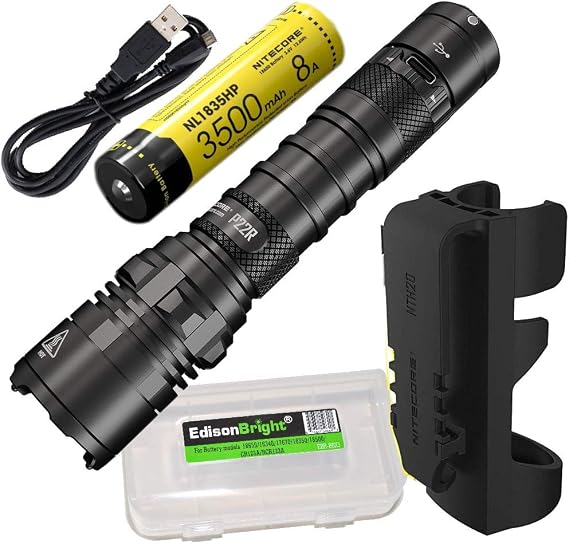
Nitecore P22R Tactical Flashlight Bundle
$109.95 price checked August 2026
For those needing maximum distance, view our comparison of long throw rechargeable batteries.

CoyoteLight Portable Rechargeable Night Vision Flashlight
$244.99 price checked August 2026
Read our full CoyoteLight Flashlight review
If you are looking for different power sources, explore the alternatives to flashlight batteries.

What do IEC standards guarantee for rechargeable batteries?
IEC standards are international benchmarks established by the International Electrotechnical Commission. For flashlight batteries, these standards govern the chemical composition, charging protocols, and environmental tolerances of lithium-ion and alkaline cells. They ensure that a battery produced in one country will behave predictably when used in a device manufactured in another.
IEC standards do not guarantee that a battery is “best” for a specific flashlight model. A battery may meet all IEC safety and capacity standards but still lack the high-discharge rate required for a high-lumen tactical light. These standards ensure baseline compatibility and chemical stability, but they do not account for the specific power demands of specialized lighting equipment.
Selecting the correct power level is easy when you see the voltage guide for flashlight batteries.
Which safety standards address common flashlight battery failures?
Safety standards for flashlight batteries primarily address two failure modes: thermal runaway and electrolyte leakage. Thermal runaway occurs when a battery’s internal temperature rises uncontrollably, often due to overcharging or internal shorts, leading to fire or explosion. Standards like those from UL or IEC require manufacturers to include internal protection circuits or specific cell chemistries that mitigate this risk.
Electrolyte leakage is addressed through housing integrity standards. These ensure that the physical casing of the flashlight battery remains sealed even when subjected to moisture or minor impacts. Certifications requiring IP (Ingress Protection) ratings or specific drop-test standards ensure the battery remains chemically contained during regular use.
How do you verify a battery certification is real?
Verifying a certification requires looking beyond the printed graphics on the packaging. Because a logo can be easily reproduced by any designer, you must look for specific identifiers that link the product to a laboratory’s registry.
- Check for a certification number or a QR code that links directly to the issuing body’s official database.
- Verify the specific standard number, such as a specific IEC or UL code, rather than just a generic “Safety Certified” badge.
- Cross-reference the manufacturer’s name with the authorized list of certified producers on the laboratory’s official website.
- Look for “Tested to” language, which indicates the product met the standard, versus “Compliant,” which can sometimes be a self-declaration by the manufacturer.
Which marks are non-negotiable for flashlight batteries?
Non-negotiable marks for flashlight batteries are those that verify the chemical safety and thermal limits of the cell. If a battery lacks a recognized safety certification from a major body like UL or an equivalent national standard, the risk of fire or chemical leakage increases significantly. These marks are the primary defense against low-quality cells that lack internal protections.
Optional marks include high-performance ratings or specific brand-name “fast-charge” certifications. While these may indicate a high-quality product, they are not essential for basic safety. A buyer should prioritize a recognized safety standard as the primary requirement and treat performance-based markings as secondary factors that can be weighed against price and capacity.
More Flashlight Battery explainers and comparisons
- Which Flashlight Batteries Are Best for High Lumen Output?
- Best Rechargeable Flashlight Batteries for Duty Use
- Affordable Flashlight Batteries Under $200 Compared
- Which Rechargeable Flashlight Batteries Are Best for Night Vision?
- Best Replacement Flashlight Batteries for Heavy Duty Use
- Long Throw Rechargeable Flashlight Batteries Compared