Understanding EDC Knife Specifications
When researching everyday carry knives, you will encounter a mix of load-bearing technical specifications and marketing vocabulary. Load-bearing terms—such as blade steel chemistry, locking mechanisms, and blade geometry—directly impact the mechanical reliability, edge retention, and safety of the tool. These are the metrics you should use to evaluate what each dollar buys. In contrast, marketing terms like “ergonomic,” “tactical,” or “premium” are subjective and lack a standardized measurement. You can ignore these descriptors and focus on the quantifiable data points that dictate how a knife performs under pressure.
Where these choices show up in our reviews
These 3 have their own full review on this site, and run from $199.49 to $332.87.

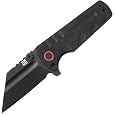
ARTISANCUTLERY Tactical Knife Proponent Folding Knife
$199.49 price checked August 2026
If you need a low-profile blade, find the best lightweight folding knife for your daily routine.

Blade Steel and Material Standards
Blade steel and material standards determine how long a knife stays sharp and how well it resists corrosion or wear.
Beyond general specs, you can find the best edc knife for men and women based on specific user needs.
- Stainless Steel – This refers to steel containing chromium, which creates a protective oxide layer to prevent rust. A higher chromium content generally increases corrosion resistance but can sometimes make the steel harder to sharpen.
- High-Carbon Steel – This steel contains more carbon and less chromium than stainless options, resulting in superior edge retention and ease of sharpening. You should prioritize this if you plan to maintain a sharp edge frequently and can ensure the blade remains dry.
- Rockwell Hardness (HRC) – This measures the material’s resistance to indentation, typically ranging from 54 to 62 for knives. A higher HRC number means a harder edge that stays sharp longer, but if the number is too high, the blade may become brittle and prone to chipping.
- 18/10 Stainless Steel – This indicates the percentage of chromium (18) and nickel (10) in the alloy. The nickel provides added corrosion resistance and helps maintain the steel’s luster over time.
- Powder Metallurgy – This is a manufacturing process where metal powders are pressed and sintered to create a very uniform grain structure. This process allows for high-strength steels that maintain a sharp edge while resisting the “edge roll” that occurs during heavy use.
Locking Mechanisms and Safety
Locking mechanisms and safety features define how the blade stays open or closed and how the knife deploys.
- Liner Lock – This is a metal plate inside the handle that rotates into place to lock the blade. It is a standard for compact EDC knives because it provides a secure lock without the extra bulk of a secondary locking bar.
- Frame Lock – This mechanism uses the handle’s frame itself as the locking point. It is often stronger than a liner lock but may result in a slightly thicker handle to accommodate the internal geometry.
- Axis Lock – This is a rotating locking bar that pivots on a central axis. It provides a very secure lock and a smooth deployment, though it is generally found on larger, more expensive folding knives rather than ultra-compact models.
- Flipper Tab – This is a small protrusion on the blade that you use to initiate the opening motion. A larger, more ergonomic flipper tab makes the knife easier to open with one hand, while a smaller one keeps the profile slim.
- Thumb Stud – This is a small protrusion on the blade used to pivot the knife open with your thumb. While reliable, it can sometimes be harder to clean than a flipper tab.
Blade Geometry and Dimensions
Blade geometry and dimensions dictate the cutting capability and the physical footprint of the knife.
- Drop Point – This is a blade shape where the spine curves downward toward the tip. It is the most common geometry for EDC knives because it offers a balance of piercing ability and slicing efficiency.
- Wharncliffe – This is a blade with a straight cutting edge and a false edge on the back. It provides a very consistent, flat cutting surface, making it useful for precision tasks like carving.
- Blade Length – This is the measurement of the cutting edge from the pivot to the tip. For everyday carry, a shorter blade length (usually under 3 inches) is often preferred for portability and ease of concealment.
- Blade Thickness – This refers to the distance from the spine to the sharpened edge. A thicker blade provides more structural integrity and prevents the edge from bending, while a thinner blade allows for a “scary sharp” feel and easier slicing.
- Blade Roll – This is a failure mode where the edge of the blade tilts or “rolls” away from the cutting surface during use. You want to avoid this by selecting a blade with a proper grind and geometry that supports the edge.
Commonly Confused Terms
Several terms in the EDC knife category are often confused by shoppers, but they represent different mechanical properties.
Edge Retention vs. Sharpenability
Edge retention is the ability of the blade to stay sharp over a long period of use, while sharpenability is how easily the blade can be restored to a sharp edge. A very hard steel might have excellent edge retention but be difficult to sharpen, whereas a softer steel might dull quickly but be easy to hone.
Stainless vs. High-Carbon
Stainless steel is designed primarily to resist rust and corrosion, while high-carbon steel is designed primarily to hold a sharp edge and take a fine polish. If you work in wet environments, choose stainless; if you prioritize the ability to maintain a razor edge, consider high-carbon.
Liner Lock vs. Frame Lock
A liner lock uses an internal plate to secure the blade, while a frame lock uses the handle’s structural frame. While both are reliable, a frame lock is generally more robust and can handle higher stresses, whereas a liner lock allows for a slimmer, more compact profile.