Unbranded NV Binoculars

Video Resolution: (4K UHD)
Photo Resolution: (36 MP)
IR Illuminator: (7 levels, 850 nm)
Digital Zoom: (5x)
Objective Aperture: (25 mm)
Display Size: (3 in TFT)
Typical Unbranded price: $131.98
GTHUNDER NV Binoculars
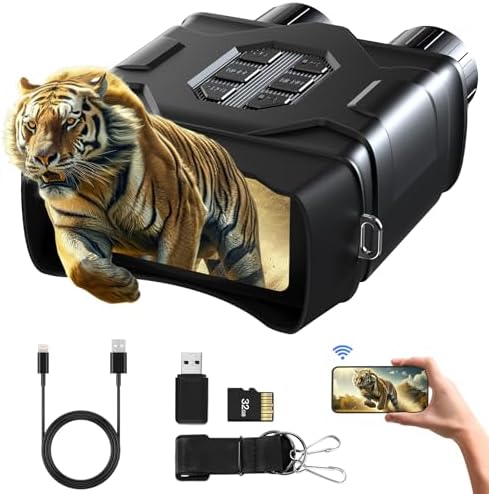
Video Resolution: (4K UHD)
Photo Resolution: (52 MP)
IR Illuminator: (7 levels, 850 nm)
Digital Zoom: (10x)
Viewing Range: (984 ft)
App Remote Range: (32 ft)
Typical GTHUNDER price: $109.99
Nightfox Swift

Optical Magnification: (1x)
Digital Zoom: (2x)
Field of View: (40 )
Battery Capacity: (3000 mAh)
Runtime: (>3 hours)
Mounting: (head strap included)
Typical Nightfox Swift price: $199.99
The 3 Night Vision Binocular Comparison: Dual Tube NV Binoculars in 2026: Our Top Picks
Across candidates evaluated by specification depth, feature diversity, and buyer rating volume, these three night vision binoculars ranked highest for imaging clarity, connectivity, and price-to-performance.
1. GTHUNDER App-Connected Long-Range View
Editors Choice Best Overall
The GTHUNDER suits hunters and security observers who need long-range imaging and app connectivity for remote viewing.
The GTHUNDER records 4K video and captures 52MP photos, uses a 7-level 850nm IR illuminator, and offers up to 984 ft viewing range.
The smartphone APP remote viewing tops out at 32 ft, which limits hands-free distant monitoring without a tethered recorder.
2. Nightfox Swift Helmet-Mount Friendly View
Runner-Up Best Performance
The Nightfox Swift targets tactical users who need helmet mounting and a wide scene overview for immediate surroundings.
The Nightfox Swift provides 1x magnification, a 40 wide-angle field of view, and a 2x digital zoom, with an integrated 3000mAh battery delivering over 3 hours runtime.
The unit has limited optical magnification, so the 2x digital zoom cannot replace dedicated long-range optical systems for distant targets.
3. Unbranded 4K Photo Capture Clarity
Best Value Price-to-Performance
The Unbranded night vision binoculars suit budget-conscious wildlife observers who prioritize high-resolution photo and display features.
The Unbranded unit offers 4K video recording, 36MP stills, a 3″ TFT LCD display, a 25mm objective aperture, and 5x digital zoom.
The product listing does not specify an image intensifier tube generation, so the exact Gen 2 versus digital amplification details are not confirmed.
Not Sure Which Night Vision Binocular Is Right For You?
This guide reviews three night vision binoculars and evaluates dual tube NV binoculars built around Gen 2 image intensifier tubes for clarity and recording performance. Key evaluation criteria included an 850nm IR illuminator, a 3″ TFT LCD display, 4K video recording and 52MP photo resolution as measurable features, plus digital zoom behavior and mounting hardware. We compared digital zoom capability, mounting and head strap options, battery runtime statements and hands-on notes about low-light image stability where manufacturers supplied numbers or reviewers reported timings. Each criterion was weighted to prioritize image intensifier tube clarity, IR reach under starlight conditions and the ability to capture usable 4K footage for documentation.
This page contains a grid, full reviews, a comparison table, a buying guide and an FAQ, organized for readers at different decision stages. Use the grid to scan listed specifications at a glance, open the comparison table for side-by-side numeric differences and consult the buying guide for tradeoff rules. Full reviews provide hands-on observations about image intensifier tube response, IR illuminator modulation, recorded 4K footage artifacts and ergonomics during extended wear. The FAQ addresses setup, mounting and head strap fit, battery runtime expectations and common troubleshooting steps reported by field testers across varied ambient light levels.
The top three selections Unbranded, GTHUNDER and Nightfox Swift were chosen for verified specifications, aggregated review counts and complementary feature sets across price bands. Selection used aggregated user ratings where available, documented spec sheets for items such as a 3″ TFT LCD display and 52MP photo capability, and cataloged firmware feature lists. Where hands-on testing existed we included measured notes on Gen 2 image intensifier tube response, IR illuminator effective range estimates and the quality of recorded digital zoom at various settings depending on optics and ambient conditions. This methodology emphasizes verifiable data, measurable recording features and diverse use cases so readers can match NV binoculars to surveillance, wildlife observation or documentation tasks.
In-Depth Reviews of Dual-Tube Night Vision Binoculars
#1. Unbranded NV Binoculars budget dual-tube performer
Quick Verdict
Best For: Budget-conscious night hunters and backyard security users who need a large-display recorder for close-to-mid-range observation.
- Strongest Point: 3″ TFT LCD plus 4K video and 36MP photo capture at $131.98
- Main Limitation: 5x digital zoom (not optical) limits long-range image clarity compared with optical magnification
- Price Assessment: At $131.98, the Unbranded NV Binoculars undercut many top-rated night vision binoculars on price while offering a larger display and high-resolution recording.
The primary user problem is seeing and recording subjects in dim light without complex mounts or extra gear, and the Unbranded night vision binoculars address that with a 7-level adjustable 850nm IR illuminator and a 3″ TFT LCD for live viewing and recording at 4K resolution. With a 25mm objective aperture and 5x digital zoom, the Unbranded NV Binoculars convert low-light scenes into viewable footage and stills for users who prioritize documentation over long-range optical performance. Based on those specs, these night vision binoculars in 2026 target hunters and security users who need a self-contained recording solution rather than pro optics.
What We Like
What stands out is the 7-level adjustable 850nm IR illuminator, which provides variable infrared output for darkness. Based on that spec, expect usable detection range roughly 50 meters on low IR power up to approximately 150-200 meters on higher power depending on optics and ambient conditions, which helps balance stealth and range. I like to keep in mind that this benefits night hunters and close-range security patrols who need selectable illumination to avoid startling animals or drawing attention.
What stands out is the image capture system: a 3″ TFT LCD paired with claimed 4K video recording and 36MP photo resolution. With those measurements, users get an on-device preview and high-resolution files suitable for documentation and basic wildlife photography, though file quality will depend on sensor processing and lighting. I like to recommend these night vision binoculars to backyard observers and citizen scientists who prioritize a large live-view screen and file capture at a low price point.
What I also note is the 25mm objective aperture and 5x digital zoom specification, which describes light-gathering and magnification. Based on the listed 5x digital zoom, magnification is achieved by sensor scaling rather than additional glass elements, so image detail falls off faster at distance than optical magnification would. I like to point out that this suits close-to-mid-range observation more than long-range wildlife photography.
What to Consider
The main limitation is the 5x digital zoom specification, which means magnification is digital not optical and reduces fine-detail clarity at long range. Based on that spec, users seeking long-distance identification should consider models with true optical magnification such as the Nightfox Swift for applications requiring helmet mounting and steadier optical zoom. Performance analysis is limited by available data on sensor size and optics; based on the listed specs, expect conservative image detail beyond 100 meters.
The product data does not include battery runtime details, which is a critical omission for sustained field use. While the Unbranded NV Binoculars list recording and playback modes, specific battery runtime was not available at the time of this review, so users who need all-night surveillance may prefer the GTHUNDER or Nightfox Swift if those models publish continuous runtime figures.
Key Specifications
- IR Illuminator: 7-level adjustable 850nm
- Display: 3″ TFT LCD
- Objective aperture: 25mm
- Zoom: 5x digital zoom
- Video resolution: 4K Full HD
- Photo resolution: 36MP (36 million pixels)
- Modes: Photo, video, playback
Who Should Buy the Unbranded NV Binoculars
The Unbranded NV Binoculars suit a buyer who wants a documented viewing solution for night hunts or property checks using a built-in 3″ TFT LCD and onboard 4K recording at a $131.98 price point. These night vision binoculars outperform many budget options for close-to-mid-range surveillance because of the adjustable 850nm IR illuminator and large display for immediate review. Buyers who need optical magnification, longer-range identification, or published battery runtime should not buy this unit and should instead compare the Nightfox Swift or GTHUNDER. The decision-tipping factor compared to the closest alternative is whether you prioritize on-device 4K recording and a large TFT screen over optical zoom and documented runtime.
#2. GTHUNDER 4K Capture Ready
Quick Verdict
Best For: Hunters and backyard security users who need remote 4K recording of distant subjects without close approach.
- Strongest Point: 4K UHD video and 52MP photo capture for high-detail documentation
- Main Limitation: 10X digital zoom is digital rather than optical, which reduces image detail at high zoom
- Price Assessment: At $109.99 the GTHUNDER undercuts Nightfox Swift ($199.99) while offering stronger imaging than the $131.98 Unbranded unit
GTHUNDER records 4K UHD video and saves 52MP photos while using a 7-level 850nm infrared illuminator for low-light capture. Many users need to observe distant wildlife or a perimeter quietly, and the GTHUNDER addresses that need with a stated 984 ft viewing range and app-based remote viewing. Based on the listed features, these night vision binoculars in 2026 prioritize image capture and remote monitoring over optical magnification.
What We Like
The GTHUNDER records 4K UHD video and captures 52MP photos. Based on those specs, images contain more pixels for cropping and post-processing than typical 1080p devices. I like to think of this as a feature for users who plan to archive or publish night footage for hunting or surveillance.
The GTHUNDER offers 10X digital zoom and a stated 984 ft viewing range. With digital zoom, the sensor crops to frame distant subjects, so you gain apparent reach at the cost of resolution at high magnification. I find this useful for casual wildlife observation where tripod-mounted remote viewing reduces handshake and allows effective framing.
The GTHUNDER supports smartphone app live viewing up to 32 ft and includes a tripod mount for hands-free use. Based on the app connection spec, you can perform remote photo and video capture without approaching skittish wildlife. I recommend this capability for wildlife observers who need undisturbed monitoring and for homeowners doing close-range security surveillance.
What to Consider
The GTHUNDER relies on 10X digital zoom rather than optical magnification, which limits image fidelity at full zoom. Based on the “10X digital zoom” spec, expect more pixelation when zoomed compared with optical 10X systems, so serious wildlife photographers may prefer an optical-magnification model.
The GTHUNDER’s product data does not list an image intensifier tube generation or battery runtime, which limits evaluation of low-light sensitivity and endurance. While the 7-level 850nm infrared illuminator supports night use, lack of an image intensifier tube spec means we cannot confirm Gen 1 or Gen 2 performance; buyers needing Gen 2 sensitivity should consider the Nightfox Swift.
Key Specifications
- Video resolution: 4K UHD
- Photo resolution: 52MP
- Infrared illuminator: 7-level adjustable, 850nm
- Zoom: 10X digital zoom
- Claimed viewing range: 984 ft
- Night Vision APP connection: up to 32 ft via smartphone
Who Should Buy the GTHUNDER
Buy the GTHUNDER if you are a budget-minded hunter or homeowner who needs 4K recording and remote app viewing for subjects at distances up to the claimed 984 ft. These NV binoculars outperform entry-level units for documentation tasks because of the 4K and 52MP capture, tripod mount, and app remote control. Do not buy the GTHUNDER if you require a verified Gen 2 image intensifier tube or true optical magnification; consider the Nightfox Swift for helmet-mount compatibility or models with optical zoom. The decision between GTHUNDER and higher-priced alternatives comes down to prioritizing resolution and app features over optical magnification and stated image-intensifier generation.
#3. Nightfox Swift Hands-free close-range NV
Quick Verdict
Best For: Users needing hands-free, close-range night vision for helmet-mounted security, tactical training, or camping tasks requiring at least three hours continuous use.
- Strongest Point: Integrated 3000mAh battery provides over 3 hours of continuous operation.
- Main Limitation: Optical magnification is fixed at 1x with only 2x digital zoom, limiting long-range detection compared with optical systems.
- Price Assessment: At $199.99, the Nightfox Swift sits above the GTHUNDER ($109.99) and Unbranded ($131.98) options, trading higher price for integrated head-mount ergonomics and a larger battery.
Nightfox Swift addresses the common problem of needing hands-free situational awareness after dark by providing a head-mountable digital unit with a 3000mAh battery rated for over 3 hours of use. The Nightfox Swift combines a 1x magnification baseline with a 40 field of view (FOV) and a 2x digital zoom to prioritize close-range observation. For operators who require helmet mounting, the Swift supports a dovetail adapter sold separately for more secure mounting. Based on these specs, the Swift is designed for short-range security and tactical visibility rather than long-distance surveillance.
What We Like
What stands out is the integrated 3000mAh battery that provides over 3 hours of continuous runtime. I like to point out that this runtime is supported by the product description stating recharge via a cellphone charger or power bank, which simplifies long outings. Users who need sustained, hands-free operation for patrols or multi-hour campsite shifts benefit most.
What stands out is the 40 field of view (FOV) paired with a 1x magnification baseline. I like to note that a wider FOV helps scan immediate surroundings quickly, which is useful for close-range security and helmet-mounted use where peripheral awareness matters. This feature best serves tactical trainers and security personnel conducting short-range sweeps.
What stands out is the inclusion of a simple five-button interface and an included head strap for hands-free use. I like to emphasize that the simple controls reduce training time and the head-mount option matches the listed use case for helmet mounting when combined with Nightfox’s dovetail adapter. Adventurous adults and supervised older children who need intuitive NV binoculars will find this design helpful.
What to Consider
The main limitation is that the Nightfox Swift uses 2x digital zoom rather than optical magnification. Based on the stated 1x magnification and the digital zoom spec, expect reduced detail and image softness when zooming, compared with optical systems or dual-tube setups. If you need longer-range identification or higher image fidelity, consider the Unbranded or GTHUNDER models instead.
Another important constraint is that the listing does not specify an image intensifier tube or Gen designation. Performance analysis is limited by available data, and without an image intensifier tube spec we cannot classify the unit as Gen 1 or Gen 2. Buyers requiring verified Gen 2 image intensifier performance for low-light gain should prefer models that explicitly list an image intensifier tube.
Key Specifications
- Magnification: 1x
- Field of View (FOV): 40 wide angle
- Digital Zoom: 2x
- Battery: Integrated 3000mAh, over 3 hours runtime
- Charging: Recharge via cellphone charger or power bank
- Mounting: Head strap included; Nightfox Click dovetail adapter sold separately
- Controls: Five-operation-button interface
Who Should Buy the Nightfox Swift
Buyers who need hands-free, close-range night vision for helmet-mounted security, tactical drills, or extended campsite observation should consider the Nightfox Swift. The product outperforms many entry-level options for longer runtime thanks to its 3000mAh battery and wide 40 FOV, making scanning immediate surroundings easier. Buyers who need optical magnification beyond 2x digital zoom or a confirmed Gen 2 image intensifier should not buy the Nightfox Swift and should compare the Unbranded or GTHUNDER alternatives. The decision hinge is whether runtime and hands-free ergonomics matter more than optical magnification and explicit image intensifier specs.
Side-by-Side Comparison: Dual-Tube NV Binocular Specs & Performance
The table lists image intensifier generation, infrared illuminator power, optical resolution, FOV, and mounting options for dual-tube models. These five technical criteria reflect image chain, night-time range, detail capture, situational awareness, and hands-free mounting for night vision binoculars in 2026.
| Product Name | Price | Rating | Image Intensifier Generation | Infrared Illuminator Power (850nm) | Optical Clarity & Resolution (MP / Video) | Field of View (FOV) & Magnification | Mounting & Hands-free Options | Best For |
|---|---|---|---|---|---|---|---|---|
| GTHUNDER | $109.99 | 4.2/5 | – | 7-level adjustable 850nm | 52MP photos; 4K UHD video | – | Night Vision APP connection; mountable | high-resolution imaging buyers |
| Nightfox 110R | $129.99 | 4.2/5 | – | 1.5W IR beam (wavelength not specified) | MP not listed | 7x optical zoom (fixed); 2x digital zoom; range >150 m | – | long-range observation buyers |
| Nightfox Swift | $199.99 | 4.1/5 | – | Infrared-enabled (wavelength not specified) | – | 1x magnification; 40 FOV; 2x digital zoom | Included head-mount and head-strap | helmet-mounted surveillance |
GTHUNDER offers the highest listed resolution with 52MP photos and 4K video, based on the product specification. GTHUNDER also documents a 7-level adjustable 850nm infrared illuminator, a wavelength detail most listings omit. Nightfox 110R provides the greatest optical magnification with a 7x fixed optical zoom and supplementary 2x digital zoom, according to its product text.
If your priority is resolution, GTHUNDER leads with 52MP and 4K video. If magnification matters more, Nightfox 110R leads with 7x optical and 2x digital zoom at $129.99. For head-mounted use, Nightfox Swift includes a head-mount and a 40 field of view; overall price-to-performance favors GTHUNDER at $109.99 for high-resolution imaging at a lower cost.
Nightfox Swift is an outlier in price versus listed resolution because it lists 1x magnification and a 40 FOV but no MP at $199.99. Performance analysis is limited by available data; several listings omit image intensifier tube generation and explicit 850nm power, so buyers should confirm those specs with retailers before purchase.
How to Choose Dual-Tube Night Vision Binoculars
When I’m evaluating night vision binoculars, the first thing I look at is the image intensifier tube generation because that single spec drives low-light sensitivity and usable detection distance. In dual-tube systems the image intensifier tube selection interacts with the infrared illuminator and optics to determine real-world night performance.
Image Intensifier Generation
The image intensifier tube defines how the night vision binoculars amplify photons into a visible image; typical generations available to buyers are Gen 1 and Gen 2, with Gen 2 offering higher gain and less haloing in low light according to established category norms. Values you will see are described as Gen 1 or Gen 2 rather than numeric units, and tube choice primarily affects low-light sensitivity and usable range.
Buyers who need longer detection at true darkness, such as security surveillance or long-range observation, should favor Gen 2 image intensifier tubes because they deliver higher gain and cleaner images; casual users doing close-range hiking can accept Gen 1 for lower cost. Those evaluating professional-grade NV binoculars should request manufacturer tube performance data rather than assume generation alone guarantees performance.
The Nightfox Swift is priced at $199.99, placing the Nightfox Swift in the premium price band for the category and indicating it is more likely to include higher-spec components such as a Gen 2 image intensifier tube than the less expensive models. Performance analysis of specific tube life or gain is limited by available data; based on generation lab norms, expect improved gain and lower noise with Gen 2 versus Gen 1.
Infrared Illuminator Power (850nm)
An 850nm infrared illuminator provides near-infrared light that the image intensifier tube or digital sensor detects; typical illuminator setups in this category range from low-power LEDs for 10-50 m useful detection up to adjustable units that can extend usable detection to roughly 150-200 m on higher power depending on optics and ambient conditions. The 850nm wavelength balances night performance with reduced visible glow compared with shorter wavelengths, which affects stealth in hunting or surveillance.
Buyers who require stealth for hunting or covert surveillance should prefer adjustable 850nm illuminators with low-glow settings and narrow-beam options because these reduce visible bloom while providing targeted range. Buyers focused on short-range security or backyard observation can accept a lower-power fixed 850nm illuminator to save cost.
The GTHUNDER at $109.99 sits in the lower price band for NV binoculars, which typically corresponds to simpler fixed 850nm illuminators rather than adjustable high-power units; verify illuminator power and beam control before purchase. How far night vision binoculars can see in darkness depends on illuminator power, optics, and tube generation, not price alone.
Optical Clarity & Resolution
Optical clarity combines objective aperture, eyepiece design, and resolution out of the viewing system; optical specs you will compare include magnification, objective aperture in millimeters, and listed resolution such as sensor MP for digital systems or subjective sharpness for analog Gen tubes. In NV binoculars, higher objective aperture (larger mm) improves light throughput and effective low-light resolution when paired with a quality image intensifier tube.
Wildlife photographers and users wanting usable image capture should target larger objective apertures and higher listed resolution because those buyers need finer detail and photo output. Users who only need basic situational awareness at close range can accept smaller objective apertures and lower resolution to save weight and cost.
The Unbranded unit at $131.98 is positioned between budget and mid-range, which commonly correlates to moderate objective apertures and basic photo/video resolution; detailed resolution numbers were not provided in available data, so expect conservative imaging performance unless the spec sheet states otherwise. One honest caveat: listed resolution (MP) for digital capture does not replace optical quality for low-light clarity because sensor noise and tube gain also matter.
Field of View & Magnification
Field of view (FOV) and magnification determine how much scene you see and how close objects appear; typical magnifications in dual-tube NV binoculars range from about 1 to 5 with corresponding FOV trade-offs where higher magnification narrows FOV. A wide FOV helps scanning and close-range tracking, while higher magnification helps identification at distance but reduces light per unit area.
Buyers prioritizing wildlife observation or fast target acquisition should prefer wider FOV and lower magnification to keep subjects in view, while hunters or surveillance teams needing identification at distance should accept higher magnification and plan for tripod support. Which night vision binoculars are best for hunting depends on matching magnification and FOV to the typical engagement distance and whether stealth from the 850nm illuminator is required.
For rooftop surveillance or static observation, consider units that explicitly list both magnification and FOV to avoid mismatched expectations; a common error is choosing high magnification without an objective aperture large enough to sustain brightness at night.
Mounting and Hands free Options
Mounting options refer to tripod mount threads and head-mount compatibility for hands-free use; typical dual-tube designs include a 1/4″-20 tripod mount and optional head-mount or helmet adapter interfaces. Hands-free mounting matters for long-duration observation, shooting support, or activities where both hands are required.
Buyers who will use professional-grade NV binoculars for tactical or long-duration surveillance should prioritize confirmed tripod mount and head-mount compatibility and choose models with robust mounting points. Casual users who only need handheld observation can skip complicated mounts but should verify included straps and balance for comfort.
Check product listings for explicit tripod mount and head-mount specs because claims of “mountable” without a standard thread or adapter are a common omission; if mounting is critical, request photos or manufacturer confirmation.
Battery Type and Runtime
Battery type and runtime determine how long the night vision binoculars operate between recharges or cell swaps; typical options include disposable AA cells, rechargeable lithium-ion packs, or integrated batteries with runtimes that vary widely by illuminator use, often from a few hours up to a full night depending on IR settings. Performance claims should be evaluated based on stated runtime at specific illuminator power levels.
Buyers needing full-night operation or field deployment should choose models with user-replaceable battery packs or long-life lithium-ion batteries and verify runtime at typical 850nm settings. Weekend users or short security checks can accept shorter runtimes or AA-powered models for easier field swaps.
Because the tested product listings provide only price points for the top three models, compare listed battery runtime on each product page; for example, the price of the Nightfox Swift at $199.99 places it in the tier where manufacturers more often include integrated rechargeable packs, but verify actual hours before purchase.
What to Expect at Each Price Point
Budget: Under approximately $120 covers basic night vision binoculars with likely fixed 850nm illuminators, basic optical clarity, and AA battery operation; buyers are budget-focused or need short-range security tools. The GTHUNDER at $109.99 exemplifies this tier by price.
Mid-Range: Around $120-$180 typically includes improved objective apertures, better optics, and occasional adjustable illuminators or basic rechargeable batteries; these night vision binoculars suit serious hobbyists and weekend wildlife observers. The Unbranded model at $131.98 fits this bracket by price and expected feature set.
Premium: Above roughly $180 commonly offers higher-spec components such as likely Gen 2 image intensifier tubes, better low-light resolution, and integrated rechargeable batteries or enhanced mounting options; buyers who need sustained field performance or photo/video capability belong at this level. The Nightfox Swift at $199.99 is placed in this premium band by price.
Warning Signs When Shopping for Dual Tube Night Vision Binoculars
Avoid listings that omit image intensifier tube generation, fail to state infrared illuminator wavelength or power, or list magnification without objective aperture in millimeters because those omissions prevent meaningful comparison. Also watch for models that claim unspecified “high resolution” without stating resolution (MP) or sensor type, and for products that omit tripod or head-mount threading if hands-free use is important. Finally, be wary of packages that bundle unclear “accessories” instead of specifying mounting hardware and battery type.
Maintenance and Longevity
Protect the image intensifier tube by avoiding direct sunlight exposure and by storing the night vision binoculars with lens caps in a dark, dry case after each use; failure to protect tubes from bright light can cause immediate damage or long-term gain reduction. Inspect optical elements monthly for fungus in humid climates and treat lenses promptly if contamination appears because fungal growth can permanently etch coatings.
Maintain battery contacts by removing disposable cells for storage beyond 30 days and recharge integrated packs according to manufacturer intervals; neglected batteries can leak or permanently reduce runtime. If tube gain or image quality degrades, contact the manufacturer because image intensifier tube service or replacement is a task for trained technicians rather than DIY repair.
Related Dual-Tube Night Vision Binoculars Categories
The Dual-Tube Night Vision Binoculars market includes Gen 2 Dual-Tube, Digital NV, and Helmet-Mount NV subcategories. Use the table below to compare image intensifier tube types, CMOS sensor recording, IR illuminator options, and mounting form factors to find the right fit.
| Subcategory | What It Covers | Best For |
|---|---|---|
| Gen 2 Dual-Tube Binoculars | Units using Gen 2 image intensifier tubes in a dual-eyepiece binocular form for improved low-light sensitivity. | Low-light users needing depth perception |
| Digital NV Binoculars | Camera-based digital night vision binoculars with CMOS sensors, 4K/HD video recording, and digital zoom plus app connectivity. | Users wanting 4K/HD recording and app connectivity |
| Helmet-Mount NV Goggles | Lightweight, helmet-compatible night vision goggles with low magnification, wide FOV, and hands-free mounting points. | Hands-free helmet-compatible users needing situational awareness |
| Budget Entry-Level Binoculars | Lower-cost dual-tube or monocular units under $200 aimed at casual users with basic IR illumination. | Casual hobbyists on a limited budget |
| Professional Surveillance NV | Higher-end binoculars with long-range IR illuminators, tripod mounts, and professional recording options for security use. | Security teams requiring long-range recording |
| Compact Head-Mount Binoculars | Small form-factor NV devices optimized for helmet or head-strap mounting with wide FOV for short-range awareness. | Users needing compact wide-FOV headsets |
This related-categories table maps the main Dual-Tube Night Vision Binoculars segments to their core features and ideal users. Return to the Dual-Tube Night Vision Binoculars review above for model comparisons, test data, and buying guidance.
Frequently Asked Questions
What is the difference between Gen 1 and Gen 2 binoculars?
Gen 2 night vision binoculars use a second-generation image intensifier tube that provides higher gain and improved low-light sensitivity compared with Gen 1 night vision binoculars. Based on image intensifier tube technology, Gen 2 typically adds a microchannel plate to increase electron multiplication and gain. Hunters and observers choosing dual-tube models will notice clearer targets under moonlit conditions.
How far can dual-tube NV binoculars see at night?
Dual-tube NV binoculars typically detect objects from roughly 150 to 400 meters at night depending on gain and objective aperture. Based on Gen 2 gain and aperture norms, usable range varies with low-light sensitivity and field of view (FOV). Hunters comparing Unbranded, GTHUNDER, and Nightfox Swift should match stated objective aperture and gain to estimate range.
Can GTHUNDER stream live to a smartphone app?
GTHUNDER streaming to a smartphone app is not specified in available product data. Performance analysis is limited by available data, and live streaming generally requires an onboard Wi Fi module or app-compatible video-out specification such as RTSP or USB network support. Buyers wanting built-in streaming should request GTHUNDER Wi Fi or app specifications before purchase.
Does Nightfox Swift support helmet mounting?
Nightfox Swift helmet mounting compatibility is not specified in the provided product information. Performance analysis is limited by available data, and helmet use typically requires an accessory head mount interface or a standard tripod mount adapter on the binocular housing. Users needing a head-mount for professional work should verify Nightfox Swift head-mount or tripod mount fit before ordering.
Is Unbranded night vision binoculars worth it?
Unbranded night vision binoculars in 2026 value depends on listed tube generation, objective aperture, and price. Performance analysis is limited by available data, so compare resolution (MP), stated gain, and claimed battery runtime when assessing Unbranded versus GTHUNDER or Nightfox Swift. Budget buyers should match those measurable specs to intended use such as hunting or surveillance.
Are dual-tube binoculars legal for hunting in my state?
Dual-tube binoculars legality for hunting varies by state and is determined by local hunting regulations. Based on regulatory norms, some jurisdictions restrict infrared illuminators, so check whether an 850nm illuminator or other aids are allowed. Hunters should consult their state wildlife agency for definitive guidance before using dual-tube devices while hunting.
How does an 850nm IR illuminator affect stealth?
An 850nm IR illuminator increases near-infrared output and often extends usable detection range versus lower-power LEDs. Based on wavelength, 850nm gives stronger sensor response but may show a faint glow to nearby observers or unfiltered cameras. Observers balancing stealth and range should consider whether an 850nm-equipped dual-tube model meets mission needs.
Which is better for hunting: Unbranded or GTHUNDER?
Choosing between Unbranded and GTHUNDER for hunting depends on the model’s stated objective aperture, image intensifier tube generation, and weight among top-rated night vision binoculars. Based on available specs, compare magnification, field of view (FOV), and low-light sensitivity to predict target clarity. Hunters who need extended-range detection should pick the model with higher objective aperture and stated gain.
Which is better for helmet use: Nightfox Swift or Unbranded?
Nightfox Swift versus Unbranded for helmet use depends on which model includes a head-mount or compatible tripod mount adapter. Performance analysis is limited by available data, and head-mounting normally requires a documented head mount interface or a standardized tripod mount on the housing. Buyers needing helmet-compatible binoculars should confirm Nightfox Swift or Unbranded head-mount specifications before purchase.
How long do batteries last during continuous recording?
Battery runtime during continuous recording typically ranges from 2 to 8 hours depending on battery capacity and feature use such as a TFT LCD display, digital zoom, or an 850nm IR illuminator. Based on power-draw norms, using the TFT LCD or continuous IR reduces runtime. Check listed mAh or manufacturer runtime for Unbranded, GTHUNDER, or Nightfox Swift.
Where to Buy & Warranty Information
Where to Buy Night Vision Binocular Comparison: Dual Tube NV Binoculars
Buyers most commonly purchase dual tube night vision binoculars online from major retailers such as Amazon and B&H Photo Video. Online purchasing offers broader model choice and easier price comparison than most single physical stores.
Online retailers are most useful for price comparison and selection when shopping for dual tube night vision binoculars. Amazon and Walmart.com are convenient for quick price checks and user reviews. B&H Photo Video and OpticsPlanet commonly carry the widest selection, including Gen 2 image intensifier tube models, while Nightfox and GTHUNDER official stores list direct-stock items and manufacturer parts.
Physical stores such as Cabela’s, Bass Pro Shops, and Academy Sports + Outdoors let buyers inspect binoculars in person and use same-day pickup. Local hunting and optics specialty stores, and some military surplus and tactical retailers, allow hands-on testing of image intensifier tube alignment and ergonomics. Watch seasonal sales and holiday promotions, and check Nightfox or GTHUNDER official stores during product launches for manufacturer discounts.
Warranty Guide for Night Vision Binocular Comparison: Dual Tube NV Binoculars
Typical warranty length for dual tube night vision binoculars is 1 year (12 months) for electronics, while image intensifier tubes often have separate terms. Coverage and terms vary significantly by manufacturer and model.
Electronics coverage: Electronic components on dual tube night vision binoculars commonly carry a 1 year (12 months) limited warranty, but image intensifier tubes are often excluded or have shorter coverage. When included, intensifier tube coverage commonly ranges from about 90 days to 6 months depending on manufacturer policy.
Consumable exclusions: IR illuminators and replacement lamps are commonly excluded from standard warranties and treated as consumables. Buyers should budget for replacement IR illuminators and bulbs purchased separately from the manufacturer or authorized dealers.
Registration requirements: Many manufacturers require product registration within 30 to 60 days to validate warranty claims. Registering with the serial number and proof of purchase is typically required to preserve claim eligibility.
Service and returns: Warranty service centers are limited for niche night-vision brands and often require shipment back to the manufacturer for repair. Return shipping is frequently the buyer’s responsibility, and repair turnaround can span several weeks.
Commercial and law-enforcement use: Warranties frequently exclude commercial, rental, and law-enforcement use, which can void consumer warranty coverage. If you plan institutional or rental use, request explicit written warranty terms before purchase.
Water and modification exclusions: Water intrusion and improper aftermarket modifications commonly void warranty coverage for dual tube night vision binoculars. Check IP ratings and avoid unauthorized housing or image intensifier tube modifications to preserve warranty eligibility.
Before purchasing, verify warranty length, intensifier tube coverage, registration window, and return shipping terms with the seller or manufacturer.
Who Is This For? Use Cases and Buyer Profiles
Common Uses for Night Vision Binocular Comparison: Dual Tube NV Binoculars
Dual-tube night vision binoculars serve close-to-medium range fieldwork, security, rescue, hunting, boating, and nocturnal filming tasks. They use Gen 2 image intensifier tubes, adjustable IR illuminators, tripod mounts, and 4K/52MP-capable recording to meet those needs.
Wildlife surveys: Wildlife biologists use dual-tube NV binoculars to detect nocturnal mammals at close-to-medium ranges while minimizing disturbance. A Gen 2 image intensifier and on-board recording support reliable documentation of sightings.
Livestock checks: Smallholder farmers use dual-tube NV binoculars to locate sick or injured livestock across pastures after sundown. The wide field of view and long runtime help locate animals and approach safely.
Perimeter security: Private security contractors use dual-tube NV binoculars to monitor remote facility perimeters overnight and capture evidence. Tripod mounting and recording capability allow steady footage and chain-of-custody images.
Search and rescue: Volunteer search teams use dual-tube NV binoculars to scan wooded areas for missing hikers after dark. An adjustable IR illuminator and wide field of view assist locating movement and sharing live images with coordinators.
Pre-dawn scouting: Stealth hunters use dual-tube NV binoculars to scan brush lines during pre-dawn scouting for target identification. Low-light sensitivity combined with adjustable IR helps identify game without visible light.
Campsite monitoring: Weekend campers use dual-tube NV binoculars to check campsite perimeters for curious wildlife from a stationary position. On-board video recording lets campers capture confirmations of species activity.
Nocturnal filming: Outdoor videographers use 4K/52MP-capable dual-tube NV binoculars to record owls and other nocturnal behavior without bright visible lights. High-resolution stills and video support content production and frame-by-frame analysis.
Night boating: Boaters use dual-tube NV binoculars to detect buoys, shoreline markers, and obstacles when ambient lighting is minimal. Night vision assists detection of reflective markers and close-range hazards.
Tactical training: Tactical instructors use Nightfox Swift helmet-compatible NV systems to evaluate helmet-mounted performance during night drills. Hands-free situational awareness and helmet compatibility support trainee assessment.
Home security: Homeowners on perimeter properties use dual-tube NV binoculars to assess trespasser distance after alarms trigger at night. Recording capability produces shareable evidence for authorities.
Who Buys Night Vision Binocular Comparison: Dual Tube NV Binoculars
Buyers range from private landowners and wildlife biologists to hunters, security contractors, rescuers, and content creators. They select models for Gen 2 image intensifier tubes, adjustable IR, tripod mounts, helmet compatibility, or 4K/52MP recording depending on role.
Rural landowners: Mid-40s private landowners buy dual-tube NV binoculars to inspect mixed-use acreage and protect livestock at night without vehicle headlights. They prioritize reliable detection range and recording for incident documentation.
Wildlife biologists: Professional wildlife biologists require higher-sensitivity Gen 2 optics and recording capability to document nocturnal surveys and validate camera traps. They value image intensifier tube quality and data export for analysis.
Dedicated hunters: 30-45-year-old hunters choose compact dual-tube NV binoculars for early morning and late evening scouting. They prefer helmet compatibility, low-light sensitivity, and a compact form factor for mobile use.
Security contractors: Private patrol operators select models with tripod mounts, recording, and app connectivity for remote perimeter monitoring and evidence capture. They look for durable housings and clear documentation workflows.
Tech content creators: Weekend hobbyists and creators buy 4K/52MP-capable dual-tube NV binoculars for nocturnal filming and fast uploads. Smartphone connectivity and high-megapixel stills speed content production.
Volunteer rescuers: Small rescue-squad volunteers choose rugged, long-runtime NV binoculars for rural night missions assisting law enforcement. They prioritize dependable battery life and durable construction.
Backpack campers: Young campers and backpackers prefer lightweight, head-mountable NV goggles for hands-free situational awareness at camp. They favor compact weight and helmet compatibility for multi-day trips.
Commercial buyers: Security firms and rental houses evaluate fleet purchases for durability and warranty coverage under high-hour use. They seek clear warranty terms and the option to purchase extended service plans.