Understanding Projector Headlamp Specifications
When evaluating a projector headlamp, you must distinguish between load-bearing specifications and marketing vocabulary. Technical metrics like lumens, color temperature, and IP ratings provide the data needed to determine if a light source meets your specific environment’s requirements. Conversely, terms like “ultra-bright,” “super-zoom,” or “pro-grade” are subjective descriptors that do not correlate to standardized measurements. Focus on the numerical values and official standards to understand what each dollar buys. A projector headlamp is a specialized tool designed to cast a wide, even beam of light, and its utility depends on matching its output to your intended use case, such as trail running, camping, or search and rescue.
Where these choices show up in our reviews
These 3 have their own full review on this site, and run from $113.01 to $179.95.


Ledlenser H15R Work Rechargeable Headlamp
If you are on a budget, view top-rated rechargeable headlamps for hard hats under $150.
$179.95 price checked August 2026
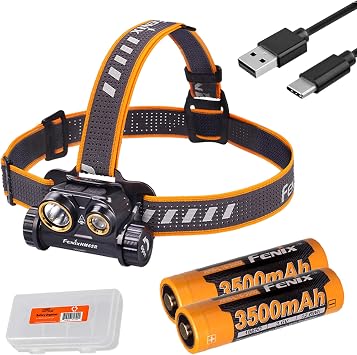
Fenix HM65R Dual Beam Headlamp
$113.01 price checked August 2026
Read our full Fenix HM65R review
To understand the different configurations available, see the various types of headlamps explained.
Projector Headlamp Brightness and Beam Metrics
Brightness and beam characteristics define how much light a projector headlamp produces and how that light is distributed across a surface.
- Lumens – This measures the total amount of visible light emitted by the source in all directions. For a projector headlamp, a higher lumen count allows you to see further or more clearly in darker environments.
- Candela (cd) – This measures the intensity of the light in a specific direction, which describes the “throw” or reach of the beam. A higher candela rating indicates a more concentrated, long-distance beam.
- Beam Angle – This is the width of the light spread, measured in degrees. A wider angle provides more peripheral vision, while a narrower angle focuses the light on a specific path ahead.
- Color Temperature – Measured in Kelvin (K), this describes the hue of the light. 4000K is the transition point from warm white to cool daylight; a higher Kelvin number produces a cooler, bluer light, while a lower number produces a warmer, yellowish light.
- Throw Distance – This is the distance at which the headlamp’s beam reaches its intended width. Knowing the throw distance helps you determine if the light will cover a wide enough area at the distance you typically travel.
Projector Headlamp Environmental and Build Specs
Environmental and build specifications determine how well a projector headlamp survives exposure to moisture, dust, and physical impact.
- IP Rating – This standard (e.g., IP67) measures resistance to dust and water. An IP67 rating is the standard for full immersion and high-pressure water resistance, ensuring the unit remains functional in heavy rain or submersion.
- Impact Resistance – This refers to the ability of the housing to withstand drops or collisions. Look for specific impact ratings or materials like polycarbonate to ensure the lens and housing do not crack under pressure.
- Weight – Measured in grams or ounces, this is a critical factor for headlamps. A lower weight reduces neck strain during long periods of use, which is a primary consideration for hiking or climbing.
- Housing Material – This describes what the lamp is made of, such as aluminum or high-grade plastics. Aluminum provides better heat dissipation and durability, while plastics may offer better weight savings.
- Lens Coating – This refers to the chemical treatments applied to the glass or plastic lens. High-quality coatings reduce beam scattering, which prevents a blinding glare from obscuring the path ahead.
Projector Headlamp Power and Battery Specs
Power and battery specifications dictate how long the headlamp will run and how easily you can recharge it in the field.
- Battery Capacity (mAh) – This measures the amount of energy the battery can hold. A higher mAh rating generally allows for longer runtimes at a specific lumen output.
- Battery Chemistry – This refers to the internal technology, such as Li-ion or NiMH. Li-ion is the standard for high-energy density and consistent power delivery.
- Charging Port – This is the physical connection for power, such as USB-C. USB-C is the universal standard for modern power delivery and compatibility with most portable power banks.
- Runtime – This is the estimated amount of time the headlamp operates on a single charge. Runtime varies based on the lumen setting; a higher lumen output will significantly decrease the total available time.
- Charging Time – This is the duration required to move from a depleted to a full battery. A shorter charging time is preferable for quick turnarounds between uses.
Common Projector Headlamp Term Confusions
Buyers often confuse several terms because they sound similar or appear in similar contexts on product listings. Understanding these distinctions ensures you select the correct tool for your needs.
- Lumens vs. Candela – Lumens measure the total amount of light produced (volume), while Candela measures the intensity of the beam in a specific direction (reach). You may need high lumens for a wide area but high candela for a long-distance path.
- Projector Headlamp vs. Flood Headlamp – A projector headlamp is designed to cast a wide, even beam of light across a broad area, whereas a flood headlamp focuses on a wider, more diffuse spread. Projector headlamps are often preferred for their ability to balance distance and peripheral coverage.
- Color Temperature vs. Color Rendering Index (CRI) – Color temperature (Kelvin) describes the “coolness” or “warmth” of the light. CRI measures how accurately the light reveals the true colors of objects. A higher CRI is better for identifying natural colors in the woods.
- Beam Scattering vs. Beam Spread – Beam spread is the intentional width of the light. Beam scattering is a failure mode where poor optics cause light to bounce around inside the housing, creating a hazy glare that makes it harder to see clearly.
- Battery Capacity vs. Runtime – A high mAh (capacity) does not automatically guarantee a long runtime. Runtime is a calculation of capacity divided by the power draw; a headlamp set to its highest brightness will drain a large battery much faster than a low-brightness setting.